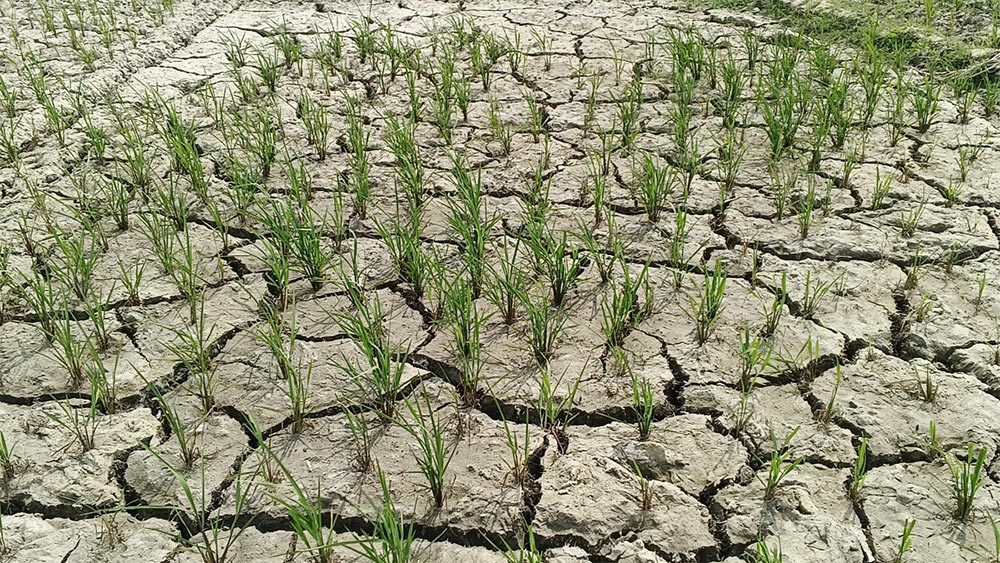
TALTOLI, BARGUNA, Apr 4: A crippling shortage of diesel, petrol, and octane has left thousands of acres of Boro paddy and other crops in Barguna's Taltoli Upazila on the verge of ruin.
Farmers, who sowed their fields with borrowed money and advances, now watch helplessly as irrigation pumps stand idle and fields dry up.
Across the upazila, once-green paddy fields are cracking under the sun. At a stage when rice plants should be filling with grain, they are instead turning yellow and withering. Irrigation pumps, installed along the fields, remain silent due to lack of fuel. Farmers roam from shop to shop with empty drums, but diesel is nowhere to be found.
Selim Mia, a farmer, broke down in tears: "I cultivated Boro with loans. Now, when the crop needs water most, I cannot find fuel to run the pumps. My land is dying before my eyes. If fuel does not come, we will have nothing to eat."
The crisis stems from inadequate supply. Payra Traders, the only government-approved dealer in the upazila, received just 10,000 litres of diesel and 2,000 litres of petrol this month.
Official allocation was supposed to be 56,000 litres of diesel and 5,000 litres of petrol.
Local sources estimate weekly demand at 95,000 litres of diesel, 50,000 litres of petrol, and 8,000 litres of octane. Monthly requirements run into several hundred thousand litres. The shortfall has left farmers desperate and crops endangered.
For years, nearly 90 per cent of agricultural fuel needs were met by local retailers who sourced supplies from dealers in other districts. That informal network has now collapsed, intensifying the crisis.
Local businessman Maharaj Hawlader said, "Government supply is far too low. If we are allowed to bring fuel from outside, farmers could buy at official prices and the crisis would ease."
Agriculture Officer Abu Zafar Mohammad Elias warned of dire consequences, "Without adequate irrigation, Boro production will be severely disrupted. Farmers must be prioritised in fuel distribution to protect yields."
Upazila Nirbahi Officer Mohammad Zahidul Islam acknowledged the severity of the situation: "We are treating the shortage seriously. Coordination with relevant departments is underway to normalis e supply quickly."
Despite assurances, farmers remain skeptical. They insist that immediate action is needed, not promises. "We cannot wait. Every day without fuel means more crops lost," one farmer said.
Economists warn that if the shortage continues, production targets for the season will collapse, threatening food security and pushing marginal farmers into deeper poverty.
The crisis could ripple through the rural economy, affecting small businesses, day laborers, and households dependent on agriculture.





