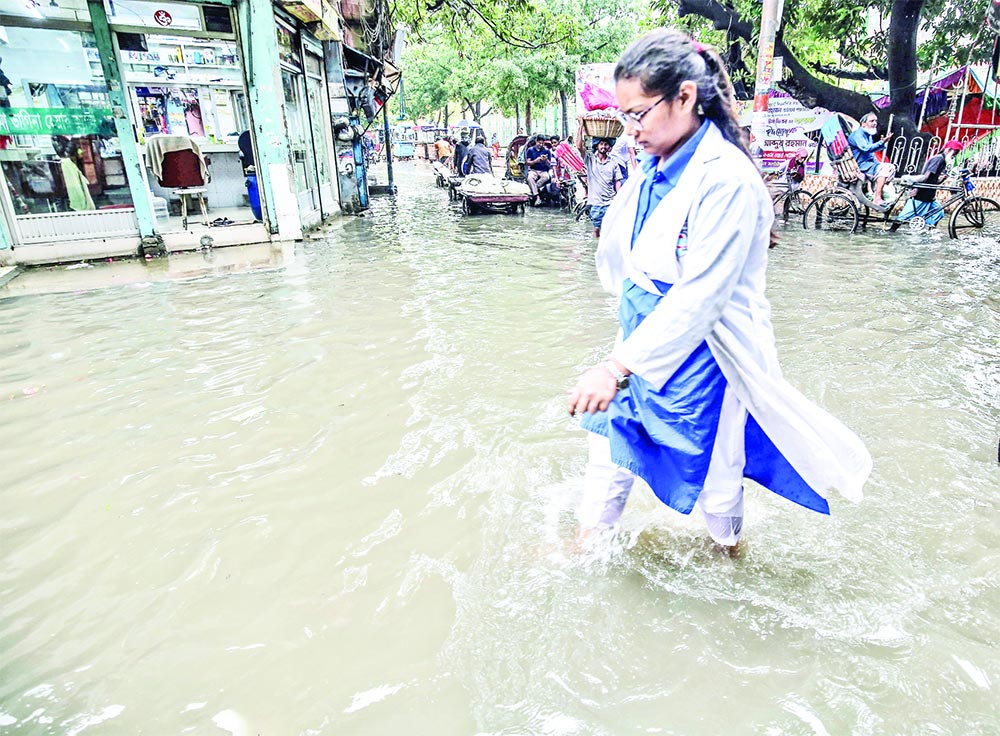
Days of incessant rain have left large swathes of Dhaka, Chattogram and Barishal waterlogged, paralysing urban life and once again laying bare the fragility of the country's drainage systems.
Since Wednesday morning, moderate to heavy downpours have inundated major roads, neighbourhoods and narrow lanes, stranding commuters and slowing the pulse of city life to a crawl. Office-goers, students and transport operators endured a day of ordeal as knee-deep water and thinning public transport compounded the misery. The Bangladesh Meteorological Department has warned that the rain may persist for several more days under the ????? of a low-pressure system over the sea.
Urban life paralysed in Dhaka, Chattogram and Barishal; calls grow for lasting fixes
In the capital, waterlogging gripped areas from Malibagh, Shantinagar and Sayedabad to Mirpur, Dhanmondi and Hatirjheel. Traffic snarled across key arteries as vehicles waded through submerged roads, while many residents were forced to walk through murky water in search of scarce rickshaws or CNG-run auto-rickshaws.
"It has been raining since morning. Fewer passengers are on the roads, and waterlogging makes driving difficult," said Habibur Rahman, a CNG driver in Mohakhali. A private office employee from Gulshan, Ehsanul Haque, said he ventured out only out of necessity, describing the city as unusually subdued.
Authorities say emergency responses are underway. A spokesperson for the Dhaka South City Corporation said field teams are working to ease water accumulation, with excess water being drained through the Kamalapur pumping station and intensified efforts to clear clogged drains and canals. Yet residents remain sceptical, pointing to a recurring crisis that resurfaces with every monsoon.
In the port city of Chattogram, hours of heavy rain on Tuesday left low-lying areas such as Probortok Mor, Muradpur, Chawkbazar and Halishahar submerged in knee- to waist-deep water. Even by Wednesday morning, water had yet to fully recede in many neighbourhoods, with residents in densely populated areas bearing the brunt.
"There is still water around my house. Even after it recedes, the mud makes movement difficult," said Katalganj resident Parveen Akhter, capturing the lingering hardship.
A similar picture emerged in Barishal, where continuous rainfall submerged low-lying zones and disrupted daily movement. Transport shortages forced many to wait for hours as rainwater choked key routes. The local meteorological office recorded 63.6 mm of rainfall in the past 24 hours and forecast more rain in the coming days.
Addressing the Jatiya Sangsad, Prime Minister Tarique Rahman warned that unmanaged waste-particularly plastic and polythene-is clogging drainage systems and worsening the crisis. He urged lawmakers to raise public awareness, noting that waterlogging has evolved into a nationwide urban challenge rather than a city-specific issue.
Experts attribute the recurring floods to unplanned urbanisation, encroachment on natural canals, clogged drains and the growing impact of climate change. Without integrated urban planning, modernised drainage infrastructure and stronger civic discipline, they warn, the cycle of rain-induced disruption is set to persist.





