



| HEADLINE |

|

Juvenile Gangs
A growing spate of violence



 A change in government was expected to stabilise law and order, yet across Bangladesh a different reality has taken hold. Juvenile gangs, often referred to as "Kishore Gangs", have evolved into organised, emboldened networks operating with alarming reach.
 Although once it was seen as scattered urban nuisances, their violence is no longer confined to petty crime. It now spills into public spaces, targets ordinary citizens and, increasingly, challenges law enforcement itself.
Recent incidents have once again exposed the scale and brutality of juvenile gang activity. On April 12, a youth named Emon was killed in Mohammadpur's Beriband after his ankle was severed during a clash between rival groups. In another incident, a courier worker was attacked and robbed in Adabor's Shunibir Housing area. Days earlier, a police couple in Cumilla were stabbed after protesting harassment, while separate killings in Noakhali and Mymensingh highlighted how deeply such violence entrenched.
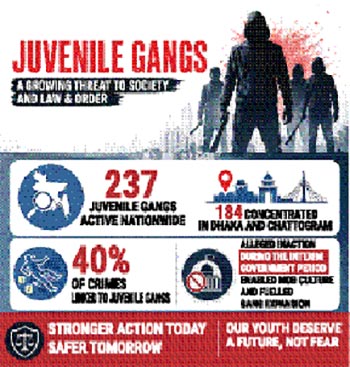
Official figures point to a sharp rise in organised youth crime. A Ministry of Home Affairs report identified 237 juvenile gangs nationwide, though experts suggest the number is higher, with membership running into hundreds of thousands. In Dhaka alone, gang numbers have surged dramatically in recent years, spreading across dozens of police station areas and turning neighbourhoods such as Mohammadpur, Mirpur and Tejgaon into persistent hotspots.
These groups are no longer loosely formed clusters. They operate with distinct identities-names, territories, dress codes and behavioural patterns-making them both visible and difficult to dismantle. Social media has further amplified their presence, with displays of weapons and acts of intimidation signalling a growing sense of impunity. Law enforcement data indicate that a significant share of urban crime is now linked to juvenile offenders, ranging from robbery and extortion to violent assaults and murder.
The situation appears to have worsened during the interim administration following the political transition of August 2024. Analysts attribute the expansion of gangs to weakened policing, shifting political patronage and a broader decline in law enforcement capacity. During this period, youth-led violence extended beyond street crime, with reports of attacks on businesses, educational institutions and individuals perceived as vulnerable.
Statistics reflect the human cost. Over the past 20 months, at least two dozen people have been killed in gang-related incidents, while arrests and criminal cases linked to such groups have risen sharply across multiple districts. In some cities, hundreds have been detained in connection with murder and robbery cases tied to juvenile gangs.
Criminologists argue that the phenomenon is no longer merely a policing issue. It is rooted in a combination of social influence, political protection and systemic gaps in enforcement.
Without addressing those underlying factors-and holding alleged patrons accountable-the networks are likely to expand further.

Loading...
Loading...
Also read



Editor : Iqbal Sobhan Chowdhury
Published by the Editor on behalf of the Observer Ltd. from Globe Printers, 24/A, New Eskaton Road, Ramna, Dhaka.
Editorial, News and Commercial Offices : Aziz Bhaban (2nd floor), 93, Motijheel C/A, Dhaka-1000.
Phone: PABX- 41053001-06; Advertisement: 41053012; 01793317829, 01550707291, E-mail: [email protected], [email protected] Online: email: [email protected] 41053014; 01550707297 Advertisement: 01550707296
Published by the Editor on behalf of the Observer Ltd. from Globe Printers, 24/A, New Eskaton Road, Ramna, Dhaka.
Editorial, News and Commercial Offices : Aziz Bhaban (2nd floor), 93, Motijheel C/A, Dhaka-1000.
Phone: PABX- 41053001-06; Advertisement: 41053012; 01793317829, 01550707291, E-mail: [email protected], [email protected] Online: email: [email protected] 41053014; 01550707297 Advertisement: 01550707296


