



| HEADLINE |

|

Fake news should be treated as a crime to tackle misinformation: Zahed
Published : Sunday, 3 May, 2026 at 11:32 AM
Observer Online Report


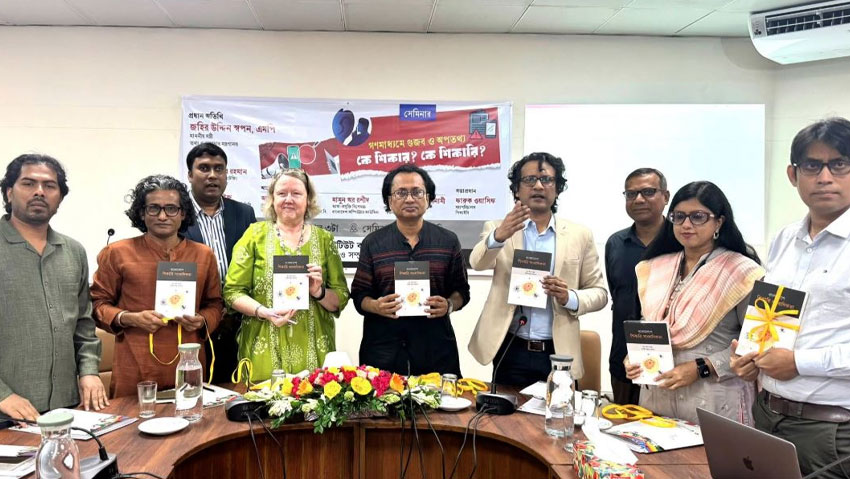
Collected Photo
Prime Minister’s Adviser on Policy and Strategy Dr Zahed Ur Rahman on Sunday said misinformation and rumours must be treated as criminal offences, warning that many people fail to grasp their seriousness.
He made the remarks at a seminar titled “Rumours and Misinformation in Media: Who is the Victim? Who is the Predator?” held at Press Institute Bangladesh (PIB).
Stressing the need for legal enforcement, he said fake news cannot be effectively curbed without clear punitive measures. He also distinguished misinformation from criticism or abusive speech, noting that these are separate issues.
The session was chaired by PIB Director General Faruk Wasif.
Dr Susan Vize, UNESCO’s Head of Office in Bangladesh, highlighted the importance of maintaining a balance between media freedom and regulation.
She called for stronger fact-checking mechanisms, improved journalistic skills, enhanced media capacity, and greater awareness of artificial intelligence and algorithm-driven systems.
In the keynote presentation, Mohammad Mamun Or Rashid emphasized the vital role of fact-checking organisations and professionals in combating misinformation.
Professor AA Mamun from Rajshahi University pointed out that disinformation is not only commercially driven but also used as a political tool. He said political actors can sometimes be victims, while in other instances they play a role in spreading misinformation.
Editor of The Dissent, Qadaruddin Shishir, criticised some media outlets for lacking accountability in correcting or retracting false information, asserting that there is no room for supporting fake news.
In his concluding remarks, Faruk Wasif warned that social media algorithms are shaping user preferences, leading to what he described as “digital servitude.”
He noted that people increasingly accept information that aligns with their views without verification, contributing to a growing crisis of trust in the media.
He stressed the need to rebuild media systems on a knowledge-based foundation to address these challenges.
SH
He made the remarks at a seminar titled “Rumours and Misinformation in Media: Who is the Victim? Who is the Predator?” held at Press Institute Bangladesh (PIB).
Stressing the need for legal enforcement, he said fake news cannot be effectively curbed without clear punitive measures. He also distinguished misinformation from criticism or abusive speech, noting that these are separate issues.
The session was chaired by PIB Director General Faruk Wasif.
Dr Susan Vize, UNESCO’s Head of Office in Bangladesh, highlighted the importance of maintaining a balance between media freedom and regulation.
She called for stronger fact-checking mechanisms, improved journalistic skills, enhanced media capacity, and greater awareness of artificial intelligence and algorithm-driven systems.
In the keynote presentation, Mohammad Mamun Or Rashid emphasized the vital role of fact-checking organisations and professionals in combating misinformation.
Professor AA Mamun from Rajshahi University pointed out that disinformation is not only commercially driven but also used as a political tool. He said political actors can sometimes be victims, while in other instances they play a role in spreading misinformation.
Editor of The Dissent, Qadaruddin Shishir, criticised some media outlets for lacking accountability in correcting or retracting false information, asserting that there is no room for supporting fake news.
In his concluding remarks, Faruk Wasif warned that social media algorithms are shaping user preferences, leading to what he described as “digital servitude.”
He noted that people increasingly accept information that aligns with their views without verification, contributing to a growing crisis of trust in the media.
He stressed the need to rebuild media systems on a knowledge-based foundation to address these challenges.
SH
Loading...
Loading...
Also read





Editor : Iqbal Sobhan Chowdhury
Published by the Editor on behalf of the Observer Ltd. from Globe Printers, 24/A, New Eskaton Road, Ramna, Dhaka.
Editorial, News and Commercial Offices : Aziz Bhaban (2nd floor), 93, Motijheel C/A, Dhaka-1000.
Phone: PABX- 41053001-06; Advertisement: 41053012; 01793317829, 01550707291, E-mail: [email protected], [email protected] Online: email: [email protected] 41053014; 01550707297 Advertisement: 01550707296
Published by the Editor on behalf of the Observer Ltd. from Globe Printers, 24/A, New Eskaton Road, Ramna, Dhaka.
Editorial, News and Commercial Offices : Aziz Bhaban (2nd floor), 93, Motijheel C/A, Dhaka-1000.
Phone: PABX- 41053001-06; Advertisement: 41053012; 01793317829, 01550707291, E-mail: [email protected], [email protected] Online: email: [email protected] 41053014; 01550707297 Advertisement: 01550707296


