



| HEADLINE |

|

Sirajganj handloom industry suffers setback for power disruption
Published : Thursday, 7 May, 2026 at 12:00 AM
Ashok Benarjee


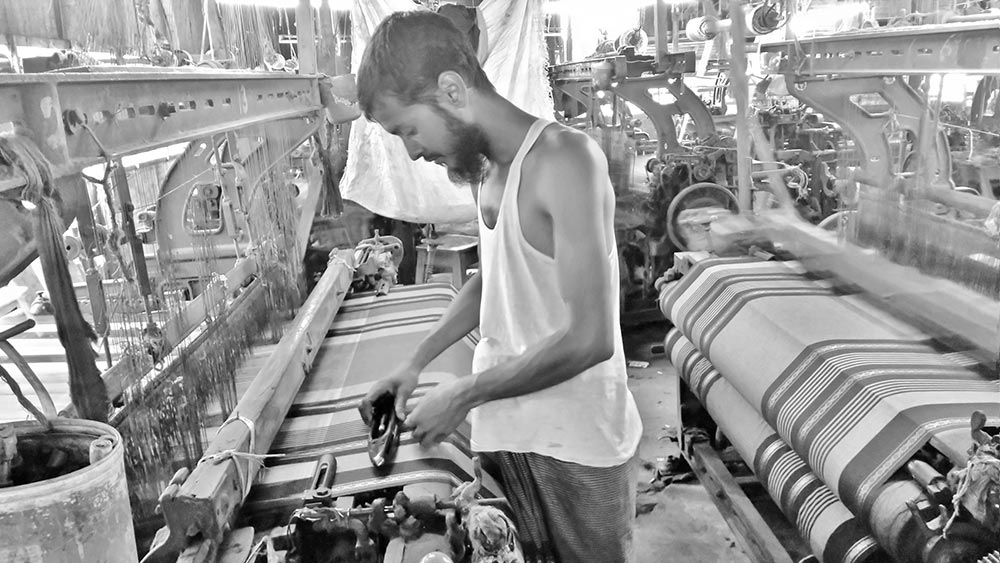 SIRAJGANJ, May 6: Frequent electricity disruption has severely reduced production in Sirajganj's centuries-old handloom industry, leaving thousands of owners and workers struggling to survive ahead of the upcoming Eid-ul-Azha.
Once considered the backbone of rural industry in northern Bangladesh, the sector is now facing a combination of crises. Rising prices of yarn, dyes and other raw materials, the lingering impact of Covid-19, recent political and economic shifts, and now recurring power shortage have pushed many units into near collapse.
Industry stakeholders say the situation has further worsened due to global energy instability linked to geopolitical tensions, including disruptions in fuel supply chains. As a result, electricity shortages and load shedding have become more frequent, directly affecting production in both handloom and power loom factories.
According to sources at Sirajganj Handloom Board, around five lakh looms across nine upazilas are linked to the industry, providing direct and indirect employment to nearly 10 lakh people. The districts of Belkuchi, Shahjadpur and Enayetpur alone account for nearly two lakh looms, producing saris, lungis, towels and three-piece fabrics that supply both domestic and export markets.
However, most of these units now depend on electricity-powered machinery. With frequent outages, production has dropped by nearly half in many factories, forcing owners to either scale down operations or shut down temporarily.
"Earlier we could run production continuously with electricity. Now we have to depend on generators for hours every day," said one factory owner in Belkuchi. "This has doubled our costs, but the market price of products has not increased accordingly."
He added that despite higher expenses, demand in the market remains weak, especially for lungis and saris, putting further pressure on profitability.
Owners also say they are unable to maintain production schedules, causing delays in fulfilling orders, particularly ahead of Eid, when demand usually rises.
Muslim Uddin, a loom worker, said, "We often sit idle for hours due to load shedding. Even when there is no work, we have to survive. It has become very difficult to manage household expenses."
In addition to electricity shortages, rising raw material costs are worsening the crisis. Loom owners say yarn, dye and other inputs have become significantly more expensive over the past year.
Almas Hossain, a Shahjadpur-based loom owner, said yarn prices have increased sharply, while product prices have either remained stagnant or declined.
"A bundle of yarn that cost around Tk 15,000 last year now costs nearly Tk 22,000," he said. "But the selling price of lungis and saris has gone down instead of increasing."
He noted that lungis that sold for Tk 220-240 during last Ramadan are now selling for Tk 180-200, resulting in heavy losses for producers.
In some areas, production has dropped so sharply that weekly earnings of workers have fallen from Tk 3,000-4,000 during peak Eid production periods to nearly Tk 1,000 now.
Belkuchi trader Lokman Sheikh said over 10,000 power looms in Tamai Village alone are affected by frequent outages and fuel shortages. "Many units have already stopped operating. Those still running are doing so at very low capacity," he said.
Central Weavers Association President Abdus Samad Khan said the crisis has reached a critical stage.
"Large factory owners are still managing production by buying diesel at high prices, but small and medium producers are collapsing under pressure," he said.
He added that rising production costs, falling product prices and electricity shortages together are making the industry unsustainable.

Loading...
Loading...
Also read



Editor : Iqbal Sobhan Chowdhury
Published by the Editor on behalf of the Observer Ltd. from Globe Printers, 24/A, New Eskaton Road, Ramna, Dhaka.
Editorial, News and Commercial Offices : Aziz Bhaban (2nd floor), 93, Motijheel C/A, Dhaka-1000.
Phone: PABX- 41053001-06; Advertisement: 41053012; 01793317829, 01550707291, E-mail: [email protected], [email protected] Online: email: [email protected] 41053014; 01550707297 Advertisement: 01550707296
Published by the Editor on behalf of the Observer Ltd. from Globe Printers, 24/A, New Eskaton Road, Ramna, Dhaka.
Editorial, News and Commercial Offices : Aziz Bhaban (2nd floor), 93, Motijheel C/A, Dhaka-1000.
Phone: PABX- 41053001-06; Advertisement: 41053012; 01793317829, 01550707291, E-mail: [email protected], [email protected] Online: email: [email protected] 41053014; 01550707297 Advertisement: 01550707296


