



| HEADLINE |

|
CURSE OF TRAFFIC CONGESTION IN DHAKA (PART-5)
From dawn's first rush to the dead of night, Dhaka remains locked in a relentless gridlock, wasting time, affecting productivity and taxing on patience of millions of commuters every single day. In this special series, The Daily Observer delves beyond the daily chaos to uncover the structural causes behind enduring traffic paralysis, examine why past interventions have failed, and explore expert-backed solutions to ease the burden.
Promises on paper, challenges on road
Published : Saturday, 9 May, 2026 at 12:00 AM
Arifur Rahman Rabbi


 As cities across the world move towards artificial intelligence-driven traffic systems that enable real-time, data-based decision-making, Dhaka is attempting a more modest reset-reviving automated traffic signals to restore order on its chronically congested roads. But the early days of implementation suggest that technology alone may not be enough to break deeply entrenched habits.
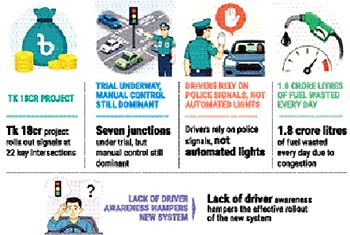
Authorities have recently allocated around Tk 18 crore to install traffic signals at 22 key intersections. So far, seven-Hotel InterContinental, Banglamotor, Sonargaon (Karwan Bazar), Farmgate, Bijoy Sarani, the Chief Adviser's Office and Jahangir Gate-have entered trial operation. Yet, on the ground, the transition remains uneven.
At several of these intersections, automated signals are functioning-cycling through red, yellow and green as programmed-but traffic officers continue to direct vehicles manually. In practice, drivers are still following hand signals rather than the lights above them. The coexistence of two parallel systems has created a hybrid reality where neither fully dominates.
Control rooms monitor traffic through CCTV, while officers maintain communication via wireless systems. Despite this, compliance with signals is inconsistent. Vehicles often edge forward as lights change, while zebra crossings meant for pedestrians are routinely occupied, narrowing safe passage.
The persistence of manual control reflects more than just a transitional phase-it points to a systemic trust deficit. Previous attempts to introduce automated signalling, despite significant investment, failed to yield lasting results. As Mozammel Haque Chowdhury, Secretary General of the Bangladesh Jatri Kalyan Samity, observed, those failures have reinforced reliance on traffic police as the ultimate authority on the road.
The scale of the problem is stark. A study by the Bangladesh University of Engineering and Technology (BUET) shows that average traffic speed in Dhaka has dropped from around 21 km/h a decade ago to just 4-5 km/h today-comparable to walking pace. Congestion costs are equally severe, with about 90 lakh working hours lost daily and fuel wastage reaching roughly 1.8 crore litres per day, translating into enormous financial losses.
Against this backdrop, the behavioural dimension of traffic management becomes critical. Field observations indicate that drivers routinely ignore red lights but stop immediately on police instruction-even when signals are green. For many, this is less a matter of defiance than adaptation.
Drivers themselves acknowledge the confusion. Years of dysfunctional or inactive signals have conditioned them to depend on human direction. Without clear differentiation between operational and non-operational systems, uncertainty persists. As a result, following traffic police remains the safest way to avoid violations.
Institutional gaps compound the challenge. Transport owners and workers say they have not received formal briefings on the new system, limiting awareness and preparedness at the driver level. Without coordinated communication, behavioural change is unlikely to take hold.
Urban planning experts argue that the issue extends beyond signalling. Dhaka's road network is inadequate relative to the volume of vehicles, while weak enforcement of traffic rules further undermines system efficiency. Indiscriminate stopping by buses and competition for passengers disrupt traffic flow, often rendering signal timing ineffective.
Transport specialists also note that initial technical glitches are expected in a pilot phase. However, they stress that such issues must be resolved quickly to build confidence in the system. More importantly, signalling reforms must be accompanied by broader measures-controlling vehicle numbers, managing sidewalks, and regulating where buses pick up and drop off passengers.
Law enforcement officials, meanwhile, highlight the practical constraints. With automated signals not yet citywide, drivers encounter a patchwork system, leading to uncertainty and inconsistent compliance. Variations in vehicle speeds at intersections also necessitate continued police intervention to maintain flow.
The authorities remain optimistic that technical refinements and greater public awareness will gradually improve compliance. But Dhaka's experience so far suggests that restoring discipline on the roads is not merely a technological challenge. It is a question of coordination, enforcement and, above all, changing long-standing behaviour-something no signal system, however advanced, can achieve on its own.
Loading...
Loading...
Also read



Editor : Iqbal Sobhan Chowdhury
Published by the Editor on behalf of the Observer Ltd. from Globe Printers, 24/A, New Eskaton Road, Ramna, Dhaka.
Editorial, News and Commercial Offices : Aziz Bhaban (2nd floor), 93, Motijheel C/A, Dhaka-1000.
Phone: PABX- 41053001-06; Advertisement: 41053012; 01793317829, 01550707291, E-mail: [email protected], [email protected] Online: email: [email protected] 41053014; 01550707297 Advertisement: 01550707296
Published by the Editor on behalf of the Observer Ltd. from Globe Printers, 24/A, New Eskaton Road, Ramna, Dhaka.
Editorial, News and Commercial Offices : Aziz Bhaban (2nd floor), 93, Motijheel C/A, Dhaka-1000.
Phone: PABX- 41053001-06; Advertisement: 41053012; 01793317829, 01550707291, E-mail: [email protected], [email protected] Online: email: [email protected] 41053014; 01550707297 Advertisement: 01550707296


