



| HEADLINE |

|

Questions raised over interim govt's agenda
Reform Commissions With Minimum Implementation



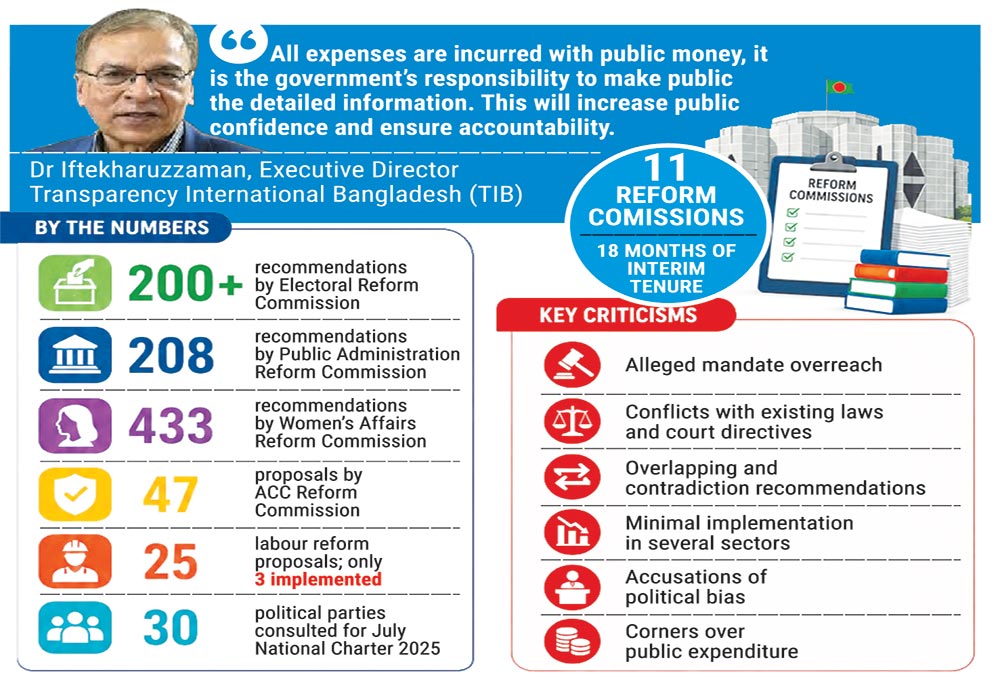 Following the fall of the Sheikh Hasina-led government on August 5 2024, the unelected interim government headed by Dr Muhammad Yunus assumed office on August 8 and constituted 11 Reform Commissions during its 18-month tenure.
The Commissions submitted reports containing thousands of recommendations on electoral, constitutional, administrative, judicial, labour, media and social reforms. However, many proposals have drawn criticism for exceeding mandates, conflicting with constitution and existing laws and judicial directives, appearing politically motivated, and creating what critics describe as unnecessary expenditure of public funds.
Wide-ranging reform proposals, limited implementation
The eight-member Electoral Reform Commission, led by Badiul Alam Majumder, proposed more than 200 recommendations on political party accountability, voting systems and parliamentary structure. The proposals faced criticism over legal and constitutional inconsistencies, while the Election Commission formally objected to 32 recommendations, including those relating to constituency delimitation, election scheduling and punitive powers over the Commission itself.
The Constitutional Reform Commission, initially headed by Shahdin Malik and later by Ali Riaz, proposed major structural changes, including a bicameral parliament, constitutional redefinition of state principles and referendum mechanisms. Critics questioned the proposals over alleged ideological bias, impracticality and legal uncertainty, while the BNP opposed several key provisions.
The Public Administration Reform Commission, led by Abdul Muyid Chowdhury, submitted 208 recommendations, including proposals on administrative restructuring, provincial divisions and early retirement benefits. Critics raised concerns over feasibility and fiscal burden.
The Police Administration Reform Commission, headed by Sarfaraz Chowdhury, proposed reforms in 13 areas alongside 22 legal amendments. Critics questioned the safeguards for institutional independence, disciplinary criteria and vulnerability to politicisation, while Transparency International Bangladesh warned of limited effectiveness.
The Judicial Reform Commission, led by former justice Shah Abu Naeem Mominur Rahman, implemented nine of its 30 recommendations, including institutional restructuring. Key proposals such as judicial decentralisation and divisional High Court benches remain controversial and largely unimplemented.
The Anti-Corruption Commission Reform Commission, chaired by Iftekharuzzaman, proposed 47 measures, including constitutional recognition and institutional strengthening. Critics argued the report overlooked deeper socio-economic drivers of corruption, while some observers later described the report as redundant following the political transition.
The Health Sector Reform Commission, led by Professor AK Azad Khan, proposed broad reforms covering healthcare governance, pharmaceuticals and administration, though implementation has remained largely absent.
The Labour Reform Commission, chaired by Syed Sultan Uddin Ahmed, submitted 25 recommendations, with only three implemented.
Labour leaders criticised the continuing insecurity faced by workers and the lack of meaningful execution.
The Women's Affairs Reform Commission, led by Shirin Parvin Haque, submitted 433 recommendations that triggered controversy over legal and social reforms. Religious groups criticised several proposals, while the National Consensus Commission rejected parts of the recommendations.
The Media Reform Commission, headed by Kamal Ahmed, proposed wide-ranging media sector reforms. However, implementation has remained minimal amid allegations that the interim government selectively withheld key recommendations from public disclosure.
The National Consensus Commission, chaired by Muhammad Yunus with Ali Riaz as vice-president, produced the July National Charter 2025 after consultations with 30 political parties. Despite this, major disagreements persisted and several political actors and legal experts questioned the legitimacy of the process. Senior lawyer Sara Hossain described the process as "undemocratic and selective".
Key sectors left out
Critics also questioned the interim government's priorities, pointing to the absence of reform bodies in several major sectors.
No Education Reform Commission was formed despite prolonged protests and demands for restructuring. Jahangirnagar University Vice-Chancellor Dr Mohammad Kamrul Ahsan observed that, despite the formation of 11 commissions, "an education commission had not yet been constituted", while decisions taken by a primary education monitoring committee remained unimplemented.
The interim administration also did not establish a fiscal reform commission despite concerns over revenue collection, budget discipline and macroeconomic stability. Similarly, no dedicated body addressed law and order issues such as mob violence and organised crime.
Observers further criticised the absence of commissions focusing on food safety, market regulation, roads and highways, particularly amid price volatility and allegations of market manipulation.
Allegations of political agenda
Several reform reports faced criticism for focusing disproportionately on the past 15 years. The Anti-Corruption Commission report described the previous administration as "kleptocratic", though critics argued corruption predates that period and that the analysis lacked historical balance.
Similarly, electoral reform proposals highlighted only three disputed elections, despite allegations surrounding a broader number of parliamentary polls, raising concerns over selective political framing.
Sources described as part of the "deep state" alleged that Chief Adviser Dr. Muhammad Yunus pursued a reform strategy aimed at prolonging his interim government tenure until 2029. Critics argued that the creation of multiple commissions and the promotion of shifting "small package" and "big package" reforms generated political uncertainty without a clear electoral roadmap.
Analysts also pointed to overlapping and contradictory recommendations across commissions. Proposals relating to bicameral legislature, caretaker government arrangements and term limits appeared in multiple reports, leading critics to question whether some commissions operated independently or aligned with broader government preferences.
Contradictions were also evident between commissions. While the Anti-Corruption Commission emphasised transparency in electoral financing, the Election Reform Commission argued that preventing such fraud was "almost impossible". Some commissions were additionally accused of exceeding their mandates by drafting laws despite lacking formal authority or specialised expertise.
TIB Executive Director Iftekharuzzaman said, "All expenses are incurred with public money, it is the government's responsibility to make public the detailed information. This will increase public confidence and ensure accountability."
Critics of the interim administration ultimately argued that many of the commissions produced more controversy than reform, questioning whether the process was intended to deliver institutional change or prolong the tenure of the Yunus-led government.

Loading...
Loading...
Also read



Editor : Iqbal Sobhan Chowdhury
Published by the Editor on behalf of the Observer Ltd. from Globe Printers, 24/A, New Eskaton Road, Ramna, Dhaka.
Editorial, News and Commercial Offices : Aziz Bhaban (2nd floor), 93, Motijheel C/A, Dhaka-1000.
Phone: PABX- 41053001-06; Advertisement: 41053012; 01793317829, 01550707291, E-mail: [email protected], [email protected] Online: email: [email protected] 41053014; 01550707297 Advertisement: 01550707296
Published by the Editor on behalf of the Observer Ltd. from Globe Printers, 24/A, New Eskaton Road, Ramna, Dhaka.
Editorial, News and Commercial Offices : Aziz Bhaban (2nd floor), 93, Motijheel C/A, Dhaka-1000.
Phone: PABX- 41053001-06; Advertisement: 41053012; 01793317829, 01550707291, E-mail: [email protected], [email protected] Online: email: [email protected] 41053014; 01550707297 Advertisement: 01550707296


