



| HEADLINE |

|

Judiciary overburdened with pending cases
People suffer, losing confidence in dispensation of justice



 Justice delayed has become justice denied for millions in Bangladesh. From corruption and money laundering cases, sensational murder investigations stretching over decades to labour disputes unresolved despite legal deadlines, the country's courts are buckling under the weight of an unprecedented and undesired backlog. Nearly five million pending cases now stand as a stark reminder of a judicial system struggling to keep pace with demand, while victims, accused persons and ordinary litigants wait years - sometimes decades - for justice.
The growing crisis has also raised broader questions about public trust, judicial independence and the state's ability to ensure timely justice.
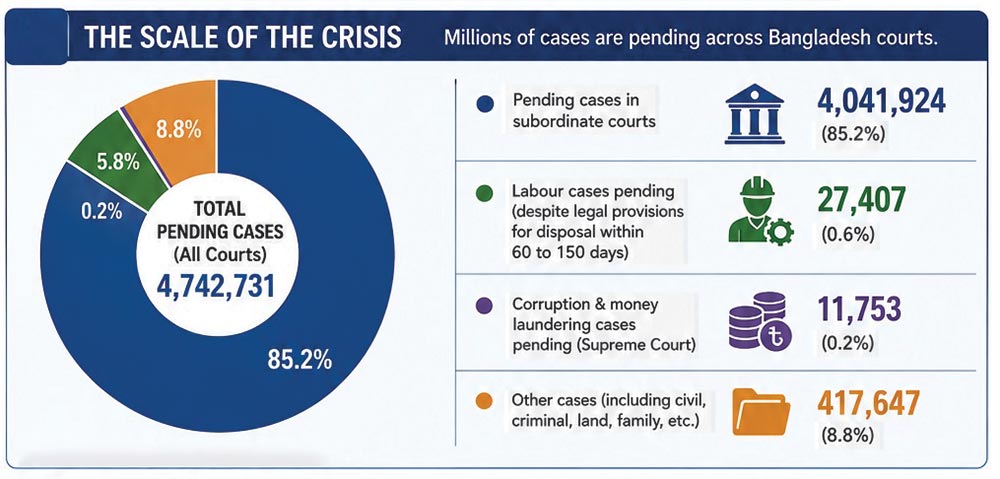
As of December 31 last year, 4,742,731 cases were pending in Bangladesh courts, including 4,041,924 in subordinate courts, according to Supreme Court data. The backlog spans nearly every sector of the justice system.
In corruption and money laundering cases, 11,753 matters remain pending across all divisions of the Supreme Court. The Land Survey Tribunal has managed to settle less than one percent of its cases. Labour courts are also heavily burdened, with 27,407 cases pending despite legal provisions requiring disposal within 60 to 150 days. New filings are arriving at almost twice the rate of disposal.
Several high profile cases illustrate the depth of the problem.
In the Rana Plaza collapse case involving 41 accused, including owner Sohel Rana, testimony from only 24.41 percent of witnesses has been completed despite repeated calls for speedy disposal. Of around 20 related cases, only one ACC case has concluded so far.
The sensational Sagar-Runi murder case has seen the investigation report deadline extended 126 times. In the Sohagi Jahan Tonu murder case, the first arrest came nearly a decade after the killing, after repeated delays and multiple changes in investigating agencies.
Attorney General AM Amin Uddin said one major reason for prolonged trials is that almost all disputes eventually reach the courts. "In developed countries many disputes are settled beforehand," he observed.
He added that judges often handle between 20 and 100 cases daily, while cases filed under the Prevention of Violence against Women and Children Act - legally meant to conclude within 180 working days - take an average of three and a half years and require around 22 hearings.
Senior Advocate Robiul Hossain identified several structural weaknesses behind the backlog, including shortages of judges, poor infrastructure, repeated adjournments, absent witnesses, delayed investigation reports by police, RAB and weak coordination among institutions.
According to estimates, murder investigations in Bangladesh take an average of 10 years and 11 months, with some lasting more than 30 years. Experts also point to false and harassing cases, weak evidence preservation, lack of witness protection and poor case management as major contributors. Sometimes the lack of seriousness by judges, magistrates in courts delay the cases mounting harassment and sufferings of litigants.
Criminologist Dr Touhidul Haque warned that lengthy investigations weaken both evidence and public confidence. "Delays destroy evidence, weaken investigations and create public distrust in the judicial process," he said.
The judiciary has also faced scrutiny, pressure and threats over political influence.
Law Adviser of interim government Dr. Asif Nazrul criticised alleged interference in judicial independence and unequal bail practices in political cases. But during his time the interim government, allegations raised over hundreds of politically motivated cases against individuals linked to the Awami League.
Following the fall of the Sheikh Hasina government on August 5, cases filed against former Prime Minister, ministers, MPs, activists, journalists and writers raised concerns over harassment, remand practices and politically motivated prosecution.
July uprising related cases similarly drew criticism over alleged misuse for revenge and property disputes.
Home Minister Salahuddin Ahmed recently admitted countless of politically motivated cases during interim government and said thousands of cases filed during the interim government have been ordered for review within one month.
The government says it has already withdrawn 23,865 politically motivated harassment cases and is reviewing the remaining ones.
To ease pressure on the judiciary, authorities have amended civil and criminal procedure laws, introduced digital summons and SMS notifications, and expanded the use of online testimony.
The government has also established 871 new courts and created 232 judge posts, while recruitment is underway for hundreds of judges and judicial staff. Alternative Dispute Resolution mechanisms settled 199,957 cases between 2009 and March 2026, while mandatory pre-litigation mediation has been introduced in 20 districts.
Yet experts say reforms must go beyond technology and staffing.
Without faster and impartial investigations, stronger accountability, fewer politically motivated cases and more efficient case management, Bangladesh's judicial backlog is unlikely to ease. Until then, millions will continue waiting for justice in a system increasingly overwhelmed by its own weight.

Loading...
Loading...
Also read



Editor : Iqbal Sobhan Chowdhury
Published by the Editor on behalf of the Observer Ltd. from Globe Printers, 24/A, New Eskaton Road, Ramna, Dhaka.
Editorial, News and Commercial Offices : Aziz Bhaban (2nd floor), 93, Motijheel C/A, Dhaka-1000.
Phone: PABX- 41053001-06; Advertisement: 41053012; 01793317829, 01550707291, E-mail: [email protected], [email protected] Online: email: [email protected] 41053014; 01550707297 Advertisement: 01550707296
Published by the Editor on behalf of the Observer Ltd. from Globe Printers, 24/A, New Eskaton Road, Ramna, Dhaka.
Editorial, News and Commercial Offices : Aziz Bhaban (2nd floor), 93, Motijheel C/A, Dhaka-1000.
Phone: PABX- 41053001-06; Advertisement: 41053012; 01793317829, 01550707291, E-mail: [email protected], [email protected] Online: email: [email protected] 41053014; 01550707297 Advertisement: 01550707296


