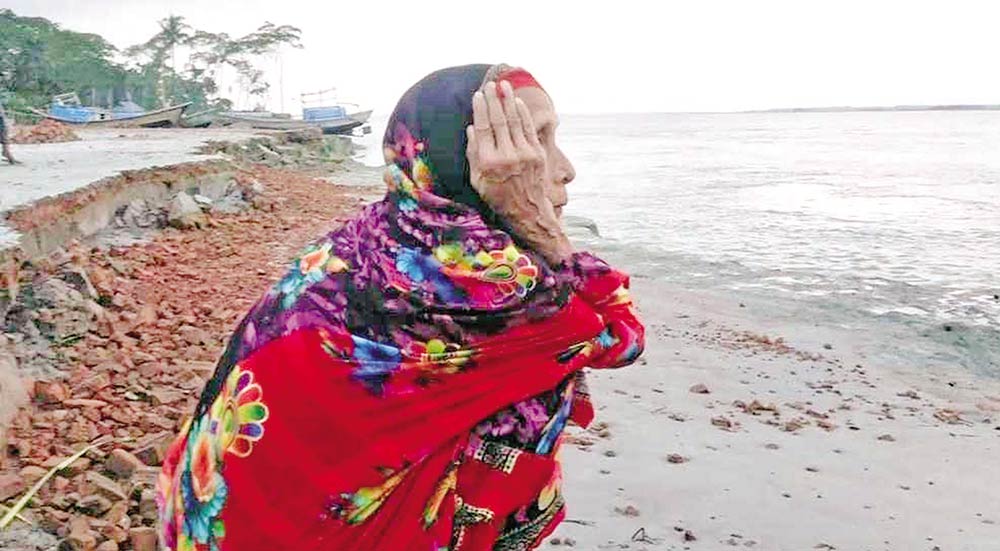
CHAR FASSON, BHOLA, May 24: Continuous erosion along the Tentulia River in Char Fasson Upazila of Bhola has left riverbank residents in despair, with around 2,000 more families at risk of becoming homeless in the current monsoon season.
In the upazila's Dularhat Police Station area, nearly 10,000 families in Nilkamal and Mujibnagar unions have already been displaced due to severe river erosion. So far, homesteads and around 2,000 acres of farmland have been swallowed by the river, with nearly one-third of the two unions already lost to the Tentulia.
Officials and locals fear that nine wards of the two unions may disappear into the river during the ongoing rainy season, while another 2,000 families are at immediate risk of losing their homes.
Although the Water Development Board (WDB) has said that measures are being taken to control erosion, affected residents say they have yet to see any effective intervention.
There have also been demands that displaced families be allowed to settle on newly emerged chars in the area.
Dularhat Upazila, located in the western part of Char Fasson, is home to around 150,000 people. Nilkamal Union lies on the eastern bank of the Tentulia River, while the newly formed Mujibnagar Union is on the western side.
Over the past two years, continuous erosion has been reshaping the area, with around 70,000 residents from the two unions losing their place on the map of Char Fasson.
A field visit shows that seven wards of Mujibnagar and two wards of Nilkamal, along with two housing projects and vast agricultural land, have already been lost to the river. Hundreds of families have been left landless and helpless.
Around 600 families have lost both homesteads and farmland and are now living in extremely difficult conditions. Many have taken shelter on embankments or in relatives' homes, while others are living in makeshift huts along the riverbank.
The erosion has hit farmers and fishermen hardest. Farmers have lost their only source of income as agricultural land has disappeared, while fishermen are struggling due to declining fish availability.
Eighty-year-old Jinal Abedin from Nilkamal said he had settled in the area after acquiring two acres of land, but now lives on an embankment after losing everything to erosion. "We are living in inhumane conditions," he said.
Another resident, elderly Wahab Ali, said he had lost his ancestral home to Meghna River erosion decades ago and later rebuilt his life in Mujibnagar, only to lose everything again to the Tetulia River.
"I am now living in someone else's house and surviving in hardship at the end of my life," he said.
Julekha Begum, who is now living near the riverbank, said she lives in constant fear of losing her shelter. "If this place also erodes, I don't know where we will go," she said.
A former BNP leader of Nilkamal Union said erosion has intensified over the last two years and warned that both unions could disappear within three years if the situation continues.
He urged immediate action to stop erosion and called for rehabilitation of displaced families on government khas land.
Sub-Assistant Engineer of the WDB Division-2, Niaz Morshed, said necessary measures have been taken and a proposal has been sent for approval to construct embankments. Work will begin once it is approved, he added.





