



| HEADLINE |

|
floods, landslides kill 33 in ctg as heavy rains batter bangladesh


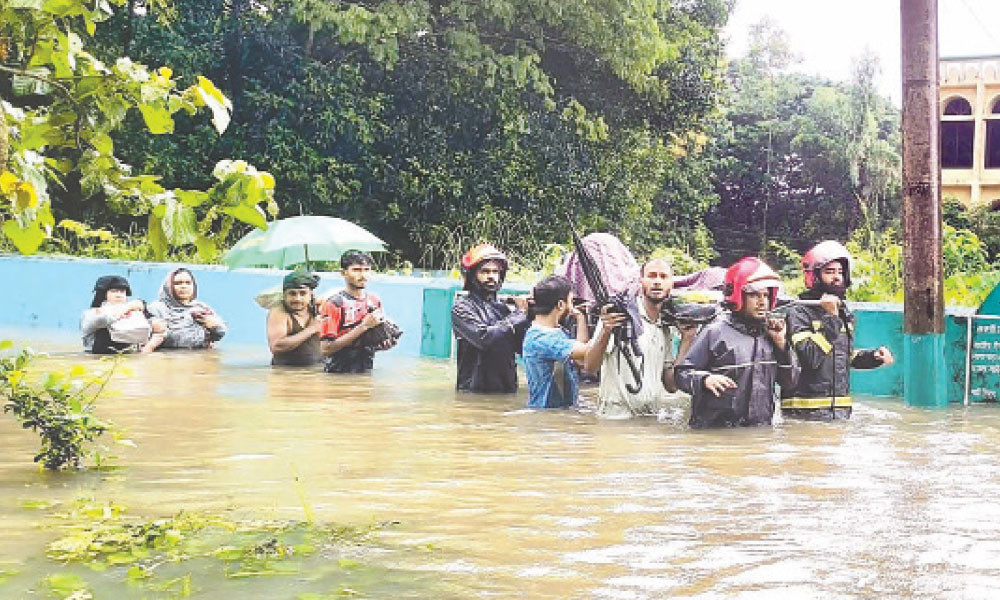
At least 33 people have died in Greater Chattogram over the past five days as relentless monsoon rains triggered floods, landslides, wall collapses and drowning incidents across southeastern Bangladesh, while thousands remain stranded and transport links have been severely disrupted.
The Bangladesh Meteorological Department (BMD) said heavy to very heavy rainfall is likely to continue for another two to three days due to an active monsoon and the influence of a low-pressure system, raising the risk of further flooding and landslides.
Among the dead are 15 Rohingya refugees. Five members of two families, including a child, were killed in a landslide in Lama, Bandarban, on Thursday, while three children died in separate landslide and drowning incidents in Chakaria, Cox's Bazar.
The Flood Forecasting and Warning Centre (FFWC) said continuous rainfall has caused water levels in rivers across the country to rise, worsening the flood situation in Greater Chattogram. Low-lying areas in Rangamati, Bandarban, Chattogram and Cox's Bazar have already been inundated.
More than 500,000 people have been affected by flooding in Greater Chattogram, with Satkania Upazila alone accounting for around 300,000 residents. Water has entered homes, government offices, hospitals and educational institutions, while several roads remain submerged, disrupting transport and daily life.
Rail services between Chattogram and Cox's Bazar have remained suspended since Tuesday after floodwater submerged sections of the railway track. Authorities said 18 intercity train services on the Cox's Bazar and Dhaka routes have been cancelled over the past three days.
Road communication with Rangamati, Khagrachhari and parts of Bandarban has also been interrupted by floodwater and landslides. Around 150 tourists stranded in Sajek for two days were evacuated with army assistance, while efforts are continuing to rescue the remaining visitors.
The Chattogram district administration has cancelled all leave for officials and activated round-the-clock control rooms in every upazila. The government has allocated 200 metric tonnes of rice, Tk10 million from the Ministry of Disaster Management and Relief, and an additional Tk20 million from the Prime Minister's relief fund for affected areas.
Flood conditions have also deteriorated in Sylhet as rivers continue to swell due to heavy rainfall and upstream runoff from India's Meghalaya. Authorities have prepared 537 shelters amid fears of flash floods and possible landslides.
Meanwhile, persistent rainfall has caused widespread waterlogging in Khulna city, inundating roads, homes and business establishments and disrupting normal life.
Authorities have urged residents living in landslide-prone hills and flood-risk areas to move to safer locations as heavy rainfall is expected to continue over the coming days.
Loading...
Loading...
Also read








Editor : Iqbal Sobhan Chowdhury
Published by the Editor on behalf of the Observer Ltd. from Globe Printers, 24/A, New Eskaton Road, Ramna, Dhaka.
Editorial, News and Commercial Offices : Aziz Bhaban (2nd floor), 93, Motijheel C/A, Dhaka-1000.
Phone: PABX- 41053001-06; Online: 41053014; 01550707296 Advertisement: 41053012; 01550707291
E-mail: [email protected] [email protected]
Published by the Editor on behalf of the Observer Ltd. from Globe Printers, 24/A, New Eskaton Road, Ramna, Dhaka.
Editorial, News and Commercial Offices : Aziz Bhaban (2nd floor), 93, Motijheel C/A, Dhaka-1000.
Phone: PABX- 41053001-06; Online: 41053014; 01550707296 Advertisement: 41053012; 01550707291
E-mail: [email protected] [email protected]


