



| HEADLINE |

|
Khamenei buried after a week of mourning by millions
Published : Friday, 10 July, 2026 at 12:00 AM


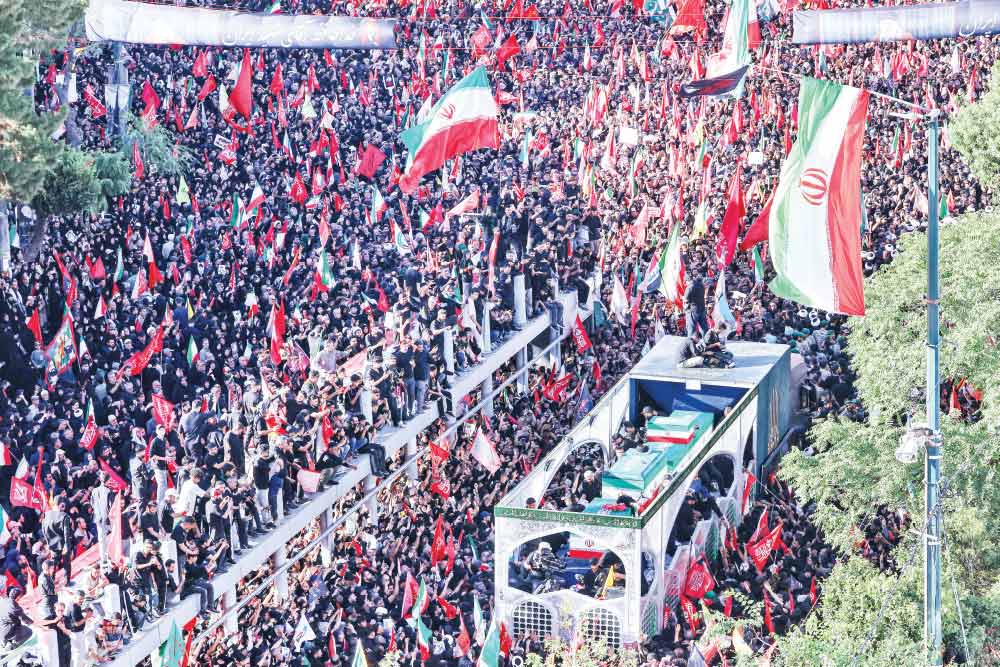 DUBAI, July 9: Iran buries its slain Supreme Leader Ayatollah Ali Khamenei on Thursday at the country's holiest shrine.
 The burial in Mashhad in northeast Iran follows a week of mass funeral processions, rallies and mourning ceremonies that has coincided with a renewed burst of conflict with the United States following weeks of truce.
Khamenei's body was carried by truck slowly through the crammed Mashhad streets towards the gilt dome and minarets of the Shrine of Imam Reza, flanked by white-turbaned clerics walking on either side.
Black-clad mourners pressed in close behind, waving Iranian flags, photographs of the late Khamenei and red placards with revolutionary slogans.
The burial is the culmination of a week of funeral events in both Iran and Iraq that the Islamic Republic's clerical leaders have been encouraging huge crowds to attend in an effort to vaunt the might and ideological fire of their theocratic state.
Crowds at mass funeral hold placards "kill Trump"
As crowds jostled in Mashhad awaiting Khamenei's funeral cortege, the crowd chanted slogans demanding revenge on U.S. President Donald Trump for his killing.
“I swear by the blood of the Supreme Leader, Trump, we will kill you!” they shouted, with women holding up placards reading "Kill Trump".
The roads leading to the shrine were a sea of black-clad mourners on Thursday, some responding to shouted chants in praise of Khamenei and against Iran's enemies, including the old revolutionary slogan of "Death to America".
As the crowds awaited the coffins of Khamenei and his family in the sweltering July heat, hoses pumped water high into the air to spray across the mourners and keep them cool.
Khamenei's remains, along with those of four family members killed alongside him, have already been paraded through Tehran, the Shi'ite Muslim clerical centre of Qom, and the Iraqi shrine cities of Najaf and Karbala.
At each event, huge crowds have thronged the streets to the mournful accompaniment of sung Shi'ite laments and chanted revolutionary slogans.
Martyrdom holds a central place in Shi'ite theology, and Khamenei's death at the hands of foreign enemies has played into a religious and political tradition that runs deep through the Islamic Republic.
The funeral comes at a critical moment for Iran, turning the page of nearly four decades of Khamenei's rule and months after the latest round of mass nationwide protests against the Islamic Republic.
While analysts see Iran as having emerged from the war strategically strengthened, with its grip over the vital Strait of Hormuz intact, it has suffered widespread damage that ?has added to internal economic woes.
The late Khamenei was appointed supreme leader in 1989, a decade after the Islamic revolution, and over the decades he consolidated political, economic and military power in his office.
That effort, which increasingly marginalised the elected president and parliament, was conducted in concert with the Islamic Revolutionary Guard Corps that grew in influence throughout Khamenei's rule.
Mojtaba Khamenei was appointed with the backing of the Guards, who are now seen as the dominant force in Iranian political and strategic thinking. �"REUTERS
Loading...
Loading...
Also read



Editor : Iqbal Sobhan Chowdhury
Published by the Editor on behalf of the Observer Ltd. from Globe Printers, 24/A, New Eskaton Road, Ramna, Dhaka.
Editorial, News and Commercial Offices : Aziz Bhaban (2nd floor), 93, Motijheel C/A, Dhaka-1000.
Phone: PABX- 41053001-06; Advertisement: 41053012; 01793317829, 01550707291, E-mail: [email protected], [email protected] Online: email: [email protected] 41053014; 01550707297 Advertisement: 01550707296
Published by the Editor on behalf of the Observer Ltd. from Globe Printers, 24/A, New Eskaton Road, Ramna, Dhaka.
Editorial, News and Commercial Offices : Aziz Bhaban (2nd floor), 93, Motijheel C/A, Dhaka-1000.
Phone: PABX- 41053001-06; Advertisement: 41053012; 01793317829, 01550707291, E-mail: [email protected], [email protected] Online: email: [email protected] 41053014; 01550707297 Advertisement: 01550707296


