



| HEADLINE |

|

Who to gain most from budget 2026-27?
Social protection, business reforms and digital economy emerge as key winners
Published : Wednesday, 10 June, 2026 at 12:00 AM
Mizanur Rahman


 The proposed national budget for FY2026-27 is being viewed as more than a conventional statement of government income and expenditure. Rather, it is emerging as a broad policy package designed to send clear signals to different segments of society, ranging from businesses and investors to farmers, freelancers and low-income households.
With a proposed outlay of approximately Tk 938,000 crore, the government aims to maintain economic momentum while providing targeted support to groups facing economic challenges. The budget combines measures aimed at simplifying business operations, expanding social protection programmes, supporting agricultural production and encouraging the growth of the digital economy.
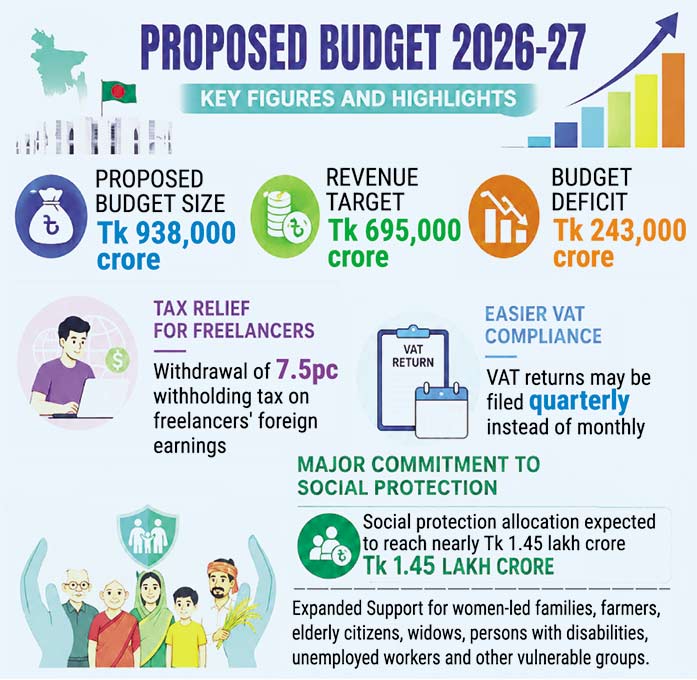
According to the budget document, the proposed allocation represents 13.7 per cent of GDP and marks a substantial increase from the revised Tk 788,000 crore budget of the outgoing fiscal year. To finance the spending plan, the government has set a revenue collection target of Tk 695,000 crore, equivalent to 10.2 per cent of GDP.
The budget deficit is projected at Tk 243,000 crore. To meet the financing requirement, the government plans to rely on both domestic and external sources. Net external financing is estimated at Tk 116,000 crore, including Tk 5,000 crore in grants. Domestic borrowing is projected at Tk 127,000 crore, of which Tk 112,000 crore is expected to come from the banking sector and Tk 15,000 crore from non-bank sources, including savings instruments.
While the overall fiscal framework focuses on financing growth and development, several specific proposals stand out because of their direct impact on citizens and businesses.
One of the most important areas addressed in the budget is the business environment. For years, business leaders have complained that complex tax and VAT procedures increase compliance costs and create unnecessary administrative burdens. The proposed budget attempts to respond to these concerns through a series of reforms.
Under the proposed changes, businesses will continue to pay VAT every month, but VAT returns may be submitted once every three months instead of monthly. If implemented, companies would need to file returns only four times a year rather than 12 times.
The budget also proposes fully automated online VAT registration and the removal of document submission requirements for firms using Enterprise Resource Planning (ERP) software. Customs clearance procedures are also expected to become more streamlined.
The government has further addressed long-standing concerns regarding delays in product testing and port-related processes.
The proposal recommends expanding testing facilities beyond the Bangladesh Standards and Testing Institution (BSTI) and the Bangladesh Atomic Energy Commission by allowing other institutions accredited by ISO and the Bangladesh Accreditation Board to conduct testing.
Another measure expected to benefit businesses is the simplification of access to the Authorised Economic Operator (AEO) facility. This would allow trusted importers and exporters to clear goods more quickly, reducing delays and costs. Business leaders believe such reforms could improve competitiveness, encourage investment and support industrial expansion.
The budget also contains a significant proposal for Bangladesh's growing digital economy. One of the most widely discussed measures is the withdrawal of the 7.5 per cent withholding tax on foreign earnings received by freelancers and content creators.
At present, income earned from overseas platforms is subject to tax deduction at source. If the proposal is approved, earnings from platforms such as YouTube, Facebook, TikTok and various freelancing marketplaces would no longer be subject to withholding tax.
With nearly 500,000 freelancers currently working in Bangladesh, industry stakeholders believe the measure could provide a major boost to young entrepreneurs and digital professionals. It is also expected to strengthen the country's position in the global digital services market and encourage greater participation in online work.
Perhaps the most significant feature of the proposed budget is the expansion of social protection programmes. The largest new initiative in this area is the Family Card programme.
Under the programme, 4.1 million women-led families will receive monthly assistance of Tk 2,500 during the coming fiscal year. The government plans to expand the programme gradually and bring 16.1 million families under coverage within the next five years.
The initiative is expected to provide direct financial support to vulnerable households and help them manage rising living costs. Analysts believe it could become one of the largest family-based cash assistance programmes in the country's history.
Agriculture has also received attention through the introduction of a new Farmer Card programme. Under the initiative, around 4.25 million farmers will receive Tk 2,500 annually.
With agricultural producers facing increasing costs for inputs and production, the support is expected to provide some relief while helping sustain agricultural activity. The programme is also intended to strengthen food security by supporting those directly involved in food production.
In addition to these new programmes, the budget proposes increased allowances for several vulnerable groups.
The old-age allowance is expected to increase from Tk 650 to Tk 700 per month, while the number of beneficiaries will rise to 6.2 million. Allowances for widowed and distressed women are also proposed to increase to Tk 700 per month.
For persons with disabilities, the monthly allowance is set to rise from Tk 900 to Tk 1,000. Educational stipends for beneficiaries will also be increased.
A new social protection initiative is being introduced for unemployed workers. Under the proposed programme, 15,000 workers will receive Tk 5,000 per month for up to three months. Amid uncertainty in employment markets and export-oriented industries, the initiative is expected to provide temporary financial support for affected workers.
The budget further includes a new honourarium programme for individuals serving in religious institutions. Around 250,000 people, including imams, muezzins, priests, caretakers, monastery heads and khadems, are expected to benefit from the initiative.
Another notable proposal relates to families of those killed and individuals injured during the July uprising. The budget includes monthly honourarium payments for affected families and individuals. Families of martyrs and severely injured persons are expected to receive allowances of up to Tk 20,000 per month.
Urban commuters could also benefit from the proposed budget. The existing VAT exemption on metro rail fares may continue for another year. With approximately 350,000 passengers using the service daily, continuation of the exemption could help prevent fare increases and reduce transportation costs.
The government has also proposed reforms to the minimum tax system and signalled its intention to make the overall tax structure more predictable. According to National Board of Revenue sources, a long-term tax policy framework is under consideration to provide greater certainty for both individual and corporate taxpayers.
An overall assessment of the budget suggests that the most substantial direct financial benefits are likely to go to low-income citizens through expanded social safety programmes. Allocations for social protection are expected to rise to nearly Tk 1.45 lakh crore, making it one of the largest areas of government spending. At the same time, businesses stand to gain from reduced compliance burdens and simplified procedures, freelancers from tax relief on foreign earnings, farmers from direct support under the Farmer Card programme and urban commuters from the continuation of metro rail VAT exemptions. Taken together, the proposed FY2026-27 budget appears to focus less on imposing new taxes and more on improving the ease of doing business, supporting the digital economy and expanding social protection. As a result, businesses, farmers, freelancers, workers, senior citizens, widows, persons with disabilities and ordinary citizens all appear set to benefit in different ways from the government's latest fiscal plan.

Loading...
Loading...
Also read



Editor : Iqbal Sobhan Chowdhury
Published by the Editor on behalf of the Observer Ltd. from Globe Printers, 24/A, New Eskaton Road, Ramna, Dhaka.
Editorial, News and Commercial Offices : Aziz Bhaban (2nd floor), 93, Motijheel C/A, Dhaka-1000.
Phone: PABX- 41053001-06; Advertisement: 41053012; 01793317829, 01550707291, E-mail: [email protected], [email protected] Online: email: [email protected] 41053014; 01550707297 Advertisement: 01550707296
Published by the Editor on behalf of the Observer Ltd. from Globe Printers, 24/A, New Eskaton Road, Ramna, Dhaka.
Editorial, News and Commercial Offices : Aziz Bhaban (2nd floor), 93, Motijheel C/A, Dhaka-1000.
Phone: PABX- 41053001-06; Advertisement: 41053012; 01793317829, 01550707291, E-mail: [email protected], [email protected] Online: email: [email protected] 41053014; 01550707297 Advertisement: 01550707296


