



| HEADLINE |

|
Economy requires 2-yr of austerity for recovery: Khosru
Published : Saturday, 13 June, 2026 at 12:00 AM
Business Correspondent


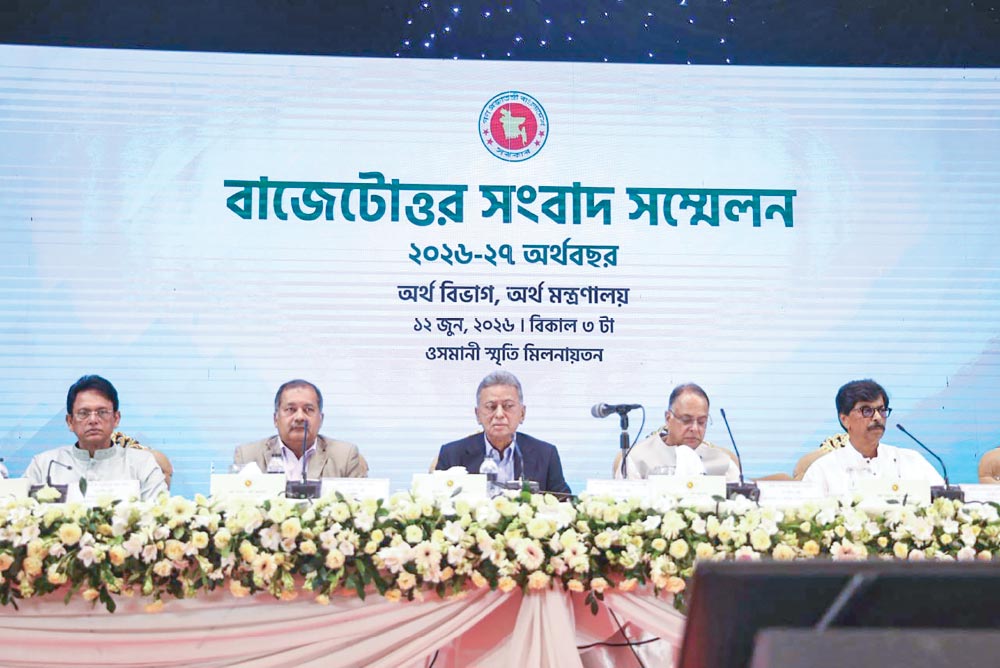 Finance and Planning Minister Amir Khosru Mahmud Chowdhury on Friday said Bangladesh must undergo at least two years of austerity measures to stabilise its economy, while a full economic recovery and sustainable transformation would take four to five years.
Speaking at the post-budget press conference for the FY2026�"27 national budget at the Osmani Memorial Auditorium in Dhaka, the minister expressed confidence that Bangladesh could achieve a new phase of development through sound policies, increased investment, a skilled workforce and effective implementation of reforms.
The government has proposed a Tk 938,000 crore budget for FY2026-27 under the theme "Journey Towards a Democratic, Humane and Inclusive Economy". The budget size is equivalent to 13.7 percent of GDP and is Tk 148,000 crore higher than the current fiscal year.
 The Finance Secretary moderated the press conference organised by the Ministry of Finance. Senior political leaders, advisers and top officials from key ministries and institutions attended, including ministers from power, education, health, agriculture, ICT, and senior representatives from the central bank, NBR and the Prime Minister's Office.
The Finance Minister said the budget was prepared within a limited timeframe of one and a half to two months, compared to the usual six-month preparation period, but still aimed to reflect public expectations and national priorities.
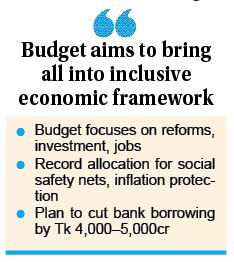
He said the central objective of the budget is to bring all sections of society into the mainstream economy, arguing that in the past, economic opportunities had disproportionately benefited a limited group. The current government, he added, aims to create broader opportunities for citizens who had long remained outside the economic system.
To protect low-income groups from inflation, the government has allocated the highest-ever funding for social safety net programmes. Significant investments have also been made in agriculture, universal healthcare, primary healthcare, education, reskilling and youth employment generation.
On inflation control, the minister said price stability cannot be achieved through enforcement drives alone. Instead, structural reforms in supply chains, reduced business costs and institutional strengthening are required. He also cited global conflicts, banking sector weaknesses and capital flight as contributing factors to inflationary pressure.
The Finance Minister announced that government borrowing from domestic banks has been reduced by Tk 4,000-5,000 crore in the proposed budget compared to the previous fiscal year. He said continued reduction in bank borrowing would increase credit availability for the private sector, boosting investment, production and employment.
He also stressed the need to transform Bangladesh from a debt-driven economy into an investment-driven economy.
On business environment reforms, he said it currently takes six months to a year to establish a company or obtain regulatory approvals, significantly raising costs. To address this, the government plans deregulation and regulatory reforms, including the formation of a high-powered task force and a dedicated website to receive complaints related to harassment in public service delivery.
A major initiative in the budget is the proposed establishment of an integrated creative economy centre on nearly 160 acres of land in Purbachal, with an estimated investment of Tk 800 crore. The facility will include theatres, fine arts spaces, designer outlets, exhibition venues and entertainment infrastructure.
The minister said Bangladesh's cultural assets-including music, folk traditions and the heritage of Lalon-remain underutilised economically. He said the country has the potential to replicate global creative economy models similar to those seen in countries that have successfully exported cultural industries.
He further noted that government borrowing from local banks has been reduced by around Tk 4,000-5,000 crore, adding that this would help redirect banking sector liquidity towards private investment, supporting growth and job creation if the trend continues.
On land valuation reforms, the minister said the government is working to align mouza rates with real market prices. He said this would reduce the scope for whitening undisclosed income through property transactions and curb underreporting of asset values.
On public sector salaries, he noted that no new pay scale has been introduced for 11 years despite rising inflation and living costs, adding that better compensation could help reduce corruption incentives.
Expressing confidence in the reform agenda, he said that if even 80 percent of the proposed measures are implemented effectively, Bangladesh could achieve a higher economic trajectory, with stability expected after two years of austerity and full recovery within four to five years.
Other speakers at the event also outlined key policy directions. The Power and Energy Minister said Bangladesh has maintained stable fuel supply despite global disruptions and outlined plans to strengthen energy security through expanded gas exploration and a target of 5,000MW solar generation by 2030.
The ICT Adviser said the government aims to develop the electronics sector as the next major export earner after garments, with proposed tax relief and bonded warehouse facilities to boost manufacturing of electronics and software exports.
The Finance Secretary echoed the need to reduce government borrowing from banks, warning that excessive public-sector borrowing crowds out private credit and slows investment growth.
Loading...
Loading...
Also read



Editor : Iqbal Sobhan Chowdhury
Published by the Editor on behalf of the Observer Ltd. from Globe Printers, 24/A, New Eskaton Road, Ramna, Dhaka.
Editorial, News and Commercial Offices : Aziz Bhaban (2nd floor), 93, Motijheel C/A, Dhaka-1000.
Phone: PABX- 41053001-06; Advertisement: 41053012; 01793317829, 01550707291, E-mail: [email protected], [email protected] Online: email: [email protected] 41053014; 01550707297 Advertisement: 01550707296
Published by the Editor on behalf of the Observer Ltd. from Globe Printers, 24/A, New Eskaton Road, Ramna, Dhaka.
Editorial, News and Commercial Offices : Aziz Bhaban (2nd floor), 93, Motijheel C/A, Dhaka-1000.
Phone: PABX- 41053001-06; Advertisement: 41053012; 01793317829, 01550707291, E-mail: [email protected], [email protected] Online: email: [email protected] 41053014; 01550707297 Advertisement: 01550707296


