



| HEADLINE |

|

FICCI calls for digital tax ecosystem, broader revenue base to spur investment
Published : Friday, 19 June, 2026 at 12:00 AM
Business Desk


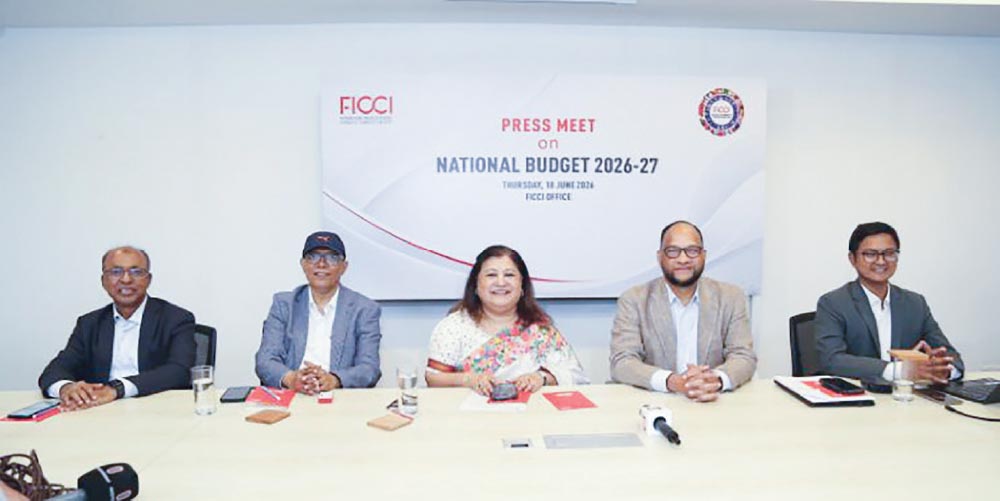 The Foreign Investors' Chamber of Commerce and Industry (FICCI) on Thursday urged the government to implement sweeping structural reforms, including automated tax administration and a broadened tax base to maintain a competitive investment climate ahead of Bangladesh's LDC graduation.
While acknowledging the proposed national budget for the fiscal year FY2026-27 as positive and relatively predictable, the apex chamber of multinational companies emphasised that sustainable revenue growth will require a shift away from over-relying on compliant taxpayers.
The observations were shared by FICCI President Rupali Haque Chowdhury at a post-budget press briefing held at the chamber’s office in Dhaka on Thursday, according to UNB report.
To address fiscal deficits without adding extra burdens on existing compliant businesses, FICCI emphasized that expanding the tax net must remain a top policy priority.
The chamber recommended making the Proof of Submission of Return (PSR) mandatory for all license renewals, permit issuances, and VAT return submissions.
It also called for a 360-degree cross-checking mechanism between suppliers' tax returns and withholding tax records to curb evasion.
Presenting the detailed technical observations, FICCI Tax Consultant Snehasish Barua urged the National Board of Revenue (NBR) to adopt a comprehensive automation roadmap that fully integrates Customs, VAT, and Income Tax systems.
As an immediate "quick-win" strategy to improve the tax-to-GDP ratio, the chamber proposed establishing a dedicated Data and Analytics Team within the NBR to analyze market share against revenue share across industries.
FICCI voiced concerns that recurrent hikes in indirect taxes and supplementary duties have pushed the Effective Tax Rate (ETR) in several domestic sectors much higher than in competing economies.
To retain and attract foreign direct investment (FDI), the chamber demanded a clear roadmap to optimize the ETR. Key recommendations included: lowering corporate income tax rates by reintroducing cashless transaction conditions for unlisted companies, transitioning the country to a fully cashless economy within the next five years, gradually reducing the minimum tax on sales and withdrawing inadmissible expense provisions, reviewing the Personal Income Tax (PIT) structure to cushion taxpayers against inflation and easing Trade and Customs Bottlenecks.
In preparation for LDC graduation, the chamber underscored the need for urgent customs reforms to boost trade competitiveness.

Loading...
Loading...
Also read



Editor : Iqbal Sobhan Chowdhury
Published by the Editor on behalf of the Observer Ltd. from Globe Printers, 24/A, New Eskaton Road, Ramna, Dhaka.
Editorial, News and Commercial Offices : Aziz Bhaban (2nd floor), 93, Motijheel C/A, Dhaka-1000.
Phone: PABX- 41053001-06; Advertisement: 41053012; 01793317829, 01550707291, E-mail: [email protected], [email protected] Online: email: [email protected] 41053014; 01550707297 Advertisement: 01550707296
Published by the Editor on behalf of the Observer Ltd. from Globe Printers, 24/A, New Eskaton Road, Ramna, Dhaka.
Editorial, News and Commercial Offices : Aziz Bhaban (2nd floor), 93, Motijheel C/A, Dhaka-1000.
Phone: PABX- 41053001-06; Advertisement: 41053012; 01793317829, 01550707291, E-mail: [email protected], [email protected] Online: email: [email protected] 41053014; 01550707297 Advertisement: 01550707296


