



| HEADLINE |

|

Entrepreneurs, investors welcome PM's move to reopen closed factories
Published : Monday, 22 June, 2026 at 12:00 AM
Mizanur Rahman


 Business leaders, prominent entrepreneurs and investors have welcomed the Prime Minister's initiative to reopen the closed factories saying that such move will reshape the country's industrial landscape. They also feel that such policy will provide "highly promising opportunities" for both local and potential foreign investors.
Prime Minister Tarique Rahman on Saturday held a high-level meeting with some local and foreign investors assuring them of full government support to reopen non-operational and loss-making closed state-owned mills and factories. Organised by Ministry of Industries, Ministry of Textiles and Jute and Bangladesh Investment Development Authority (BIDA) the Prime Minister urged the investors and entrepreneurs to come forward to take the opportunity to revive the industrial production by running the closed factories. He reiterated that the government would remove the obstacles for creating a business-friendly environment.
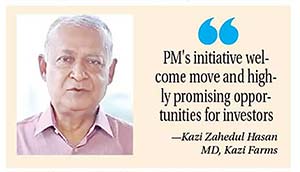
Talking to the Daily Observer on Sunday, Kazi Zahedul Hasan, Managing Director of Kazi Farms and a leading entrepreneur who was present at the meeting, said that the Prime Minister's initiative to reopen the closed state-owned mills and factories is a "welcome move that can reshape the country's industrial landscape." He described PM's initiative as a "highly promising opportunities" for both local and foreign investors.
Kazi Zahedul Hasan noted that the plan covers factories under five major sector corporations and aims to bring them back into production through private investment participation. According to him, these facilities are particularly attractive because they already possess factory buildings, sheds, and other basic infrastructure-eliminating one of the biggest challenges faced by new investors, which is securing suitable land and developing industrial facilities from scratch.
He explained that acquiring appropriate industrial land in Bangladesh often takes between two to five years, significantly delaying new projects. In contrast, the proposed model of utilising existing government-owned factory premises could enable investors to begin production much faster, substantially reducing both time and capital expenditure.
On utilities such as gas and electricity, he said the matter was discussed in general terms during the meeting. Authorities indicated that utility support would be provided based on availability in each location. However, he acknowledged that gas infrastructure is not uniformly available across all sites.
Regarding foreign investment prospects, he said it is still too early to assess the level of international interest. Nevertheless, he observed that domestic investors have already shown considerable enthusiasm for the initiative, as access to ready-made industrial setups significantly simplifies investment decisions.
Kazi Zahedul Hasan also said that discussions included both leasing and outright sale options for the factories. However, no final decision has yet been made regarding the model to be adopted in each case. Some facilities may be offered on a lease basis, while others could potentially be sold directly to investors.
He added that several priority sectors have been identified in preliminary discussions, including food processing and electronics, while agro-based industries have also been highlighted as a key area of focus. However, he clarified that the final list of priority sectors has not yet been officially confirmed. It remains unclear whether industries such as textiles, garments (RMG), or leather will be included among the priority categories.
On the timeline of implementation, he said no specific schedule has been announced so far. In some cases, international tenders have already been issued, while in others, such tenders are expected to be floated soon. However, the overall process remains at an early stage, and a detailed roadmap is yet to be finalised.
He further stated that various government agencies have already completed preliminary assessments, including identifying which factories will be offered for investment and which will remain excluded. Relevant sector corporations under the Ministry of Industries have prepared lists and initial restructuring proposals.
According to him, preparatory work has already been completed for several factories, and investment frameworks for some units are in advanced stages of formulation. In particular, proposals concerning jute mills and textile mills under respective corporations have been presented as part of the broader restructuring plan.
He cited examples of long-closed textile and sugar mills across the country that have already been included in preliminary lists and are being considered for revival under the new framework. Some sugar mills, he confirmed, have already been officially listed for potential redevelopment.
Addressing concerns over operational flexibility, he said investors will not be restricted to continuing the original production lines of these factories. Instead, they will have the flexibility to introduce alternative industrial activities based on market demand and feasibility.
He also mentioned that several dormant industrial units, including a textile mill in Dinajpur and a sugar mill in Setabganj, are among the facilities under consideration, reflecting growing interest at the local level.
Concluding his remarks, Kazi Zahedul Hasan expressed optimism that if implemented effectively, the initiative could significantly accelerate industrialisation in the country by utilising existing infrastructure and reducing investment barriers. He described the plan as a potentially transformative step that could create faster, more efficient opportunities for industrial growth.
Sources said that the government has taken an initiative to attract domestic and foreign investment by utilizing the land and infrastructure facilities of closed, sick or unprofitable state-owned industrial enterprises. As part of this initiative, the Prime Minister held three meetings with prominent industrialists and businessmen of the country.
Loading...
Loading...
Also read



Editor : Iqbal Sobhan Chowdhury
Published by the Editor on behalf of the Observer Ltd. from Globe Printers, 24/A, New Eskaton Road, Ramna, Dhaka.
Editorial, News and Commercial Offices : Aziz Bhaban (2nd floor), 93, Motijheel C/A, Dhaka-1000.
Phone: PABX- 41053001-06; Advertisement: 41053012; 01793317829, 01550707291, E-mail: [email protected], [email protected] Online: email: [email protected] 41053014; 01550707297 Advertisement: 01550707296
Published by the Editor on behalf of the Observer Ltd. from Globe Printers, 24/A, New Eskaton Road, Ramna, Dhaka.
Editorial, News and Commercial Offices : Aziz Bhaban (2nd floor), 93, Motijheel C/A, Dhaka-1000.
Phone: PABX- 41053001-06; Advertisement: 41053012; 01793317829, 01550707291, E-mail: [email protected], [email protected] Online: email: [email protected] 41053014; 01550707297 Advertisement: 01550707296


