



| HEADLINE |

|
Unspoken struggle of our coastal women farmers
Published : Wednesday, 1 July, 2026 at 12:00 AM
Abdul Gani


 Every day begins with a struggle for Mosammat Bilkis Khatun. In Dumuria village under Gabura union of Shyamnagar upazila in Satkhira, the 34-year-old spends her days caring for two sons and a daughter while trying to keep her household afloat. Her husband, Majed Mistri, works far from home for months at a time after salinity destroyed their ability to farm. Sometimes he manages to send money home. Often, he cannot.
The land around their home no longer produces crops because of the severe shortage of fresh water and increasing soil salinity. Like many families across Bangladesh's southwestern coast, they have been forced to adapt to a changing landscape shaped by climate change.
In front of her house, Bilkis dug a small pond to collect rainwater. It provides enough water to grow vegetables that mostly feed her family. She also keeps a few chickens to supplement the household income.
"If I did somewhere else the work I do all day at home, I'd earn a lot more," she says. "But I can't leave my children to go work outside. "Bilkis's story reflects the daily reality of hundreds of women farmers across Bangladesh's coastal belt and the haor regions. In many villages, fresh water has become so scarce that women routinely walk up to four kilometres to collect a single kolshi�"around 15 to 18 litres�"of water. This exhausting journey is repeated day after day, yet the labour that keeps households functioning remains largely invisible.
Climate change has also accelerated male migration from rural areas. As more men leave in search of work, women increasingly shoulder the responsibility for farming while continuing to manage households and care for children.
According to economist Dr Mustafa K Mujeri, former Director General of BIDS, this shift presents both challenges and opportunities. "Rising male migration due to climate change is shifting the core farming duties onto women, which creates both risks and opportunities for food security," he says. The risks, he explains, are substantial. Women generally own little or no land, have limited access to agricultural credit, technology and extension services, while continuing to bear the overwhelming burden of unpaid household work. These constraints suppress productivity. Yet with appropriate policy support, he argues, women's expanding role in agriculture could strengthen the country's food security.
The structural barriers become painfully clear in the experience of Najma Khatun, 40, from Gabura union in Satkhira. Widowed and still living on her late husband's homestead, she effectively farms without owning land in her own name.
"I thought I'd take an agricultural loan from the bank and raise poultry," she says. "But I didn't get the loan. They told me you need to own land to qualify for an agricultural loan." Her circumstances improved only after she obtained financial support from Local Environment Development and Agriculture Research Society (LEDARS), a service organisation working in the Satkhira region.
"This loan has helped me a lot," Najma says. "I've managed to get back on my feet a bit. I put this money into farming, and now I'm earning enough to get by." Her experience illustrates how access to even modest financial support can transform livelihoods for women farmers who remain excluded from mainstream agricultural finance.
Women's contribution to Bangladesh's agricultural economy extends far beyond cultivation. According to the Bangladesh Bureau of Statistics and UN Women (2023), unpaid household and care work contributes an estimated 21 to 30 per cent of the country's GDP. The 2022 Time Use Survey shows that women spend five to seven times more hours on household work than men, with a significant share devoted to collecting water and fuel.
Yet this work remains absent from formal economic accounting. Dr Mujeri argues that although unpaid care work and agricultural labour generate substantial economic value, they are excluded because GDP measures only market transactions. Limited time-use data and deep-rooted social attitudes further reinforce the perception that such labour is merely a family responsibility rather than productive economic activity.
Shaheen Anam, Executive Director of Manusher Jonno Foundation (MJF), believes the lack of recognition reflects a broader structural problem. Women's work, she says, continues to be ignored because household labour is never sold in the marketplace. Society tends to recognise only activities with a visible market price as productive. Achieving institutional recognition of women's contribution, she argues, will require structural reforms and significant public investment that only government policy can provide.
The absence of land ownership has consequences far beyond recognition. Without legal ownership, many women remain ineligible for agricultural loans, farmer identity cards and government incentives. Dr Mujeri believes the problem lies within the policy framework itself, which continues to define farmers primarily through land ownership. He argues that meaningful reform requires expanding the definition of who qualifies as a farmer, creating a separate registry for women farmers, introducing gender-sensitive quotas, expanding collateral-free microcredit and recognising joint land ownership.
Alongside economic hardship, women also face severe health consequences from prolonged exposure to saline water. Dr Nahid Nazrul, Director of Khulna Friendship Hospital, says urinary tract infections, vaginal infections and pelvic inflammatory diseases are increasing among women in coastal communities. For pregnant women, prolonged exposure to saline water can worsen high blood pressure and pre-eclampsia, increasing the risks of premature birth, low birth weight and maternal or infant death. She also notes a sharp rise in skin diseases across the Khulna-Satkhira coastal belt, including dry skin, itching, eczema, fungal infections, scabies and heat rashes.
The health crisis is inseparable from the broader water crisis. According to Mohan Kumar Mondal, Executive Director of LEDARS, access to safe water has become the region's greatest challenge. Many households manage to secure drinking water but still lack sufficient water for cooking, bathing and other daily needs. Meanwhile, drought and salinity have severely disrupted agriculture.
Without restoring agricultural land and investing in sustainable water storage, he warns, food production will continue to decline, livelihoods will deteriorate further, and migration from the coast will intensify.
To address these interconnected challenges, LEDARS works to strengthen climate resilience among vulnerable communities. Its programmes support local service providers and government institutions to improve access to essential services, particularly for women and adolescent girls. They also focus on empowering women to challenge inequality, social injustice and violence, while promoting alternative livelihoods that reduce poverty and strengthen economic resilience. The organisation actively works to prevent domestic violence and child marriage in climate-vulnerable communities.
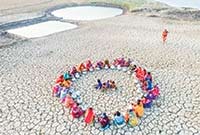
Government efforts are also underway, although gaps remain. Waliul Islam, Upazila Agriculture Officer for Shyamnagar under the Satkhira District Agriculture Extension Department, identifies salinity as the region's greatest agricultural challenge. "We're promoting salt-tolerant crop varieties," he says, "but training and credit specifically for women farmers are still very limited." One initiative seeking to bridge these gaps is the Community-based Climate Resilience and Women's Empowerment (CREA) project. Funded by the Swedish government through Manusher Jonno Foundation and implemented by LEDARS, the programme focuses on strengthening women's economic and social independence, promoting leadership, preventing gender-based violence and child marriage, protecting the rights of marginalised communities, improving climate resilience, and expanding access to government services while encouraging good governance and human rights at the grassroots level.
Dr Mujeri believes programmes such as CREA demonstrate how local capacity can be strengthened when women receive sustained institutional support. However, lasting impact, he argues, depends on stronger coordination between government agencies and non-governmental organisations so that successful local initiatives become part of national policy.
The lessons emerging from Bangladesh's coastal communities point towards a clear policy agenda.
The writer is a photojournalist
Loading...
Loading...
Also read



Editor : Iqbal Sobhan Chowdhury
Published by the Editor on behalf of the Observer Ltd. from Globe Printers, 24/A, New Eskaton Road, Ramna, Dhaka.
Editorial, News and Commercial Offices : Aziz Bhaban (2nd floor), 93, Motijheel C/A, Dhaka-1000.
Phone: PABX- 41053001-06; Advertisement: 41053012; 01793317829, 01550707291, E-mail: [email protected], [email protected] Online: email: [email protected] 41053014; 01550707297 Advertisement: 01550707296
Published by the Editor on behalf of the Observer Ltd. from Globe Printers, 24/A, New Eskaton Road, Ramna, Dhaka.
Editorial, News and Commercial Offices : Aziz Bhaban (2nd floor), 93, Motijheel C/A, Dhaka-1000.
Phone: PABX- 41053001-06; Advertisement: 41053012; 01793317829, 01550707291, E-mail: [email protected], [email protected] Online: email: [email protected] 41053014; 01550707297 Advertisement: 01550707296


