A football fan may walk away from family ties, leave behind friends, change jobs, or even relocate across countries. But one thing he rarely abandons is the football team he loves. Support, for many it's not a decision ,it's identity, belief, and a lifelong emotional bond that does not change with circumstance.
That sentiment runs through the global Brazilian football community as memories of successive World Cup heartbreaks continue to accumulate, now overshadowed by the emotional weight of Neymar Jr.’s uncertain presence in Brazil’s future.
Brazil’s modern World Cup history has been defined by repeated near-misses and painful exits. From the 2014 humiliation in Belo Horizonte, to the penalty heartbreak against Croatia in 2022, and earlier disappointments in 2018, each tournament has ended in renewed hope followed by deeper disappointment.
Yet, supporters have continued to return. Because for them, supporting Brazil has never been only about winning, it is about enduring belief.
For one supporter’s perspective, the journey has been equally emotional. The 2014 defeat did not bring tears, as the shock reportedly left many emotionally numb. The 2018 campaign ended against a defensive wall of brilliance, while the 2022 elimination became too difficult to revisit even in highlights. Recent defeats have been accepted, but not fully absorbed.
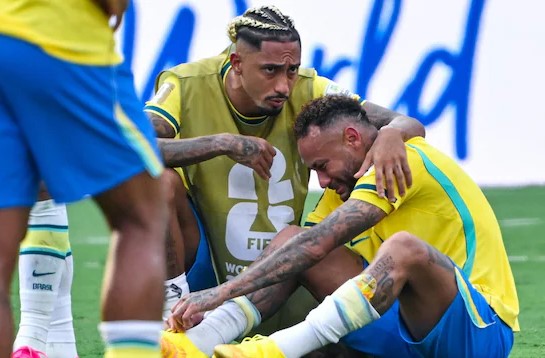
What remains most difficult to process is the image of Neymar Jr.,Brazil’s long-time talisman,visibly emotional after setbacks.
For more than a decade, Neymar has carried Brazil’s attacking expectations through periods of transition and inconsistency. While operating in the shadow of global club football pressures, he consistently prioritized the national team. His career has been repeatedly disrupted by injuries, surgeries, and intense scrutiny, yet his commitment to Brazil’s jersey has remained constant.
Historically, Brazilian legends have rarely carried such responsibility alone. Pelé had Garrincha, Zico had Sócrates, Ronaldo had Rivaldo, and Romário shared brilliance with Bebeto. Neymar, however, has largely shouldered Brazil’s modern expectations without a consistently reliable supporting cast of equal stature.
As a result, his story has become less about statistics and more about persistence through physical pain and collective underperformance 'an unfinished narrative in international football'.
Brazil, however, is expected to return once again. History suggests so. The nation rebuilt after long gaps between World Cup triumphs in 1970, 1994, and 2002, each time re-emerging as champions of the world.
But when that moment of return eventually arrives, Neymar may no longer be part of it.
And that possibility creates a deeper emotional void for many supporters: the idea that Brazil could lift the World Cup again, but without the player who defined an entire era of hope, pressure, and expectation.
For fans, loyalty to a team does not change. Brazil will still be followed, still be believed in, still be emotionally invested in. But the absence of Neymar from that future victory if it comes may leave an enduring sense of incompleteness.
That, for many, may become the defining football sorrow of a generation.