



| HEADLINE |

|
June inflation eases to 9.16pc
Published : Tuesday, 7 July, 2026 at 12:00 AM
Special Correspondent


 Bangladesh's point-to-point inflation eased slightly to 9.16 percent in June 2026, down from 9.42pc in May, according to the latest data released by the Bangladesh Bureau of Statistics (BBS) on Monday.
 Despite the marginal decline, overall inflation remained above the 9pc threshold for the third consecutive month, underscoring the continued cost-of-living pressure on households.
The June inflation rate was, however, higher than the 8.48pc recorded in June 2025, indicating that prices remain significantly elevated compared with a year ago.
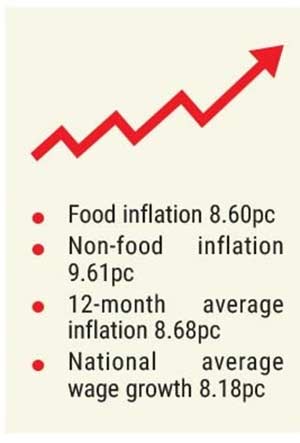
The BBS data also showed that the 12-month moving average inflation for the period from July 2025 to June 2026 declined to 8.68pc, compared with 10.03pc during the corresponding period a year earlier, reflecting an overall moderation in inflationary pressures over the fiscal year despite recent spikes.
Both food and non-food inflation registered month-on-month declines in June.
Food inflation fell to 8.60pc in June from 9.06pc in May, while non-food inflation eased to 9.61pc from 9.71pc during the same period.
However, both categories remained higher than their levels a year earlier. Food inflation increased from 7.39pc in June 2025 to 8.60pc this June, while non-food inflation rose from 9.37pc to 9.61pc over the same period.
According to the BBS, inflation remained above 9pc in both urban and rural areas, indicating that rising prices continue to affect households across the country.
Economists and market observers attribute the sustained inflationary pressure largely to recent increases in energy prices.
The government raised fuel prices twice in April and May, followed by an increase in electricity tariffs during the final week of May. These adjustments have raised transportation, production and distribution costs, which have subsequently pushed up retail prices of essential commodities.
Higher fuel prices typically increase logistics costs, making it more expensive to transport goods across the country. As a result, consumers are paying more for vegetables, fish, meat and other daily necessities. Rice prices have also remained elevated.
Although inflation showed some moderation in June, wage growth has failed to keep pace with rising prices.
According to the BBS, the national average wage rate growth stood at 8.18pc in June, below the 9.16pc inflation rate. This means that real incomes have continued to decline, reducing the purchasing power of workers and placing greater financial strain on low- and middle-income families.
When wages grow more slowly than inflation, households often struggle to meet rising living costs. Many families are forced to reduce spending on food, clothing, transportation and other essential expenses, while some resort to borrowing to manage their daily needs.
While the latest BBS figures indicate a modest improvement from May, inflation remains persistently high. The easing in both food and non-food inflation offers some relief, but continued increases in energy costs and their ripple effects across the economy suggest that managing inflation will remain a key policy challenge in the months ahead.
Loading...
Loading...
Also read



Editor : Iqbal Sobhan Chowdhury
Published by the Editor on behalf of the Observer Ltd. from Globe Printers, 24/A, New Eskaton Road, Ramna, Dhaka.
Editorial, News and Commercial Offices : Aziz Bhaban (2nd floor), 93, Motijheel C/A, Dhaka-1000.
Phone: PABX- 41053001-06; Advertisement: 41053012; 01793317829, 01550707291, E-mail: [email protected], [email protected] Online: email: [email protected] 41053014; 01550707297 Advertisement: 01550707296
Published by the Editor on behalf of the Observer Ltd. from Globe Printers, 24/A, New Eskaton Road, Ramna, Dhaka.
Editorial, News and Commercial Offices : Aziz Bhaban (2nd floor), 93, Motijheel C/A, Dhaka-1000.
Phone: PABX- 41053001-06; Advertisement: 41053012; 01793317829, 01550707291, E-mail: [email protected], [email protected] Online: email: [email protected] 41053014; 01550707297 Advertisement: 01550707296


