



| HEADLINE |

|
H1 Financial Statements
Profitable banks turn to govt treasury investments
Published : Friday, 31 July, 2026 at 12:00 AM
Shamsul Huda


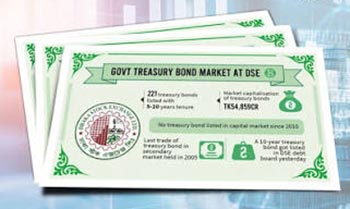 Bangladesh's stronger banks posted hefty profits in the first half of 2026 by earning more from investments in government treasury bills and bonds rather than expanding private sector lending, while weaker lenders plunged deeper into losses due to rising bad loans, weak recoveries and higher provisioning costs.
The widening divide between strong and weak banks is evident in the half-yearly financial statements released by 13 listed banks through 30 July.
According to disclosures submitted to the Dhaka Stock Exchange (DSE), a handful of private commercial banks delivered robust profit growth despite sluggish demand for private sector credit. In contrast, several lenders slipped deeper into losses as non-performing loans, declining interest income and higher provisioning eroded their earnings.
The latest results suggest that Bangladesh's banking sector is increasingly split between well-capitalised banks with healthier loan portfolios and troubled lenders burdened by deteriorating asset quality.
Among the listed banks, BRAC Bank led the sector with a net profit of Tk1,423 crore during January-June, up 57 percent from a year earlier. Eastern Bank, Southeast Bank, City Bank, Jamuna Bank, Prime Bank, Dutch-Bangla Bank and United Commercial Bank also remained profitable despite weak demand for private sector loans.
A common feature among these banks was their greater reliance on investments in government treasury bills and bonds instead of aggressively expanding lending in a weak economy. Government securities generated relatively attractive risk-free returns of around 8-10 percent, while healthier loan portfolios kept provisioning expenses under control.
BRAC Bank's earnings reflected this strategy. Higher net interest income, stronger treasury earnings and lower credit costs helped it record the highest profit among listed private banks.
Southeast Bank reported a profit of Tk219 crore, up 64 percent from a year earlier, largely because it required lower provisions against bad loans. Eastern Bank earned Tk439 crore as higher income from government securities boosted its bottom line.
United Commercial Bank illustrated the changing earnings mix. Its net interest income fell 65 per cent to Tk284 crore as loan growth slowed. However, investment income surged 71 per cent to Tk921 crore, enabling the bank to increase its net profit by 90 per cent to Tk34 crore.
The picture was sharply different for weaker lenders.
National Bank posted the sector's largest loss of Tk2,286 crore during the first six months of the year, more than double its loss a year earlier. Its net asset value (NAV) per share fell to negative Tk14.49, indicating that its liabilities exceeded its assets.
IFIC Bank remained under severe financial pressure, reporting a loss of Tk1,668 crore. Its NAV also turned negative at Tk3.69 per share, reflecting further deterioration in asset quality and mounting financial stress.
Islami Bank Bangladesh, once the country's most profitable private bank, reported a loss of Tk1,316 crore. The sharp reversal was driven by large defaulted investments, particularly those linked to the S. Alam Group, which reduced interest income and required significantly higher provisioning.
State-owned Rupali Bank also remained in the red, reporting a loss of Tk641 crore during the first half.
Premier Bank remained profitable, although its net asset value declined to Tk1,288 crore from Tk2,532 crore a year earlier, signalling weaker capital strength.
The results indicate that treasury income has become a key driver of bank profitability at a time when private sector credit demand remains subdued. Banks with cleaner loan portfolios have benefited from higher returns on government securities while keeping provisioning costs under control.
By contrast, lenders with large exposures to defaulted borrowers have suffered falling interest income, rising funding costs and heavier provisioning requirements, resulting in substantial losses.
The capital position of some banks has also become increasingly concerning. Negative net asset values at National Bank and IFIC Bank indicate that their liabilities now exceed their assets, underscoring the need for fresh capital support and stronger regulatory oversight.
According to banking sector insiders, many profitable banks adopted a defensive strategy during the first half by investing billions of taka in government treasury bills and bonds instead of extending riskier corporate loans amid weak credit demand.
The first-half results underscore that asset quality has become a more important determinant of profitability than loan growth. Banks with healthier balance sheets generated stable earnings from government securities while maintaining lower provisioning costs. Those weighed down by bad loans suffered heavy losses as interest income declined and provisioning requirements increased.
Together, the eight profitable banks earned around Tk3,100 crore during the first six months of the year, while the five loss-making lenders reported combined losses of roughly Tk6,300 crore, highlighting the growing divergence within Bangladesh's banking sector.
The contrast is also reflected in capital strength. National Bank's NAV fell to negative Tk14.49 per share, while IFIC Bank's stood at negative Tk3.69. By comparison, BRAC Bank's NAV rose to Tk49.38 per share, Eastern Bank's to Tk30.71 and Southeast Bank's to Tk27.16.
The second half of the year will show whether troubled lenders can stabilise their financial position or whether regulators will be compelled to step up intervention to restore confidence in the banking sector.
Loading...
Loading...
Also read



Editor : Iqbal Sobhan Chowdhury
Published by the Editor on behalf of the Observer Ltd. from Globe Printers, 24/A, New Eskaton Road, Ramna, Dhaka.
Editorial, News and Commercial Offices : Aziz Bhaban (2nd floor), 93, Motijheel C/A, Dhaka-1000.
Phone: PABX- 41053001-06; Advertisement: 41053012; 01793317829, 01550707291, E-mail: [email protected], [email protected] Online: email: [email protected] 41053014; 01550707297 Advertisement: 01550707296
Published by the Editor on behalf of the Observer Ltd. from Globe Printers, 24/A, New Eskaton Road, Ramna, Dhaka.
Editorial, News and Commercial Offices : Aziz Bhaban (2nd floor), 93, Motijheel C/A, Dhaka-1000.
Phone: PABX- 41053001-06; Advertisement: 41053012; 01793317829, 01550707291, E-mail: [email protected], [email protected] Online: email: [email protected] 41053014; 01550707297 Advertisement: 01550707296


