



| HEADLINE |

|
Bangladesh's Stolen Billions
Can the Nation Bring Back Its Lost Wealth?
Published : Saturday, 11 July, 2026 at 12:00 AM


 For years, the money disappeared quietly.
It left through inflated import bills, fraudulent bank loans, fake trade invoices, shell companies and informal hundi networks, while hospitals lacked medicines, schools struggled for funding, banks weakened and businesses cried out for investment.
Today, Bangladesh faces one of the largest financial crimes in its history. The question confronting the nation is no longer simply how much was stolen, but whether the country can recover even a fraction of its missing billions.
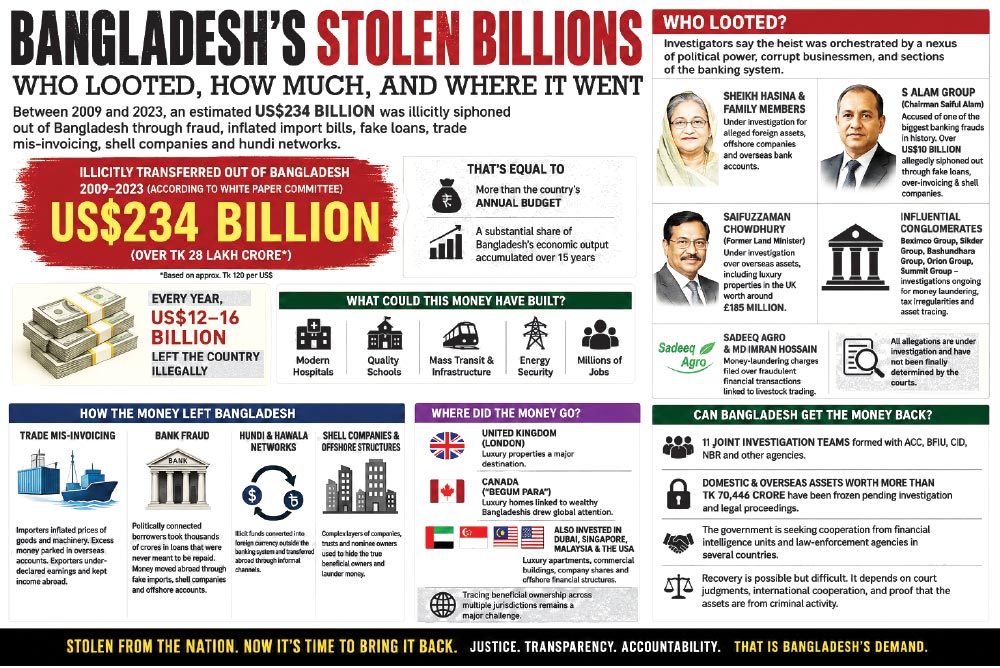
According to the government's White Paper Committee on the State of the Economy, around US$234 billion was illicitly transferred out of Bangladesh between 2009 and 2023. Transparency International Bangladesh (TIB) and other independent assessments estimate that between US$12 billion and US$16 billion left the country every year through various illegal channels.
To appreciate the magnitude, the alleged outflow is greater than Bangladesh's current annual national budget and represents a substantial share of the country's economic output accumulated over the period. It is money that could have transformed transport, healthcare, education, energy security and employment.
The Alleged Architects
Investigators believe the laundering was not the work of isolated individuals but of a sophisticated alliance involving political influence, sections of the banking system, dishonest business groups and international financial networks.
The Anti-Corruption Commission (ACC), Bangladesh Financial Intelligence Unit (BFIU), Criminal Investigation Department (CID) and National Board of Revenue (NBR) are investigating numerous high-profile cases.
Among those under investigation are former Prime Minister Sheikh Hasina and several members of her family over allegations involving undisclosed foreign assets, offshore companies and overseas bank accounts. The allegations remain subject to ongoing legal proceedings and have not been finally determined by the courts.
The S Alam Group, headed by businessman Saiful Alam, is accused of orchestrating one of Bangladesh's largest banking scandals. Bangladesh Bank Governor Ahsan H. Mansur has publicly described the alleged fraudulent lending and overseas transfer of funds as among the biggest banking frauds in modern history. Authorities allege that more than US$10 billion may have been siphoned abroad through fake loans, over-invoiced imports and complex corporate structures.
Former Land Minister Saifuzzaman Chowdhury has also come under investigation after authorities identified an extensive portfolio of overseas assets, including luxury properties in the United Kingdom reportedly valued at around £185 million.
Investigations have also involved several influential conglomerates, including Beximco Group, Sikder Group, Bashundhara Group, Orion Group and Summit Group. Various cases involving alleged money laundering, tax irregularities and asset tracing are at different stages of investigation or judicial process. The companies have denied wrongdoing in cases where public responses have been issued.
Authorities have also filed money-laundering charges against Sadeeq Agro and its Managing Director Mohammad Imran Hossain, alleging fraudulent financial transactions linked to livestock trading.
How the Money Left Bangladesh
Experts say the largest share of illicit financial outflows occurred through trade mis-invoicing, one of the world's most common methods of money laundering.
Importers allegedly inflated the prices of imported machinery, raw materials and industrial goods. The excess foreign currency remained in overseas accounts controlled by the perpetrators.
Exporters, meanwhile, under-declared export earnings, allowing part of their foreign income to remain abroad without entering Bangladesh's banking system.
Another major route was bank fraud.
Politically connected borrowers allegedly obtained thousands of crores of taka in unsecured loans from state-owned and private banks. Many of these loans were never intended to be repaid. Once disbursed, the money was allegedly transferred abroad through fictitious imports, shell companies and offshore accounts.
Investigators also point to widespread use of hundi and hawala networks, which enabled illicit funds to be converted into foreign currencies outside the formal banking system.
Where Did the Money Go?
The money appears to have followed the world's safest financial and property markets.
The United Kingdom, particularly London's luxury property market, has emerged as a major destination.
Canada's so-called "Begum Para" became a symbol of unexplained wealth, where numerous luxury homes allegedly linked to wealthy Bangladeshis attracted international attention.
Investigators have also identified substantial investments in Dubai, Singapore, Malaysia and the United States, involving luxury apartments, commercial buildings, company shares and offshore financial structures.
Tracing beneficial ownership across multiple jurisdictions remains one of the greatest challenges facing investigators.
Can Bangladesh Recover the Money?
Recovering stolen assets is far more difficult than tracing them.
Once illicit funds pass through offshore companies, trusts, nominee shareholders and multiple jurisdictions, they become extremely difficult to identify legally.
Nevertheless, Bangladesh has begun an unprecedented asset recovery campaign.
The interim government has established 11 Joint Investigation Teams comprising the ACC, BFIU, CID, NBR and other agencies.
Authorities say domestic and overseas assets worth more than Tk 70,446 crore have already been frozen pending investigation and legal proceedings.
The government is also seeking cooperation from financial intelligence units, anti-money laundering authorities and law-enforcement agencies in several countries.
International Cooperation Is Essential
Experience from countries including Nigeria, Malaysia, Kazakhstan and Switzerland shows that recovering stolen assets is possible but usually takes many years.
Asset recovery depends on court judgments, mutual legal assistance treaties, international cooperation and proof that the assets originated from criminal activity.
Experts caution that only a fraction of illicit wealth is normally recovered because sophisticated laundering networks disperse assets across numerous jurisdictions before investigators begin tracing them.
Bangladesh may therefore recover billions of dollars over time, but expecting the full US$234 billion to return would be unrealistic.
Reform Is the Real Safeguard
Economists argue that recovering stolen money, while important, addresses only the consequences rather than the causes.
Preventing another episode requires stronger banking supervision, independent regulators, digital monitoring of trade transactions, tougher enforcement of anti-money laundering laws, greater transparency in beneficial ownership and a judiciary capable of resolving complex financial crimes without political interference.
Without structural reform, new networks could simply replace the old ones.
A Defining Test for Bangladesh
The alleged laundering of US$234 billion represents far more than financial crime.
It is a measure of lost hospitals that were never built, schools that never opened, industries that never emerged and millions of jobs that were never created.
The recovery campaign has therefore become more than an anti-corruption drive. It is a test of Bangladesh's commitment to restoring the rule of law, rebuilding confidence in its financial system and convincing citizens and international investors that the era of impunity is ending.
Whether the country succeeds in bringing back a meaningful share of its stolen wealth may well determine the credibility of its institutions for decades to come.
Loading...
Loading...
Also read



Editor : Iqbal Sobhan Chowdhury
Published by the Editor on behalf of the Observer Ltd. from Globe Printers, 24/A, New Eskaton Road, Ramna, Dhaka.
Editorial, News and Commercial Offices : Aziz Bhaban (2nd floor), 93, Motijheel C/A, Dhaka-1000.
Phone: PABX- 41053001-06; Advertisement: 41053012; 01793317829, 01550707291, E-mail: [email protected], [email protected] Online: email: [email protected] 41053014; 01550707297 Advertisement: 01550707296
Published by the Editor on behalf of the Observer Ltd. from Globe Printers, 24/A, New Eskaton Road, Ramna, Dhaka.
Editorial, News and Commercial Offices : Aziz Bhaban (2nd floor), 93, Motijheel C/A, Dhaka-1000.
Phone: PABX- 41053001-06; Advertisement: 41053012; 01793317829, 01550707291, E-mail: [email protected], [email protected] Online: email: [email protected] 41053014; 01550707297 Advertisement: 01550707296


