



| HEADLINE |

|

IMF warns of persistent energy shock, rising global debt
Published : Saturday, 5 September, 2026 at 12:00 AM
F&E Report


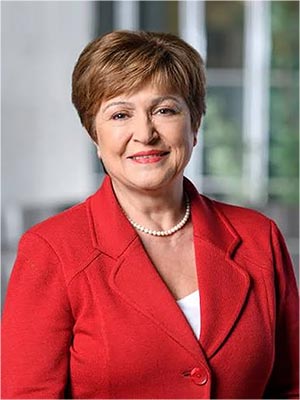 International Monetary Fund (IMF) Managing Director Kristalina Georgieva has warned that persistent energy shocks, rising public debt and stalled disinflation pose significant risks to global economic growth.
She said the global growth outlook for 2026 had firmed at around three per cent since April, noting that the global economy had absorbed the energy supply shock better than expected.According to her, the resilience was supported by the use of oil and gas reserves, new energy sources and demand management measures.
She said surging investment in artificial intelligence (AI), including power projects to meet rising energy demand, was also driving growth, particularly in the United States.
Georgieva, however, said significant divergence remained in economic fortunes, while risks to the global outlook remained high.
“First, the energy shock is not over. The Strait of Hormuz remains largely closed, strategic oil and gas reserves will need restocking, AI drives up energy demand, and in the northern hemisphere winter is coming,” she said.
She said global public debt had reached almost 100 per cent of Gross Domestic Product (GDP), exceeding post-World War II highs and expected to rise further.
“Looking back, the debt trajectory resembles a staircase: big vertical steps when shocks occur, little or no reduction afterward,” she said.
The IMF chief also said the disinflation process had stalled in many countries, while fiscal pressures were pushing core bond yields upward.
She said the interaction between fiscal and monetary policy was also raising concerns in financial markets.
On AI, Georgieva said its future impact on productivity and financial stability remained uncertain.
She urged central banks to focus on their price stability mandate and fiscal authorities to develop credible medium-term consolidation plans.
She also called for structural policies aimed at cutting red tape and removing barriers to growth.
“Stronger potential growth would help address the fiscal problem, and addressing the fiscal problem would help lift growth prospects,” she said.

IMF highlights debt risks in developing countries
Georgieva said the sovereign debt situation in emerging and low-income countries had gradually improved in recent years, supported by domestic policy efforts and international cooperation.
She, however, said progress had been uneven, while persistent global economic risks required policy discipline and stronger buffers.
She said rising interest rates were particularly concerning because increases in yields in advanced economies lifted yield curves across much of the world.
According to her, high refinancing needs and rising debt-service costs were constraining many developing economies, particularly low-income countries.
She said the situation was limiting their capacity to finance critical infrastructure, health and education spending.
“These challenges are compounded by a sharp decline in net external financing, including cuts in official development assistance, and a marked reduction in new inflows from non-Paris Club creditors,” she said.
Georgieva said helping countries create fiscal space for growth-enhancing spending was increasingly important.
She identified three dimensions for addressing debt challenges.
The first, she said, was decisive action in countries where debt was unsustainable, supported by further improvements in restructuring processes.
She said progress had been made under the G20 Common Framework, while the G20 Memorandum of Understanding template agreed this year was part of the effort.
She also cited the Global Sovereign Debt Roundtable’s updated “Restructuring Playbook” and efforts to facilitate implementation of comparability of treatment and inter-creditor group coordination.
Georgieva said solutions should also be developed for countries not eligible for the Common Framework.
The second priority, she said, was accelerating implementation of the IMF-World Bank Three-Pillar Approach for countries with sustainable debt.
She said the approach would support strong growth-enhancing reforms, domestic resource mobilisation and effective liability management operations.
According to her, the approach had worked well in countries such as Ecuador and Pakistan.
She said strong support from other partners, including bilateral creditors, remained essential.
The third priority, she said, was maintaining sound economic fundamentals to build resilience and prevent unsustainable debt accumulation.
She identified debt transparency, debt management capacity and debtor-investor relations as areas requiring strengthening.
IMF calls for action on global imbalances
Georgieva said the IMF’s latest External Sector Report showed that excess global imbalances widened further in 2025.
She said the increase was 0.7 per cent of GDP, describing it as the largest increase in the past decade.
According to her, the widening was broad-based, with major contributions from the two largest economies.
She said excess imbalances in major economies could signal uneven growth patterns and macro-financial vulnerabilities.
They could also result in cross-border spillovers, trade tensions and economic fragmentation, she said.
Georgieva said the widening of global imbalances in recent years had occurred alongside ongoing trade tensions and changes in trade relationships among countries.
She said sustained rebalancing required policy action in both surplus and deficit countries because macroeconomic factors were the main drivers of imbalances.
“In surplus economies, market-oriented structural reforms can boost domestic consumption, promote investment, and lift growth prospects,” she said.
“In deficit economies, appropriate fiscal consolidation can increase savings and help rebuild fiscal buffers,” she added.
Georgieva said simultaneous and mutually reinforcing policies across major economies would produce the best outcomes, including for global growth.
She said the IMF was working with member countries and other international organisations to improve cross-country data and external sector statistics.
The IMF was also refining its External Balance Assessment methodology used to assess excess imbalances.
She said the Fund had extended its analytical framework to better understand the links between trade and industrial policies and current account imbalances.
The Fund was also advancing complementary work on capital flow and stock imbalances, she said.
Georgieva said the IMF’s Comprehensive Surveillance Review would provide a more comprehensive and forward-looking assessment of external sector issues at country level and cross-country spillovers.
She said the IMF remained committed to engaging with member countries to address global imbalances.
“The G20 offers a unique platform to advance this dialogue, and we will continue to support our membership going forward,” she said.

Loading...
Loading...
Also read



Editor : Iqbal Sobhan Chowdhury
Published by the Editor on behalf of the Observer Ltd. from Globe Printers, 24/A, New Eskaton Road, Ramna, Dhaka.
Editorial, News and Commercial Offices : Aziz Bhaban (2nd floor), 93, Motijheel C/A, Dhaka-1000.
Phone: PABX- 41053001-06; Advertisement: 41053012; 01793317829, 01550707291, E-mail: [email protected], [email protected] Online: email: [email protected] 41053014; 01550707297 Advertisement: 01550707296
Published by the Editor on behalf of the Observer Ltd. from Globe Printers, 24/A, New Eskaton Road, Ramna, Dhaka.
Editorial, News and Commercial Offices : Aziz Bhaban (2nd floor), 93, Motijheel C/A, Dhaka-1000.
Phone: PABX- 41053001-06; Advertisement: 41053012; 01793317829, 01550707291, E-mail: [email protected], [email protected] Online: email: [email protected] 41053014; 01550707297 Advertisement: 01550707296


