



| HEADLINE |

|
Banks in Bangladesh Reel Under Tk 11.2tn Stress Asset Burden


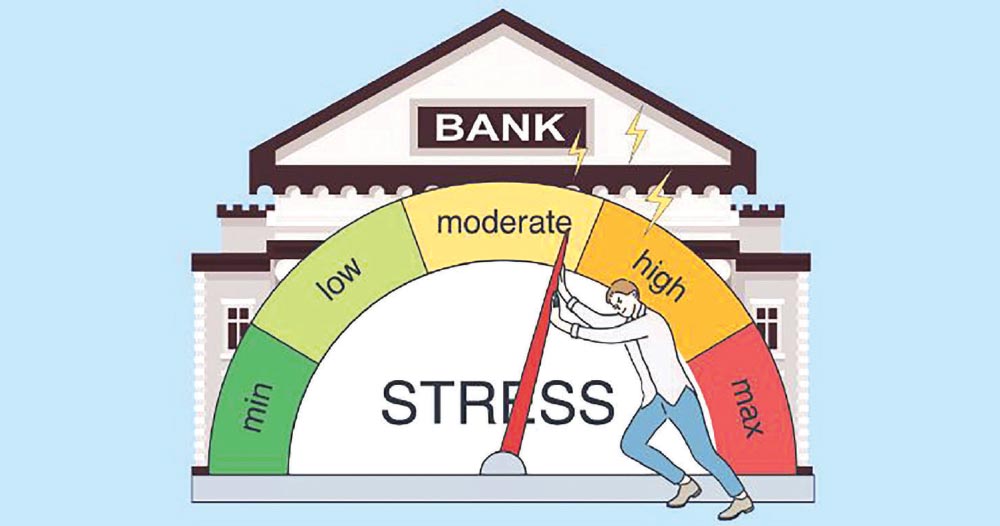 Bangladesh's banking sector is facing its deepest crisis in decades, with total stressed assets soaring to an unprecedented Tk 11.2 trillion, equivalent to 61 per cent of all outstanding loans, exposing the true scale of financial distress hidden within the country's banking system.
The staggering figure, uncovered through Bangladesh Bank's newly introduced Risk-Based Supervision (RBS) framework, goes far beyond conventional non-performing loans (NPLs). It includes classified defaulted loans, rescheduled accounts, written-off loans and credits tied up in court proceedings, offering the most comprehensive assessment yet of the sector's deteriorating financial health.
The central bank's latest risk assessment paints an alarming picture. As of mid-2026, 19 of the country's 61 scheduled banks have failed to maintain the minimum Capital to Risk-Weighted Assets Ratio (CRAR) under the Basel III framework, dragging the sector's average capital adequacy to minus 2.64 per cent. The negative capital position indicates that a significant number of banks no longer possess sufficient capital buffers to absorb potential losses.
The sector's liquidity position is equally fragile. Bangladesh Bank's latest stress tests show that 18 banks would be unable to withstand a sustained five-day run on deposits, exposing serious weaknesses in liquidity management and highlighting the vulnerability of depositor confidence.
Taken together, the findings suggest that Bangladesh's banking problems extend far beyond mounting default loans. They reveal a systemic erosion of capital strength, liquidity resilience and corporate governance, leaving the financial system increasingly exposed to economic shocks.
In response, Bangladesh Bank launched its long-awaited Risk-Based Supervision (RBS) framework in January, marking the most sweeping overhaul of banking supervision since financial sector liberalisation. The central bank has dismantled its traditional compliance-driven oversight and replaced it with 17 specialised supervisory units, including 12 dedicated Bank Supervision Departments, equipped with real-time data analytics, risk dashboards and macroprudential stress-testing tools.
The new supervisory model abandons the long-standing "one-size-fits-all" approach in favour of institution-specific oversight. Instead of merely checking regulatory compliance, supervisors now assess each bank's asset quality, governance standards, capital adequacy, liquidity profile and overall risk exposure, enabling earlier regulatory intervention before problems escalate into full-blown crises.
The reforms bring Bangladesh closer to global Basel standards, where risk-based supervision has become the cornerstone of modern banking regulation. Internationally, such frameworks have strengthened financial resilience, improved capital allocation and enabled regulators to detect vulnerabilities before they threaten systemic stability.
However, banking experts warn that stronger regulation alone cannot resolve the sector's deep-rooted weaknesses.
Credit risk remains the industry's biggest threat. Weak borrower screening, excessive lending to a handful of influential business groups, poor collateral valuation and years of politically driven lending have combined to produce an unprecedented stock of stressed assets.
Poor-quality financial data further complicates effective risk management. Incomplete credit information�"particularly for small and medium-sized enterprises (SMEs) and businesses operating in the informal economy�"continues to undermine accurate risk assessment and delays the early detection of deteriorating loans.
Meanwhile, the rapid expansion of digital banking is creating new vulnerabilities. Although artificial intelligence, fintech innovation and digital financial services are improving efficiency and expanding financial inclusion, they are also exposing banks to heightened cyber risks, operational failures, model risks and data privacy concerns.
Liquidity pressures continue to mount as many banks remain heavily dependent on short-term deposits while facing widening mismatches between assets and liabilities. In periods of market uncertainty, these weaknesses can quickly trigger funding stress.
Analysts argue that governance failures remain the root cause of the crisis. Weak boards, regulatory breaches, poor internal controls and unethical lending practices have steadily eroded public confidence and weakened the resilience of many financial institutions.
Bangladesh also faces structural challenges uncommon in many regional banking systems. Lending remains concentrated among a small number of large corporate borrowers, while shortages of skilled risk professionals, inadequate data infrastructure, political influence over lending decisions and rapidly evolving financial technologies continue to undermine effective risk management.
Experts caution that sophisticated risk models and advanced technology cannot replace sound governance or experienced professional judgement. Without reliable data, ethical leadership and robust institutional oversight, even the most advanced supervisory systems are unlikely to prevent future crises.
Rebuilding confidence in the banking sector will therefore require more than regulatory reform. Stronger credit appraisal, higher-quality data, advanced risk analytics, investment in skilled professionals, greater transparency, stronger corporate governance and consistent regulatory enforcement will all be essential.
Ultimately, the banks that emerge strongest will be those that combine technological innovation with prudent lending, disciplined risk management and ethical leadership. The success of Bangladesh Bank's new supervisory regime will depend not only on smarter technology but also on the determination of regulators, bank boards and management to address the structural weaknesses that have left the country's banking system burdened with Tk 11.2 trillion in stressed assets.
Loading...
Loading...
Also read



Editor : Iqbal Sobhan Chowdhury
Published by the Editor on behalf of the Observer Ltd. from Globe Printers, 24/A, New Eskaton Road, Ramna, Dhaka.
Editorial, News and Commercial Offices : Aziz Bhaban (2nd floor), 93, Motijheel C/A, Dhaka-1000.
Phone: PABX- 41053001-06; Advertisement: 41053012; 01793317829, 01550707291, E-mail: [email protected], [email protected] Online: email: [email protected] 41053014; 01550707297 Advertisement: 01550707296
Published by the Editor on behalf of the Observer Ltd. from Globe Printers, 24/A, New Eskaton Road, Ramna, Dhaka.
Editorial, News and Commercial Offices : Aziz Bhaban (2nd floor), 93, Motijheel C/A, Dhaka-1000.
Phone: PABX- 41053001-06; Advertisement: 41053012; 01793317829, 01550707291, E-mail: [email protected], [email protected] Online: email: [email protected] 41053014; 01550707297 Advertisement: 01550707296


