



| HEADLINE |

|
RMG exports to EU suffer significant setback


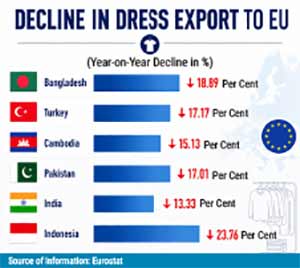 Bangladesh's ready-made garment (RMG) exports to the European Union (EU) suffered a significant setback during the first five months of 2026, recording the steepest decline among the bloc's major apparel suppliers.
According to the latest data from Eurostat, the EU's statistical office, the value of apparel imports from Bangladesh fell by 18.89 per cent year-on-year to €7.28 billion during January-May 2026, down from €8.97 billion in the corresponding period of 2025.
The decline was not limited to export earnings alone. Bangladesh's export volume dropped by 10.46 per cent, while the average unit price (euro per kilogram) declined by 9.41 per cent, indicating that the country exported both fewer garments and at lower prices. Among the major apparel-exporting nations, Bangladesh was the only supplier to experience such a pronounced simultaneous decline in both volume and unit prices.
The analysis was prepared by Bangladesh Apparel Voice (BAV) based on Eurostat data.
Overall, the EU's apparel imports from the world declined by 9.96 per cent year-on-year to €33.84 billion during January-May 2026, compared with €37.58 billion a year earlier. Import volume fell by 6.46 per cent, while the average unit price dropped by 3.74 per cent, suggesting that weaker consumer demand and softer prices jointly contributed to the contraction in the EU apparel market.
The monthly performance was equally concerning. In May 2026 alone, Bangladesh's apparel exports to the EU declined by 17.12 per cent in value, 13.55 per cent in volume and 4.13 per cent in unit price compared with May 2025.
Among Bangladesh's competitors, China remained the most resilient, with export value declining by only 4.20 percent. It was also the only major supplier to register positive volume growth, increasing shipments by 1.96 percent, although it reduced average prices by 6.05 percent to maintain market share.
Vietnam posted the strongest overall performance, with export value slipping by just 1.51 per cent. Although its export volume fell by 12.27 per cent, the country offset the decline by increasing its average unit price by 12.26 per cent, enabling it to preserve export earnings.
Turkey and Cambodia experienced volume-led declines of 17.17 per cent and 15.13 per cent, respectively, while both managed to raise unit prices. Pakistan's apparel export value dropped by 17.01 percent despite a 3.0 per cent increase in export volume, as its average unit price plunged by 19.43 per cent. India's exports declined by 13.33 per cent, reflecting a milder version of Bangladesh's dual weakness. Indonesia, meanwhile, recorded the sharpest fall in export volume among major suppliers, down 23.76 per cent.
Mohiuddin Rubel, former director of the Bangladesh Garment Manufacturers and Exporters Association (BGMEA) and Founder and CEO of Bangladesh Apparel Voice (BAV), said the weakness observed in April had continued into May.
Bangladesh is the only major supplier that is simultaneously losing both export volume and unit prices on such a scale. This is no longer a temporary setback; it points to a structural problem, he said.
Syed Nazrul Islam, Senior Vice-President of BGMEA, said the EU remains Bangladesh's largest apparel export destination, making the continued decline a matter of concern.
To strengthen competitiveness, the industry must invest more in technology, develop a skilled workforce, diversify products and seek stronger policy support, he said.
He added that competing solely through lower prices is no longer a viable strategy.
We need to improve productivity, shorten lead times, move towards higher-value products and diversify our product basket. Coordinated efforts by both the government and the industry are essential, he said.
BGMEA President Mahmud Hasan Khan Babu said global demand for apparel has yet to recover fully, while European buyers continue to exert downward pressure on prices.
Rising production costs, energy challenges, high interest rates and supply chain disruptions have made it increasingly difficult for Bangladesh to remain competitive. Enhancing productivity, reducing lead times and expanding into higher-value apparel segments are now imperative, he said.
Industry insiders said high inflation in Europe, cautious consumer spending and conservative sourcing strategies adopted by global fashion brands have continued to weigh on apparel imports.
However, they noted that Bangladesh's simultaneous decline in both export volume and prices has raised fresh concerns about the country's competitive position in its largest export market.
They stressed that increasing the share of value-added products, promoting innovation, improving productivity, strengthening supply chain efficiency and ensuring supportive government policies will be crucial for restoring Bangladesh's competitiveness in the EU market. Otherwise, the country's position in the bloc could weaken further in the coming months.
Loading...
Loading...
Also read



Editor : Iqbal Sobhan Chowdhury
Published by the Editor on behalf of the Observer Ltd. from Globe Printers, 24/A, New Eskaton Road, Ramna, Dhaka.
Editorial, News and Commercial Offices : Aziz Bhaban (2nd floor), 93, Motijheel C/A, Dhaka-1000.
Phone: PABX- 41053001-06; Advertisement: 41053012; 01793317829, 01550707291, E-mail: [email protected], [email protected] Online: email: [email protected] 41053014; 01550707297 Advertisement: 01550707296
Published by the Editor on behalf of the Observer Ltd. from Globe Printers, 24/A, New Eskaton Road, Ramna, Dhaka.
Editorial, News and Commercial Offices : Aziz Bhaban (2nd floor), 93, Motijheel C/A, Dhaka-1000.
Phone: PABX- 41053001-06; Advertisement: 41053012; 01793317829, 01550707291, E-mail: [email protected], [email protected] Online: email: [email protected] 41053014; 01550707297 Advertisement: 01550707296


