



| HEADLINE |

|

First liveable atmosphere found on earth-like planet
Published : Sunday, 19 July, 2026 at 12:00 AM
Observer Desk


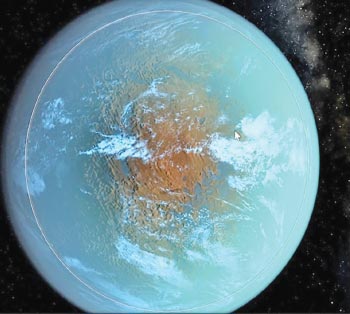 In a major milestone in the search for life on planets outside our solar system, astronomers have detected, for the first time, an atmosphere surrounding an Earth-like, rocky planet orbiting within the habitable zone of another star, according to BBC.
The finding provides the strongest evidence yet that worlds with conditions similar to Earth in composition and temperature, with the potential to support life, could exist beyond our solar system, according to a new study published July 16 in the peer-reviewed journal Science.
"An atmosphere is essential for a planet to support life as we know it," said lead author Collin Cherubim in a statement. Cherubim recently earned his PhD in Earth and planetary sciences from Harvard University. "This is the first time anyone has found an atmosphere on a rocky planet in the habitable zone of another star."
The exoplanet �" so called because its a planet outside of our solar system �" is named LhS 1140 b and is located about 49 light-years from Earth (300 trillion miles) in the constellation Cetus (the Whale). It was discovered almost a decade ago, and orbits a small red dwarf star called LHS 1140, which is almost 49 light-years away from our solar system.
Loading...
Loading...
Also read



Editor : Iqbal Sobhan Chowdhury
Published by the Editor on behalf of the Observer Ltd. from Globe Printers, 24/A, New Eskaton Road, Ramna, Dhaka.
Editorial, News and Commercial Offices : Aziz Bhaban (2nd floor), 93, Motijheel C/A, Dhaka-1000.
Phone: PABX- 41053001-06; Advertisement: 41053012; 01793317829, 01550707291, E-mail: [email protected], [email protected] Online: email: [email protected] 41053014; 01550707297 Advertisement: 01550707296
Published by the Editor on behalf of the Observer Ltd. from Globe Printers, 24/A, New Eskaton Road, Ramna, Dhaka.
Editorial, News and Commercial Offices : Aziz Bhaban (2nd floor), 93, Motijheel C/A, Dhaka-1000.
Phone: PABX- 41053001-06; Advertisement: 41053012; 01793317829, 01550707291, E-mail: [email protected], [email protected] Online: email: [email protected] 41053014; 01550707297 Advertisement: 01550707296


