



| HEADLINE |

|
World Cup 2026
The tournament that changed football again


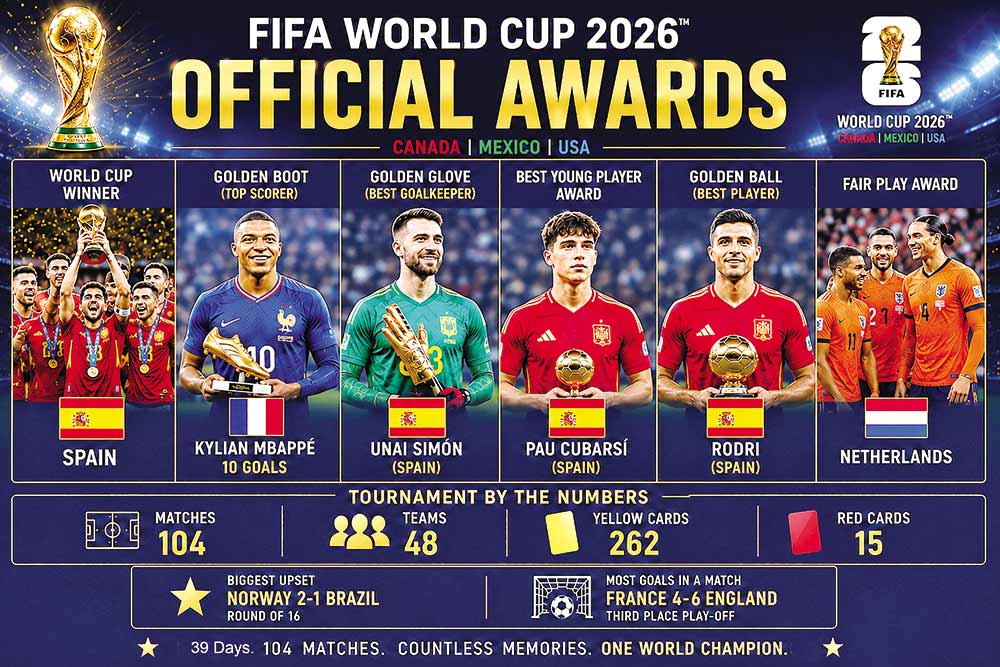 After 104 matches, countless dramatic moments and a month of football that captivated billions around the world, FIFA World Cup 2026 ended with Spain lifting the trophy and a new era of international football officially beginning.
From Lionel Messi's final World Cup appearance to Kylian Mbappé's extraordinary scoring run, from Norway's stunning upset of Brazil to Morocco's continued rise as an African powerhouse, this was a tournament that felt different from the moment it began.
It was not just a World Cup.
It was the World Cup that changed football again.
Spain end a 16-year wait
Spain returned to the summit of world football by defeating Argentina 1-0 after extra time in the final, with Ferran Torres scoring the decisive goal in the 106th minute.
The victory ended a 16-year wait for a second World Cup title, adding the 2026 crown to the historic triumph achieved in South Africa in 2010.
More importantly, Spain won with a team built around a new generation. Lamine Yamal, Pedri, Rodri and Dani Olmo became the faces of a side that combined technical quality with tactical maturity, suggesting that Spain may be entering another golden period.
Messi's last dance ends in silver
For Argentina, the final brought heartbreak but also the end of an extraordinary World Cup journey.
At 39 years old, Messi reached another final and finished the tournament with 8 goals, once again carrying Argentina through crucial knockout matches. Although the trophy slipped away, his final World Cup ended with a standing ovation from supporters of both teams.
The image of Messi leaving the field after the final may become one of the defining photographs of the tournament-a farewell to the player who shaped an entire era of football.
Mbappé claims the golden boot
While France finished fourth, Kylian Mbappé left the tournament with the Golden Boot after scoring 10 goals.
His campaign included a brilliant brace in the dramatic 6-4 defeat to England in the third-place playoff, confirming his status as the most explosive attacking player in world football.
Mbappé did not leave with the trophy, but he left with another individual milestone and a reminder that the race to become football's next global icon is far from over.
Norway and Morocco provide the biggest surprises
Every World Cup needs a shock story, and 2026 delivered several.
Norway's victory over Brazil in the Round of 16 was one of the tournament's biggest upsets, with Erling Haaland leading a team that suddenly looks capable of challenging the world's elite.
Morocco continued their remarkable rise by reaching the quarter-finals after eliminating the Netherlands in a dramatic penalty shootout. Their run confirmed that their recent World Cup success was not a one-time achievement but part of a broader transformation in African football.
The tournament that belonged to the bench
One of the clearest tactical trends of the tournament was the growing importance of substitutes.
Coaches increasingly treated their benches as weapons rather than emergency options, with late goals and game-changing substitutions deciding several knockout matches.
The old idea of a "starting eleven" dominating a World Cup became less important. In 2026, the strongest squads were often the teams with the deepest benches.
Young stars take over the stage
Another major theme was the dominance of young players.
Lamine Yamal emerged as the tournament's breakout star, while players such as Jude Bellingham, Pedri, Bukayo Saka and Julián Álvarez showed that football's next generation is ready to carry the sport forward.
For the first time in many years, the conversation was not only about Messi, Mbappé or other established superstars. It was about the players who could define the next decade.
VAR and referees remain under the spotlight
The tournament also produced intense debate over refereeing and VAR decisions.
Several controversial moments became major talking points, and referees found themselves under unprecedented scrutiny from players, coaches and supporters.
FIFA defended the use of technology, but the discussion around consistency and transparency is unlikely to disappear anytime soon.
In many ways, the whistle became almost as important as the football.
Was the 48-team format a success?
This was the first World Cup featuring 48 teams, and the expanded format proved more competitive than many critics expected.
Smaller nations were able to challenge traditional powers, and the group stage produced fewer one-sided matches than anticipated. The knockout rounds also delivered a constant stream of drama, including multiple extra-time battles and penalty shootouts.
Commercially and globally, the tournament was an enormous success, attracting huge television audiences and turning host cities into month-long football festivals.
The legacy of World Cup 2026
When Spain lifted the trophy in New Jersey, the tournament left behind more than a champion.
It left behind:
a new world champion,
a new generation of stars,
a new tactical landscape,
and a new understanding of how global football is evolving.
The era of Messi and Cristiano Ronaldo is coming to an end. Mbappé has established himself as the leading superstar of the present, while players such as Yamal and Bellingham are positioning themselves as the stars of the future.
The final word
World Cup 2026 will be remembered as the tournament where football officially turned the page.
Spain became champions, Messi said goodbye to the World Cup, Mbappé conquered the scoring charts, and a new generation announced that it is ready to take control of the sport.
The final whistle ended the tournament.
But it also marked the beginning of football's next era.
Loading...
Loading...
Also read



Editor : Iqbal Sobhan Chowdhury
Published by the Editor on behalf of the Observer Ltd. from Globe Printers, 24/A, New Eskaton Road, Ramna, Dhaka.
Editorial, News and Commercial Offices : Aziz Bhaban (2nd floor), 93, Motijheel C/A, Dhaka-1000.
Phone: PABX- 41053001-06; Advertisement: 41053012; 01793317829, 01550707291, E-mail: [email protected], [email protected] Online: email: [email protected] 41053014; 01550707297 Advertisement: 01550707296
Published by the Editor on behalf of the Observer Ltd. from Globe Printers, 24/A, New Eskaton Road, Ramna, Dhaka.
Editorial, News and Commercial Offices : Aziz Bhaban (2nd floor), 93, Motijheel C/A, Dhaka-1000.
Phone: PABX- 41053001-06; Advertisement: 41053012; 01793317829, 01550707291, E-mail: [email protected], [email protected] Online: email: [email protected] 41053014; 01550707297 Advertisement: 01550707296


