



| HEADLINE |

|
The end of Messi era


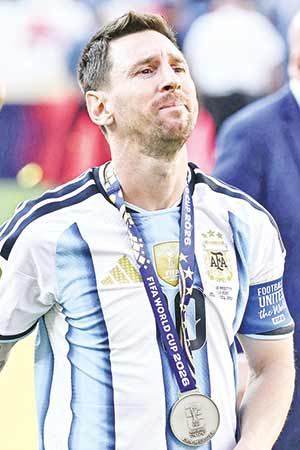 When Lionel Messi rolled a calculated 'pass back ball' towards Spanish goalkeeper (Unai Simón) in closing chapters of FIFA World Cup Final-2026, it was not an act of surrender. It was a profound managerial statement. In the twilight of an unparalleled career, the legendary forward eschewed the individual pursuit of glory for a moment of quiet, epic reflection. It was the physical manifestation of a poignant truth: "Yesterday's flowers am I", a recognition that every era eventually gives way to another.
In doing so, Messi did something rare for figures of his stature, he willingly managed his own obsolescence. Having asserted his enduring competitive relevance with a stunning hat-trick in Argentina's opening match, his capability was beyond dispute. Yet, as the final whistle neared, the operational gravity of global football did not consolidate around Argentina, nor did it pivot to Kylian Mbappé. Instead, it was seamlessly transferred to Spain's teenage sensation, Lamine Yamal.
We saw Messi look into Yamal's intensely hopeful face and, on the green-carpeted pitch of the FIFA WC football final, play his final chapter against this eager 19-year-old rising football star. The match ended 0-1 in Spain's favour, symbolising not merely a defeat on the scoreboard but the arrival of a new generation. Afterwards, in his final moments on the field, he stretched out his arms and legs and offered his gratitude to God. He made us understand one thing: Messi is Messi. As an admirer of the beautiful game, I remain a silent but passionate supporter of footballing excellence wherever it appears - whether from Spain, England, Brazil, or Argentina.
The reality of modern football is built on this very lineage. A vast demographic of emerging talent, including Mbappé and Yamal, has been incubated on a steady diet of comparing their style against Messi and Neymar. On any other night, the clinical geometry of Messi's passing would have yielded dividends, were it not for the extraordinary resilience of the Spanish goalkeeper, who stood as a formidable barrier to Argentina's ambitions.
To witness the final was to observe a masterclass under immense psychological pressure. The environment among spectators was taut, almost suffocating. In a room populated by traditional regional rivals-a volatile mix of Brazilian and Argentine partisans-a strange geopolitical alignment occurred: For ninety minutes, the room stood united behind Argentina.
The silence was heavy with risk. There was a palpable collective anxiety that a single Argentine breakthrough would rupture the delicate equilibrium of the room, unleashing a torrent of uncontrollable emotion.
Yet, throughout this high-stakes pressure cooker, Messi adopted the mantle of the elder statesman. His performance offered a broader socio-economic lesson that transcends sport:
"We must eventually cede our hard-won positions of influence to the incoming cohort, precisely as the previous generation once vacated their space for us."
This is the definitive takeaway from the 2026 tournament, offering universal relevance for Argentines, Brazilians, and Spaniards alike.
In fact, Messi has decoupled himself from the fortunes of his home nation; he has evolved into a global institution that supersedes Argentina itself. The paradox of a World Cup Final defeat is that it may have strengthened rather than diminished his cultural influence. The outpouring of global goodwill following his loss is a phenomenon unlikely to be replicated in the sports entertainment industry for decades.
The all-time greats of the sport do not achieve immortality purely through their quantifiable metrics-the goals scored or assists recorded. Their lasting valuation lies in the intangible assets they leave behind: the aspirational capital inherited by the next generation.
Every industry inevitably faces this inflection point of leadership transition. The true elegance of football-and indeed, of any sustainable institution-lies in this fluid transfer of dreams, technical expertise, and leadership capital from one era to the next.
Messi's final appearance, irrespective of the scoreline, serves as a stark reminder of an enduring principle: a true legend's legacy is not measured by personal returns, but by the infrastructure they build for those who follow.
True leaders remain immortal because they do not just win individual campaigns; they cultivate the ecosystem of tomorrow. When the macro-economic indicators signal that our time is up, we too must display the grace to step aside, allowing the next generation the space to write their own history.
Loading...
Loading...
Also read



Editor : Iqbal Sobhan Chowdhury
Published by the Editor on behalf of the Observer Ltd. from Globe Printers, 24/A, New Eskaton Road, Ramna, Dhaka.
Editorial, News and Commercial Offices : Aziz Bhaban (2nd floor), 93, Motijheel C/A, Dhaka-1000.
Phone: PABX- 41053001-06; Advertisement: 41053012; 01793317829, 01550707291, E-mail: [email protected], [email protected] Online: email: [email protected] 41053014; 01550707297 Advertisement: 01550707296
Published by the Editor on behalf of the Observer Ltd. from Globe Printers, 24/A, New Eskaton Road, Ramna, Dhaka.
Editorial, News and Commercial Offices : Aziz Bhaban (2nd floor), 93, Motijheel C/A, Dhaka-1000.
Phone: PABX- 41053001-06; Advertisement: 41053012; 01793317829, 01550707291, E-mail: [email protected], [email protected] Online: email: [email protected] 41053014; 01550707297 Advertisement: 01550707296


