



| HEADLINE |

|

BD nationalism embodies an inclusive nat’l identity: Swapon
Published : Thursday, 23 July, 2026 at 12:00 AM
JnU Correspondent


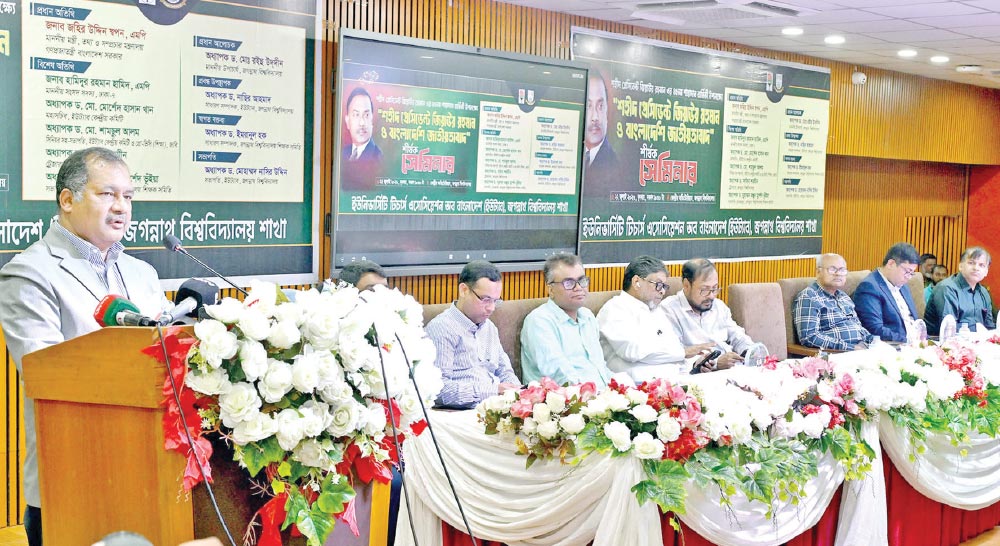 Information and Broadcasting Minister Zahir Uddin Swapan on Wednesday said the philosophy of Bangladeshi nationalism represents an inclusive national identity that embraces the country’s diverse languages, religions, cultures and ethnic communities, while recognising every citizen as an equal member of the nation.
He made the remarks while addressing a seminar “Shaheed President Ziaur Rahman and Bangladeshi Nationalism”, organised by Jagannath University chapter of University Teachers’ Association of Bangladesh (UTAB) on the university campus.
The minister said that although Pakistan was established on the basis of religion, history had shown that religion alone could not sustain a diverse state in the long term. He said the Language Movement of 1952 and the Liberation War of 1971 demonstrated that reality.
Highlighting the role of late President Ziaur Rahman in the Liberation War, Swapan said Zia’s leadership and decisions during the early stages of the war played a significant role in organising the resistance. He also described Ziaur Rahman’s declaration of independence and wartime leadership as important chapters in Bangladesh’s history.
According to the minister, a debate over national identity emerged after independence, as a language-based identity alone could not fully represent all communities. He said Ziaur Rahman later introduced the concept of Bangladeshi nationalism, a civic-based national identity that unites citizens regardless of their linguistic, religious or ethnic backgrounds.
“Every citizen of Bangladesh, regardless of the language they speak, the religion they practise or the ethnic community they belong to, enjoys equal dignity and rights under the identity of being Bangladeshi,” he said.
Swapan added that the inclusive philosophy of Bangladeshi nationalism had strengthened the country’s territorial integrity, national unity and pluralistic social structure.
He said nationalism in the modern world was no longer defined solely by language, religion or ethnicity, but by shared citizenship, common constitutional values, territorial integrity and a collective vision for the future. Bangladeshi nationalism, he said, reflected this modern concept of nationhood.
The minister also stressed that promoting one language or culture should not come at the expense of marginalising others. He said Bangladeshi nationalism had evolved by respecting and accommodating the country’s linguistic, cultural, religious and ethnic diversity, allowing every citizen to identify equally with the state.
He further said Bangladeshi nationalism remained a foundation of national unity and cohesion and would continue to guide the country’s future development.
The seminar was chaired by Acting President of the Jagannath University chapter of UTAB Prof Mohammad Nasir Uddin. Dhaka-7 lawmaker Hamidur Rahman Hamid attended as the special guest, while Jagannath University Vice-Chancellor Prof Md Rais Uddin delivered the keynote address. The keynote paper was presented by UTAB chapter General Secretary Prof Nasir Ahmad.
Loading...
Loading...
Also read



Editor : Iqbal Sobhan Chowdhury
Published by the Editor on behalf of the Observer Ltd. from Globe Printers, 24/A, New Eskaton Road, Ramna, Dhaka.
Editorial, News and Commercial Offices : Aziz Bhaban (2nd floor), 93, Motijheel C/A, Dhaka-1000.
Phone: PABX- 41053001-06; Advertisement: 41053012; 01793317829, 01550707291, E-mail: [email protected], [email protected] Online: email: [email protected] 41053014; 01550707297 Advertisement: 01550707296
Published by the Editor on behalf of the Observer Ltd. from Globe Printers, 24/A, New Eskaton Road, Ramna, Dhaka.
Editorial, News and Commercial Offices : Aziz Bhaban (2nd floor), 93, Motijheel C/A, Dhaka-1000.
Phone: PABX- 41053001-06; Advertisement: 41053012; 01793317829, 01550707291, E-mail: [email protected], [email protected] Online: email: [email protected] 41053014; 01550707297 Advertisement: 01550707296


