



| HEADLINE |

|

BAU team succeeds in innovating cost-effective duck plague vaccine
Published : Monday, 27 July, 2026 at 7:34 PM
Observer Correspondent


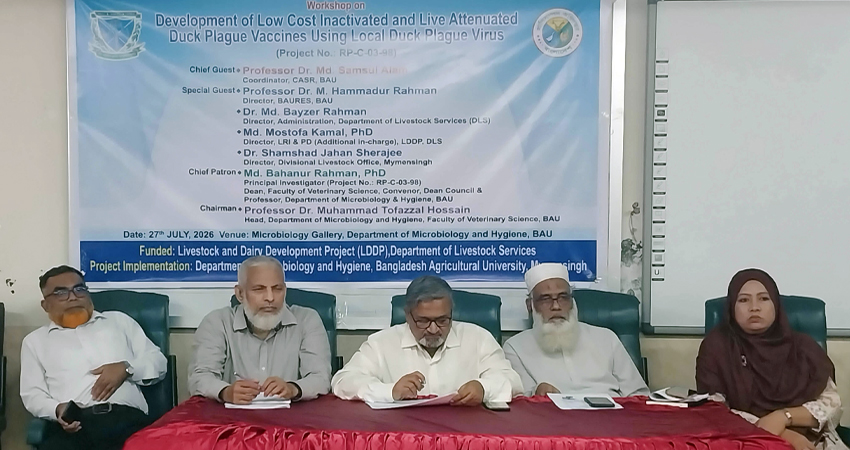
Bangladesh Agricultural University (BAU) researchers have successfully developed a low-cost duck plague vaccine utilizing local duck plague virus strains.
A team from BAU developed the vaccine. They stated that following the completion of necessary field trials, the vaccine could open up new possibilities for the country's duck farming sector.
The closing workshop of the research project, funded by the Livestock and Dairy Development Project (LDDP), was held on Monday morning, July 27 at the gallery of the university's Department of Microbiology.
Professor Dr. Mohammad Ferdousur Rahman Khan from the Department of Microbiology and Hygiene, who served as the co-investigator of the project, delivered the welcome address.
Professor Dr. Md. Samchul Alam, Coordinator of the University's Committee for Advanced Studies and Research (CASR), attended the event as the chief guest.
Special guests included Professor Dr. M. Hammadur Rahman, Director of Bangladesh Agricultural University Research System (BAURES); Dr. Shamsad Jahan Shiraji, Director of the Mymensingh Divisional Livestock Office; and Dr. Md. Jahangir Hossain, Chief Technical Coordinator of LDDP. The principal investigator of the project, Syndicate Member, and Dean of the Faculty of Veterinary Science, Professor Dr. Md. Bahanur Rahman, was also present.
Presenting the research activities, Professor Dr. Md. Bahanur Rahman stated that duck plague is a fatal viral disease. The mortality rate among infected ducks can range from 40 to 100 per cent.
Although the research initially aimed at developing an attenuated vaccine, studies on inactivated and DNA vaccines were also conducted at the request of the Department of Livestock Services (DLS). While the inactivated vaccine did not yield the expected results, the DNA and oral vaccines showed highly positive outcomes.
He further mentioned that the vaccine is currently awaiting field-level trials. If all necessary procedural steps are completed, it could reach farmers within the next one to one-and-a-half years. He expressed optimism that the newly developed vaccine will offer over 90 percent protection and contribute significantly to the growth of the duck farming sector once distributed to farmers through DLS.
In his speech as chief guest, Professor Dr. Md. Samchul Alam remarked that it is difficult to cure ducks infected with this viral disease through conventional treatment. Therefore, vaccination remains the most effective measure for disease prevention.
-MA/SA

Loading...
Loading...
Also read








Editor : Iqbal Sobhan Chowdhury
Published by the Editor on behalf of the Observer Ltd. from Globe Printers, 24/A, New Eskaton Road, Ramna, Dhaka.
Editorial, News and Commercial Offices : Aziz Bhaban (2nd floor), 93, Motijheel C/A, Dhaka-1000.
Phone: PABX- 41053001-06; Advertisement: 41053012; 01793317829, 01550707291, E-mail: [email protected], [email protected] Online: email: [email protected] 41053014; 01550707297 Advertisement: 01550707296
Published by the Editor on behalf of the Observer Ltd. from Globe Printers, 24/A, New Eskaton Road, Ramna, Dhaka.
Editorial, News and Commercial Offices : Aziz Bhaban (2nd floor), 93, Motijheel C/A, Dhaka-1000.
Phone: PABX- 41053001-06; Advertisement: 41053012; 01793317829, 01550707291, E-mail: [email protected], [email protected] Online: email: [email protected] 41053014; 01550707297 Advertisement: 01550707296


