



| HEADLINE |

|

THE WORLD WITHIN ME
Published : Saturday, 1 August, 2026 at 12:00 AM
Mohammed Amin


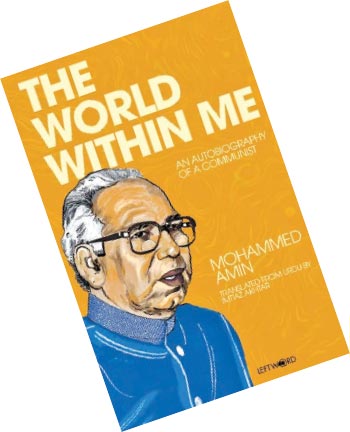 Mohammed
Amin (1928-2018) was one of the giants of the trade union movement in
India. Born in Howrah in Bengal of Urdu-speaking parents, Amin had no
formal education. At fourteen, he became a worker in a jute mill where
his father worked. He joined the Communist Party at eighteen, lived
through the endemic communal violence of the late 40s, immigrated to
East Pakistan, and lived for a while in a refugee camp there. He was
arrested for being a Communist and incarcerated.
Mohammed
Amin (1928-2018) was one of the giants of the trade union movement in
India. Born in Howrah in Bengal of Urdu-speaking parents, Amin had no
formal education. At fourteen, he became a worker in a jute mill where
his father worked. He joined the Communist Party at eighteen, lived
through the endemic communal violence of the late 40s, immigrated to
East Pakistan, and lived for a while in a refugee camp there. He was
arrested for being a Communist and incarcerated.On release,
he returned to Calcutta and became a trade union organizer. Amin taught
himself Urdu, English, Hindi and Bengali at home, in night school and
in prison. For a time, he worked as a journalist with an Urdu daily for
five years; he also rolled bidis to augment his paltry party wage. He
was elected to the West Bengal Legislative Assembly and the Rajya Sabha
multiple times, and held major ministerial portfolios in the State. He
also served as the national General Secretary of the Centre of Indian
Trade Unions and as a member of the Politburo of the Communist Party of
India (Marxist). Amin became an accomplished poet in Urdu, a published
author, and compiled a Bengali-Urdu dictionary. His was a fascinating
journey. His autobiography, published in Bengali in 2017, tells the
story of that journey.
REVIEWED BY INDRANEEL DASGUPTA
Amin provides a fascinating account of life in refugee camps and prisons in East Pakistan. He spent 26 months in the notorious Rajshahi Central Jail. This was the site of the Khapra Ward massacre of 1950, when the prison authorities opened fire on Communist detainees, killing seven and injuring about thirty others, including Mansur Habibullah-the future Law Minister of West Bengal and the Speaker of the West Bengal Assembly. Also incarcerated in Rajshahi Central Jail at the time was the legendary peasant leader Ila Mitra-an Olympic-level athlete who had suffered sexual violence and torture in police custody. In prison, Amin studied Marxism, political economy, history of religion and Bengali. He had the responsibility of reading and explaining English newspapers to those who could not read English.
Amin used this to improve his command over both English and Bengali-something he put to use after his release by writing an Urdu-Bengali dictionary. There are both revealing and tragic-ironic vignettes here. Amin’s mastery over Urdu made him stand out among Communists in East Pakistan and offered him privileges while dealing with the authorities. Sunil Sen survived Rajshahi prison only to get murdered in Calcutta in the early 70s. Ratan Sen, who stayed on in East Pakistan, was killed in Khulna after the creation of Bangladesh. After his release in November 1953, Amin returned to Calcutta and became a whole-time Communist organizer, and was tasked with building unions in Titagarh-an industrial suburb of Calcutta. Amin writes about his struggles as an organizer in Titagarh. He gradually built up Communist unions in the area. However, during and immediately after the 1962 Sino-Indian war, ideological and factional conflicts within the Party peaked. Even the paltry monthly wage that Amin used to receive as a Party whole-timer was stopped. One of the most striking aspects of Amin’s discussion of this period is his emphasis on grassroots democracy within the unions that he led.
In 1969, Amin was elected to the West Bengal Assembly on a CPI(M) ticket and became the Transport Minister in the short-lived United Front Government. He writes about his experiences during the subsequent period of extreme political violence in Bengal-1971-77, especially during the elections of 1972, which were heavily rigged by the Congress. Amin was elected to the State Assembly in 1977 and became the Transport Minister in the first Left Front Government. He lost thereafter, became a member of the Rajya Sabha in 1988, and was elected to the State assembly again in 1996 and 2001. He served as a Cabinet Minister, first for Minority Affairs and subsequently for Labour. He was elected national General Secretary of the Centre of Indian Trade Unions in 2007, a position he held till 2010. In 2007, he was also elected to the Rajya Sabha once again, and to the CPI(M) Politburo in 2008. The book, however, concludes with his electoral defeat in 2006.
One of the most striking features of the book is Amin’s accounts of the extreme repression and hardship that early Communists suffered both in Pakistan and India. He tells, for example, of a trade union activist, Rumalludin, who was tied to a police car and dragged around in front of the Khulna Jute Mill in East Pakistan till he died. His body was left there as a warning to the workers. Another early Communist and Amin’s political mentor, Hafiz Jallaluddin, died in 1950 of injuries suffered during torture by the Uttar Pradesh police while in prison.
Amin’s account also highlights how strikingly footloose and cosmopolitan many of the early Communist organizers active among Calcutta’s immigrant industrial workers were. These men came to Calcutta’s industrial suburbs from many different parts of India, often as manual workers. They spoke, read and wrote multiple languages. Many of them were self-taught men like Amin, with little or no formal education. Many of them kept shifting base across South Asia in search of revolution. They survived precariously; they worked odd jobs. These men belonged everywhere and joined class battles anywhere; but everywhere they went the state sought to hunt them down. A large proportion of them were also Muslims.
This
book is essential reading for anybody interested in the history of
labour and Communist organizing efforts, especially among Hindi and
Urdu-speaking workers, in the industrial suburbs of Calcutta.
The reviewer is a Professor of Economics, Indian Statistical Institute, Kolkata

Loading...
Loading...





Editor : Iqbal Sobhan Chowdhury
Published by the Editor on behalf of the Observer Ltd. from Globe Printers, 24/A, New Eskaton Road, Ramna, Dhaka.
Editorial, News and Commercial Offices : Aziz Bhaban (2nd floor), 93, Motijheel C/A, Dhaka-1000.
Phone: PABX- 41053001-06; Advertisement: 41053012; 01793317829, 01550707291, E-mail: [email protected], [email protected] Online: email: [email protected] 41053014; 01550707297 Advertisement: 01550707296
Published by the Editor on behalf of the Observer Ltd. from Globe Printers, 24/A, New Eskaton Road, Ramna, Dhaka.
Editorial, News and Commercial Offices : Aziz Bhaban (2nd floor), 93, Motijheel C/A, Dhaka-1000.
Phone: PABX- 41053001-06; Advertisement: 41053012; 01793317829, 01550707291, E-mail: [email protected], [email protected] Online: email: [email protected] 41053014; 01550707297 Advertisement: 01550707296


