



| HEADLINE |

|
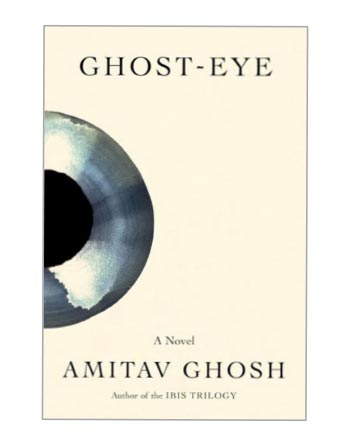
GHOST-EYE
Reviewed by Gary K Wolfe
Published : Saturday, 29 August, 2026 at 12:00 AM
AmitaV Ghosh


 Like time travel and psychic powers, reincarna¬tion seems to have migrated from religious beliefs and paranormal investigations into a dandy narrative device that can, at its best, result in brilliantly ambitious novels like Vajra Chandrase-kera’s Rakesfall a couple of years ago. But treating it as an actual clinical mystery has become relatively uncommon, especially when compared to sensa¬tional cases like that of “Bridey Murphy” back in the 1950s, and the spate of reincarnation tales and mov¬ies that followed. Amitav Ghosh, one of the most honored Indian novelists of the past half-century, is also among those literary mainstream writers who have not been shy about occasionally venturing into mythic themes or even, occasionally, SF. Fairly early in his career, he won an Arthur C. Clarke award with The Calcutta Chromosome (1996), which offered a sort of semi-SF rationalization for reincarnation or even immortality, as the title chromosome could somehow be transferred into a new body, eventually taking possession of that body and raising the pros¬pect of body-hopping your way into immortality. (Interestingly, the same sort of possession was the theme of Tim Powers’s The Mills of the Gods last year.) But that was only one feature in a pretty wild novel that also featured a near-future New York, and various mysteries, historical discoveries, and secret societies.
With Ghost-Eye, however, Ghosh returns to the idea of treating reincarnation in terms of clinical investigation. The novel follows two timelines, Calcutta in 1969 (Ghosh uses the older spelling for the earlier timeline) and Brooklyn in the post-COVID era. The event that sets off both narrative threads involves Varsha, the three-year-old daughter of a well-to-do family, who suddenly refuses to eat until her family prepares her favorite fish. The only problem is, she’s never tasted or even seen a fish in her strictly vegetarian household, which would regard it as contamination.
Furthermore, she claims to have lived in a village in the Sundarbans, the mas¬sive mangrove forest (which was also the setting of Ghosh’s 2004 novel The Hungry Tide), and to have died there from a snakebite. The family pediatrician suggests consulting his wife Shoma, a psychologist, whose methodical investigation reveals far more detailed “dissociative memories,” as well as Varsha’s remarkable ability to distinguish even rare types of fish by taste alone. As Shoma tries to track down the village of Varsha’s prior life, a second narra¬tive thread shifts to the Brooklyn of 2020, where Shoma’s nephew Dimu, now a retired antiquarian bookseller (who also appeared in an earlier Ghosh novel), finds himself drawn into the same mystery, trying to track down the adult Varsha, who seems to have thoroughly disappeared from any historical records. Encouraged by his young climate activist friend Tipu �" whose condition of heterochromia is sometimes called ghost-eye, thought to convey a gift of supernatural perception �" and whose environ¬mental group thinks that Vasha’s reincarnation may be an example of an “irruption,” “when the world’s hidden potentialities burst out.” As the Sundarbans and the entire subcontinent face the possibility of a catastrophic weather event, Tipu and his colleagues seem more than willing to explore the possibility of magical transformations as a means of confronting climate change.
If the link between reincarnation and climate change seems tenuously stitched together, Ghosh’s clear and compelling narrative voice kept me fasci¬nated on a chapter-by-chapter basis, even as we get pages of digression on varieties of rare South Asian fish (and the problems of tracking them down in contemporary Brooklyn), on the political history of the Sundarbans, on capitalist exploitation in South Asia, on legends of snake-goddesses; at times the digressions are as compelling as the main narrative. Shoma’s methodical investigation of Varsha’s rein¬carnation has the rigorous appeal of a procedural, as does Dimu’s cold-case revisiting of the puzzle decades later. With a varied cast of complex but intriguing characters, Ghost-Eye is as fascinating narratively as it is a bit wobbly in terms of unifying its most important themes.
Loading...
Loading...



Editor : Iqbal Sobhan Chowdhury
Published by the Editor on behalf of the Observer Ltd. from Globe Printers, 24/A, New Eskaton Road, Ramna, Dhaka.
Editorial, News and Commercial Offices : Aziz Bhaban (2nd floor), 93, Motijheel C/A, Dhaka-1000.
Phone: PABX- 41053001-06; Advertisement: 41053012; 01793317829, 01550707291, E-mail: [email protected], [email protected] Online: email: [email protected] 41053014; 01550707297 Advertisement: 01550707296
Published by the Editor on behalf of the Observer Ltd. from Globe Printers, 24/A, New Eskaton Road, Ramna, Dhaka.
Editorial, News and Commercial Offices : Aziz Bhaban (2nd floor), 93, Motijheel C/A, Dhaka-1000.
Phone: PABX- 41053001-06; Advertisement: 41053012; 01793317829, 01550707291, E-mail: [email protected], [email protected] Online: email: [email protected] 41053014; 01550707297 Advertisement: 01550707296


