



| HEADLINE |

|

Gas crisis chokes RMG output, risks exports
Published : Saturday, 1 August, 2026 at 12:00 AM
Mizanur Rahman


 Bangladesh's export-oriented garment industry is facing mounting pressure as an acute gas shortage has disrupted production at factories in Savar-Ashulia, threatening shipment schedules and raising fears of lost export orders, higher production costs and further job cuts if the crisis persists.
Factory visits to Jamgora, Kathgara, Zirabo, Narsinghpur, Berun, Shimultola, Palashbari, Nischintapur, Baipayl and Zirani in Ashulia found severe disruptions to gas-dependent operations, particularly finishing, ironing, dyeing, washing, drying and packaging.
Factory owners said gas pressure had fallen so sharply that boilers could no longer generate sufficient heat to complete the final stages of production, leaving finished garments unable to be packed and dispatched to ports.
Ahmed Mortuza, director of Projon Sweater, said almost all manufacturing work had been completed, but the absence of adequate gas had stalled finishing operations.
"As a result, we cannot pack the products and send them to the port. There is a growing risk that shipments will miss their deadlines," he said.
Ripon Sarker, an official of another factory, warned that delayed deliveries could damage Bangladesh's reputation with international buyers.
"If we fail to deliver on time, foreign buyers may place their future orders elsewhere. That could seriously affect our business," he said.
The gas shortage has also left workers idle for hours despite reporting to work on time.
"I come to the factory in the morning, but we often cannot start work because of the gas shortage," said worker Sohrab Hossain.
Another worker, Rajon, said the uncertainty had become routine.
"There is no certainty about when the gas pressure will return to normal," he said.
Industry stakeholders said hundreds of factories in Ashulia supply garments to Europe, the United States and other major markets, meaning prolonged disruptions could affect not only exporters but also the country's broader supply chain.
Entrepreneurs said the option of switching to diesel or LPG was limited because of the significantly higher costs. While low gas pressure has been a recurring problem, they described the current situation as unprecedented.
Amzad Hossain Bulbul, a management teacher at Abdul Mannan College, warned that Bangladesh could lose its competitive edge if shipment deadlines were repeatedly missed.
"Once a buyer is lost, it is not easy to bring them back," he said.
The crisis has intensified as the country's gas supply continues to lag behind demand. Government estimates show daily demand at around 380 crore cubic feet, compared with supply of only 270-280 crore cubic feet, leaving a shortfall of 100-110 crore cubic feet. The shutdown of one of the floating LNG terminals in Maheshkhali has further reduced gas availability across the national grid.
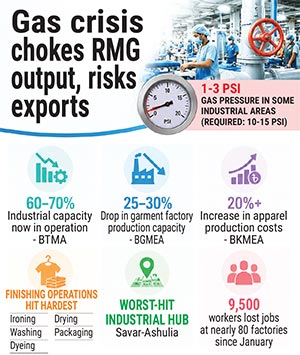
The impact has spread beyond Ashulia. Production in industrial areas including Kaliakoir, Konabari, Tongi, Sreepur, Mouchak, Chandra and Board Bazar in Gazipur has reportedly fallen by 50-60 per cent. In some factories, gas pressure has dropped to 1-3 PSI, far below the 10-15 PSI needed to operate boilers, generators and machinery.
According to the Bangladesh Textile Mills Association (BTMA), most industrial units are operating at only 60-70 per cent of installed capacity. Textile, spinning, dyeing, steel, ceramics, paper and plastic factories are also struggling, with many relying on diesel or LPG despite sharply higher fuel costs.
Bangladesh Knitwear Manufacturers and Exporters Association (BKMEA) President Mohammad Hatem said the energy crisis had pushed apparel production costs up by at least 20 per cent. He said some industrial areas were enduring six to eight hours of load-shedding each day, while garment factories also faced around three hours of power outages. Some exporters had been forced to ship goods by air to meet delivery deadlines, further increasing costs.
"Overall, production costs have increased by at least 20 per cent," Hatem said, adding that uninterrupted gas and electricity supplies should be the government's immediate priority.
BKMEA Executive President Fazle Shamim Ehsan said although some factories were receiving fuel through fuel cards, the system had yet to be introduced effectively across many industrial areas. He also said organising international industrial exhibitions despite the current challenges could help sustain investor confidence.
Bangladesh Garment Manufacturers and Exporters Association (BGMEA) President Mahmud Hasan Khan said inadequate gas and electricity supplies had reduced factory production capacity by 25-30 per cent.
Industry stakeholders said declining output was placing factories under severe financial strain as wages, loan repayments, utility bills and maintenance costs continued despite falling revenues. Small and medium-sized enterprises were particularly vulnerable.
Industry sources said around 9,500 workers had lost their jobs at nearly 80 factories since January. If the energy crisis continues, more workers could face shorter working hours, temporary layoffs or factory closures.
Engineer Abu Saleh Mohammad Khademuddin, manager of Titas Gas's Ashulia Zonal Marketing Office, said efforts were underway to identify the causes of the crisis and restore normal gas supply.
"Necessary measures are being taken to address the problem, but it is not possible to say at this moment how long it will take for the situation to become fully normal," he said.

Loading...
Loading...
Also read



Editor : Iqbal Sobhan Chowdhury
Published by the Editor on behalf of the Observer Ltd. from Globe Printers, 24/A, New Eskaton Road, Ramna, Dhaka.
Editorial, News and Commercial Offices : Aziz Bhaban (2nd floor), 93, Motijheel C/A, Dhaka-1000.
Phone: PABX- 41053001-06; Advertisement: 41053012; 01793317829, 01550707291, E-mail: [email protected], [email protected] Online: email: [email protected] 41053014; 01550707297 Advertisement: 01550707296
Published by the Editor on behalf of the Observer Ltd. from Globe Printers, 24/A, New Eskaton Road, Ramna, Dhaka.
Editorial, News and Commercial Offices : Aziz Bhaban (2nd floor), 93, Motijheel C/A, Dhaka-1000.
Phone: PABX- 41053001-06; Advertisement: 41053012; 01793317829, 01550707291, E-mail: [email protected], [email protected] Online: email: [email protected] 41053014; 01550707297 Advertisement: 01550707296


