



| HEADLINE |

|
Don’t Touch, Don’t Panic: What to Do Around a Suspicious Object
Published : Saturday, 1 August, 2026 at 7:27 PM
Sakia Kawser Siddique


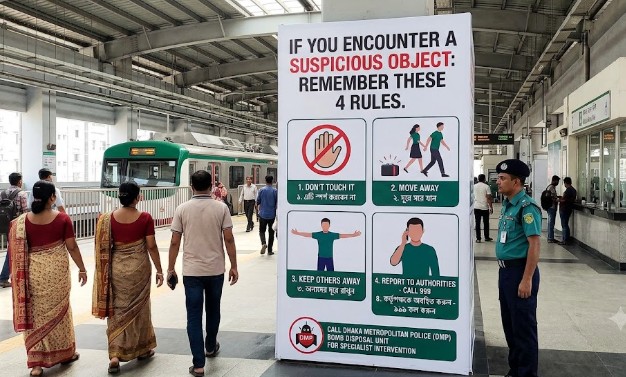
generated from AI
Two suspicious, bomb-like objects found at the Mirpur-10 and Farmgate metro rail stations on Saturday morning triggered security alerts in Dhaka.
The objects were examined by the Dhaka Metropolitan Police’s Counter Terrorism and Transnational Crime (CTTC) Bomb Disposal Unit and were later confirmed not to contain explosives. At Mirpur-10, the suspicious bag was found to contain a zarda tin and betel leaves, according to police.
A confirmed improvised explosive device (IED) found beneath the Motijheel Metro Rail Station on July 24 was safely neutralised by the DMP Bomb Disposal Unit.
Although police later confirmed that neither contained explosives.
The incident nevertheless highlights a question that commuters and residents may face in a crowded city: What should you do if you encounter an object that appears to be a bomb?
The answer is straightforward: do not touch it, move away, keep others away and alert the authorities.
Do not touch or move it
An unattended bag or package does not necessarily contain an explosive. But if an object appears suspicious or is clearly out of place, the public should not attempt to inspect it.
The US Cybersecurity and Infrastructure Security Agency (CISA) advises people not to touch, tamper with or move a suspicious item and to immediately report it to law enforcement or emergency responders.
Do not open, kick, pick up or otherwise handle the object. Do not attempt to examine any wires, electronics or other components.
Whether an object is dangerous should be determined by trained personnel.
Move away and keep others away
Once you notice a suspicious object, create distance between yourself and it.
Avoid gathering around the object or allowing others to approach it. In a busy location such as a metro station, market, shopping centre or transport hub, curiosity can quickly draw a crowd and make the situation more difficult for emergency responders.
Do not approach the object simply to take photographs or videos.
If security personnel are nearby, alert them from a safe location and follow their instructions.
Report it to authorities
After moving away, report the object to the authorities.
Bangladesh Police lists 999 as the national emergency service and 102 as the Fire Service hotline.
When reporting a suspicious object, provide its location and explain what you observed from a safe distance. Do not return to the object to obtain additional information.
The important point is to report what you actually saw rather than speculate about what the object may contain.
Don't try to determine whether it is a bomb
Saturday's incidents show why members of the public should not attempt to identify suspicious objects themselves.
The objects found at Mirpur-10 and Farmgate appeared suspicious enough to prompt police intervention, but the CTTC Bomb Disposal Unit later determined that neither contained explosives.
But a different incident at Motijheel Metro Rail Station on July 24 demonstrates why such objects cannot simply be dismissed as harmless.
An improvised explosive device was found concealed inside an abandoned umbrella beneath the station. Police cordoned off the area and the DMP Bomb Disposal Unit neutralised the device. A passer-by was injured during the disposal operation.
The lesson is simple: the public should report a suspicious object without attempting to determine whether it is genuine.
What if you have already touched it?
If you have already handled an object before realising it may be suspicious, do not continue handling or moving it.
Move away and tell authorities what happened. Follow any instructions given by emergency responders.
Do not return to the object to check it or attempt to place it somewhere else.
Don't spread unverified claims
A suspicious object can quickly trigger fear, particularly when photographs and claims circulate on social media.
But a report that an object is “a bomb” should not be treated as confirmed until authorities have assessed it.
The Mirpur-10 and Farmgate incidents are a clear example: initial reports described bomb-like objects, while subsequent examination found no explosives.
Residents should therefore avoid spreading unverified claims or presenting speculation as fact.
Follow police instructions
If police establish a cordon or ask people to leave an area, comply immediately.
Do not cross a barricade, approach the scene or return simply to watch the operation.
The Motijheel incident demonstrated the potential risks even during a controlled disposal operation, when a passer-by was injured by shrapnel.
Bomb disposal is a specialist task. The public should leave the assessment and handling of suspected explosive devices to trained personnel.
Four things to remember
If you encounter a suspicious object in Dhaka, remember four basic rules:
-Don't touch it.
-Move away.
-Keep others away.
-Report it to the authorities.
The object may turn out to be completely harmless, as happened at Mirpur-10 and Farmgate. Or, as the Motijheel incident showed, it could require specialist intervention.
For ordinary residents, the safest response is therefore not to investigate.
Step away, alert others, report the object and leave the rest to the professionals.
The safest response is also the simplest
In a densely populated city, the discovery of a suspicious object can cause fear within minutes. But the public's role is not to identify, inspect or neutralise a suspected bomb.
It is to recognise the warning signs, keep away, keep others away and alert the authorities.
For Dhaka residents, the key numbers to remember are 999 for national emergency services and 102 for Fire Service.
When something looks wrong, the safest decision is not to find out what it is.
Step away. Warn others. Call 999. Leave the rest to the professionals.
Loading...
Loading...
Also read






Editor : Iqbal Sobhan Chowdhury
Published by the Editor on behalf of the Observer Ltd. from Globe Printers, 24/A, New Eskaton Road, Ramna, Dhaka.
Editorial, News and Commercial Offices : Aziz Bhaban (2nd floor), 93, Motijheel C/A, Dhaka-1000.
Phone: PABX- 41053001-06; Advertisement: 41053012; 01793317829, 01550707291, E-mail: [email protected], [email protected] Online: email: [email protected] 41053014; 01550707297 Advertisement: 01550707296
Published by the Editor on behalf of the Observer Ltd. from Globe Printers, 24/A, New Eskaton Road, Ramna, Dhaka.
Editorial, News and Commercial Offices : Aziz Bhaban (2nd floor), 93, Motijheel C/A, Dhaka-1000.
Phone: PABX- 41053001-06; Advertisement: 41053012; 01793317829, 01550707291, E-mail: [email protected], [email protected] Online: email: [email protected] 41053014; 01550707297 Advertisement: 01550707296


