



| HEADLINE |

|
Madrasa body urges fair assessment of isolated incidents


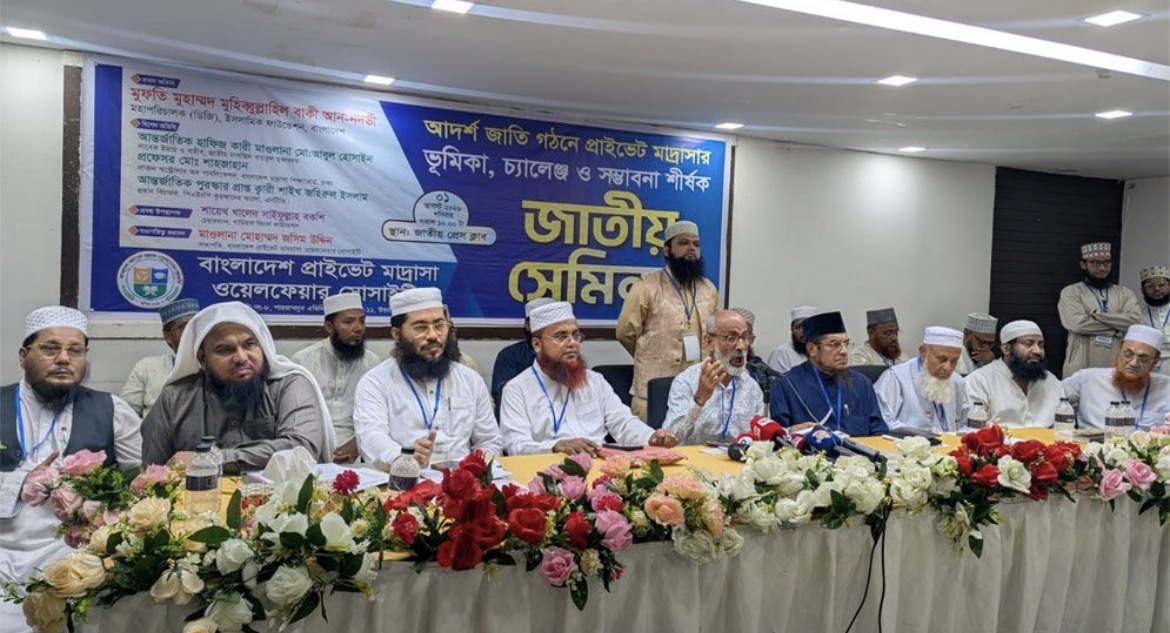
Leaders of the Bangladesh Private Madrasa Welfare Society have expressed concern over what they described as a growing tendency to judge the country’s entire madrasa education system based on a handful of isolated incidents.
Speaking at a national seminar held at the Zahur Hossain Chowdhury Auditorium of the National Press Club in Dhaka on Saturday, the leaders said unverified or incomplete reports circulated on social media and in some media outlets have, in many cases, unfairly affected innocent teachers, students and educational institutions. They urged journalists and the public not to portray isolated incidents as representative of the entire madrasa system.
The newly formed Bangladesh Private Madrasa Welfare Society said its goal is to improve the quality of education, strengthen accountability and ensure the safety of students in private madrasas across the country. It stressed that the organisation aims to support reforms and development rather than oppose any individual, institution or media outlet.
Speakers noted that private madrasas have long contributed to religious education, character development and the production of skilled professionals serving in education, research, administration, business and other sectors both at home and abroad.
The organisation announced a 12-point action plan for private madrasas, including the implementation of child protection policies, installation of CCTV cameras, stricter screening of teachers and staff, training on child rights and ethics, secure complaint mechanisms, enhanced supervision of residential students, regular communication with parents, greater administrative transparency, prompt investigation of complaints and the promotion of technology-based learning.
It also called on the media to verify information before publishing reports, include the views of the institutions concerned, avoid portraying individuals as guilty before legal proceedings are completed and practise responsible journalism that promotes social harmony.
The organisation further urged parents to stay engaged with their children’s education, maintain regular communication with madrasa authorities, avoid sharing unverified information on social media and report any suspected irregularities to the appropriate authorities.
In addition, it presented an 18-point list of demands to the government, including easier registration and recognition procedures for private madrasas, quicker issuance of EIIN numbers, student stipends, teacher training, IT support, stronger security policies, an end to unnecessary harassment of madrasas and the assurance that institutions are not held responsible for individual offences without due legal process.
The seminar was chaired by the organisation’s president, Maulana Mohammad Jasim Uddin, and moderated by Senior Vice-President Maulana Zafar Ahmed Majumder. Among the speakers were Bangladesh Betar Qari Hafez Maulana Abul Hossain, international Qari Hafez Maulana Zahirul Islam and Professor Md. Shahjahan. The keynote paper was presented by the organisation’s adviser, Maulana Khaled Saifullah Bakshi.



Published by the Editor on behalf of the Observer Ltd. from Globe Printers, 24/A, New Eskaton Road, Ramna, Dhaka.
Editorial, News and Commercial Offices : Aziz Bhaban (2nd floor), 93, Motijheel C/A, Dhaka-1000.
Phone: PABX- 41053001-06; Advertisement: 41053012; 01793317829, 01550707291, E-mail: [email protected], [email protected] Online: email: [email protected] 41053014; 01550707297 Advertisement: 01550707296


