



| HEADLINE |

|
Make Renewable Energy a Movement, Not Just a Policy: Planning Adviser
Published : Monday, 3 August, 2026 at 12:00 AM
Business Correspondent


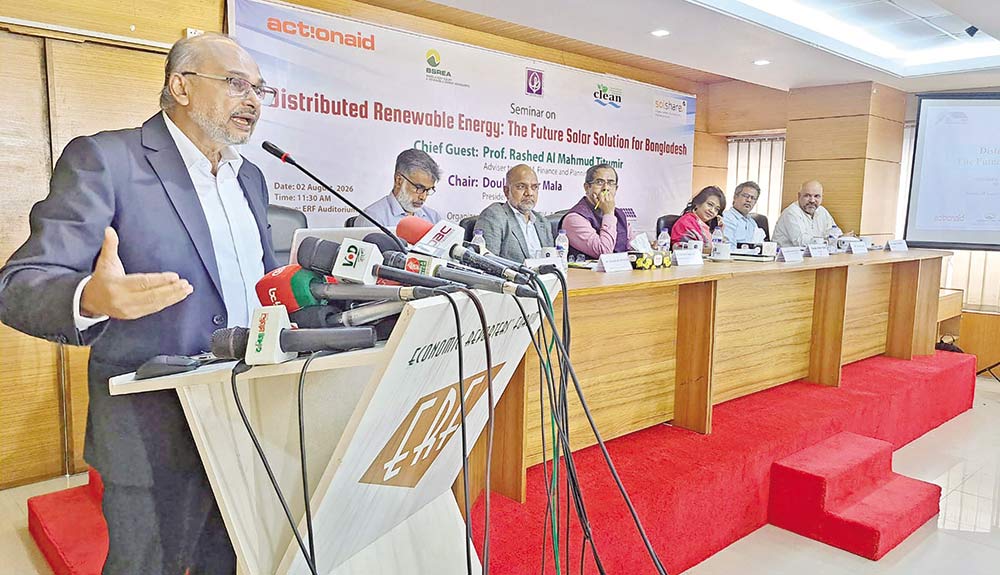 Renewable energy must move beyond policy pledges and become a nationwide social movement driven by public participation if Bangladesh is to secure energy independence, combat climate change and ensure sustainable development, Finance and Planning Adviser Prof. Rashed Al Mahmud Titumir said on Sunday.
Addressing a workshop on renewable energy organised by the Economic Reporters Forum (ERF) at its auditorium in Paltan, Dhaka, Prof. Titumir called for a fundamental shift from government-led initiatives to collective public action, describing clean energy as a matter of citizens' rights rather than merely an environmental agenda.
"Renewable energy cannot remain confined to promises on paper. It must evolve into a social movement," he said, urging society to unite in protecting life, nature, biodiversity and the environment while confronting the growing threats posed by climate change.
The workshop, chaired by ERF President Doulat Akter Mala, was also addressed by renewable energy experts and stakeholders, including Ishtiaque Ahmed, Hasan Mehedi, ASM Munir, Mehadi Hasan Shamim and ERF General Secretary Abul Kashem.
Prof. Titumir said Bangladesh must learn from past development experiences and create genuine public demand for renewable energy instead of relying solely on administrative initiatives. Civil society organisations and non-governmental organisations, he said, have a crucial role in mobilising people and establishing access to electricity and clean energy as a fundamental right.
Recalling the Liberation War, the 1990 mass uprising and the 2024 movement, he said every successful national movement had been rooted in the struggle for rights.
"People embrace change when they believe it protects their rights. Once that demand is created, markets and supply systems respond naturally," he observed.
He argued that expanding household solar-powered cooking systems could significantly reduce dependence on imported liquefied petroleum gas (LPG) and ease pressure on domestic natural gas supplies, enabling lower and middle-income families to save money and strengthen household purchasing power.
Prof. Titumir also stressed the need to convert the challenges of extreme heat and global warming into opportunities through technological innovation and renewable energy solutions.
Highlighting Bangladesh's economic progress, he said the country has emerged as South Asia's second-largest economy and the world's 34th largest economy. With the eighth-largest population globally and the potential to become the world's ninth-largest consumer market, Bangladesh cannot afford to delay its clean energy transition.
He urged policymakers to move beyond paper-based plans and pursue a bold paradigm shift towards renewable energy to accelerate poverty reduction, strengthen energy security and ensure sustainable economic growth.
The adviser said participants agreed that greater self-reliance is essential to dismantle what he described as the entrenched culture of opacity, patronage and oligarchic control that had characterised the power and energy sector under the previous administration.
"In an era marked by global shocks�"from pandemics to geopolitical conflicts�"we must reduce our dependence on external energy sources and build resilience through domestic renewable energy," he said.
To encourage investment, he noted that the government has extended tax and tariff incentives for the solar photovoltaic (PV) and renewable energy industries for another five years, while also introducing policy support for local manufacturing of electric vehicles (EVs) and related technologies through the latest budget and fiscal measures.
He said renewable energy and modern lifestyles should complement one another, helping the country reduce gas consumption, curb costly fuel imports and improve energy efficiency.
Prof. Titumir also urged NGOs to incorporate energy justice into their annual key performance indicators (KPIs), encouraging them to set measurable targets for expanding solar energy coverage in rural communities. He called on the NGO Affairs Bureau and other statutory bodies to work closely with development partners to accelerate the transition.
He further emphasised the effective utilisation of existing refinancing schemes and dedicated green funds while safeguarding the operational independence of Bangladesh Bank, arguing that widespread adoption of renewable energy would weaken monopolistic practices and foster a more transparent and competitive energy market.
Installing solar power systems in households, offices, shops, hospitals and educational institutions, he said, would mark a significant milestone in Bangladesh's journey towards a self-reliant, rights-based and sustainable energy future.
Prof. Titumir concluded by urging the government, businesses, civil society and citizens to forge a united movement to achieve the national target of generating 20 to 30 per cent of electricity from renewable sources by 2030, describing the transition as essential for reducing coal dependence and safeguarding the country's long-term economic and environmental resilience.
Loading...
Loading...
Also read



Editor : Iqbal Sobhan Chowdhury
Published by the Editor on behalf of the Observer Ltd. from Globe Printers, 24/A, New Eskaton Road, Ramna, Dhaka.
Editorial, News and Commercial Offices : Aziz Bhaban (2nd floor), 93, Motijheel C/A, Dhaka-1000.
Phone: PABX- 41053001-06; Advertisement: 41053012; 01793317829, 01550707291, E-mail: [email protected], [email protected] Online: email: [email protected] 41053014; 01550707297 Advertisement: 01550707296
Published by the Editor on behalf of the Observer Ltd. from Globe Printers, 24/A, New Eskaton Road, Ramna, Dhaka.
Editorial, News and Commercial Offices : Aziz Bhaban (2nd floor), 93, Motijheel C/A, Dhaka-1000.
Phone: PABX- 41053001-06; Advertisement: 41053012; 01793317829, 01550707291, E-mail: [email protected], [email protected] Online: email: [email protected] 41053014; 01550707297 Advertisement: 01550707296


