



| HEADLINE |

|

Bangladesh moves toward 'active sharing' to transform broadband sector
Published : Tuesday, 4 August, 2026 at 3:33 PM
Tanjeem


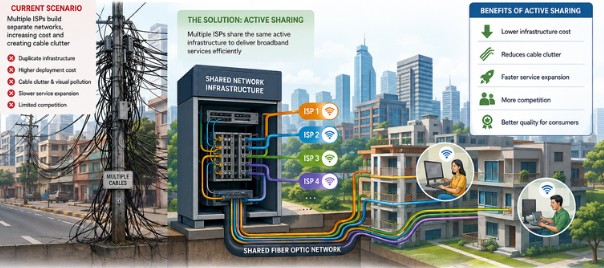
Bangladesh is moving closer to introducing 'active sharing' in its broadband internet sector, a long-discussed reform that regulators and industry stakeholders believe could significantly reshape the country's digital infrastructure by allowing multiple internet service providers (ISPs) to use the same broadband network.
The Bangladesh Telecommunication Regulatory Commission (BTRC) said it has prepared a preliminary draft of the guideline governing active sharing. The framework will be finalized after reviewing feedback from stakeholders, with nationwide implementation to be considered following pilot evaluations.
If implemented, active sharing will enable multiple ISPs to provide broadband services over a common fiber-optic infrastructure instead of building separate networks.
Dhanmondi eyed as first full-scale active sharing zone
According to multiple telecommunications sector sources, BTRC is planning to designate Dhanmondi as Bangladesh's first fully operational active sharing zone.
Officials are currently assessing the performance of a limited-scale model that has been operating there for several years. If the results remain positive, the initiative could gradually be expanded to other areas of Dhaka before being rolled out across major cities nationwide.
Tackling duplicate infrastructure
Currently, multiple ISPs often install separate fiber-optic cables, switches, distribution boxes and other equipment in the same neighborhoods. The duplication increases deployment costs, creates inconvenience during construction and contributes to the growing web of overhead cables on utility poles and building walls.
Industry leaders argue that adopting a shared infrastructure model would eliminate unnecessary investments while improving network efficiency.
Countries around the world have already embraced similar models, reducing capital expenditure and improving service quality through better utilization of existing infrastructure.
Lower costs, greater competition
At present, ISPs typically need to lay new fiber cables even when connecting customers in areas already served by another operator. The practice significantly increases operational costs, particularly for small and medium-sized providers.
Under active sharing, providers would instead lease access to existing infrastructure, allowing them to focus resources on improving service quality rather than duplicating physical networks.
The reform is also expected to benefit consumers by increasing competition.
Many neighborhoods are currently dominated by only one or two broadband providers, limiting customer choice. Switching to another ISP often requires installing entirely new cables.
With active sharing, customers would be able to change providers while using the same infrastructure, encouraging greater competition in both pricing and service quality.
Untapped network capacity
ISPAB President Aminul Hakim said Bangladesh currently has broadband infrastructure capable of serving far more households than it does today.
According to him, about 5 million households currently use broadband internet, but existing infrastructure could connect between 16 million and 17 million households if active sharing were introduced.
He estimated total investment in Bangladesh's ISP sector at around Tk 20,000 crore, while only 30 to 35 percent of the existing network capacity is currently being utilized due to policy limitations and duplicated infrastructure.
"Active sharing will ensure optimal use of existing infrastructure, reduce costs and accelerate broadband expansion," he said.
BTRC finalizing guideline
BTRC officials confirmed that work on the guideline is in its final stages.
BTRC Chairman Major General (Retd.) Md. Emdad Ul Bari said the commission has completed the initial draft and is reviewing stakeholder feedback before making a final decision.
"We are discussing every aspect carefully. The final guideline will reflect the views of all stakeholders."
Asked whether mobile network operators would also be included under the active sharing framework in the future, the chairman said the matter remains under discussion and decisions will be made after detailed assessment.
Industry workshop builds consensus
The renewed push for active sharing began in April when BTRC decided to move forward with the policy.
On April 30, the regulator organized a workshop titled "Telecommunication Infrastructure Sharing" at its headquarters in Agargaon.
Around 130 representatives from mobile operators, Nationwide Telecommunication Transmission Network (NTTN) operators, tower companies, ISPs, ISPAB, Bangladesh Satellite Company Limited (BSCL), government agencies, private organizations and universities participated.
Participants broadly agreed that active sharing would reduce infrastructure costs, speed up network expansion, improve service quality and help eliminate the growing problem of overhead fiber-optic cable congestion.
Tower companies highlighted international experience showing that shared telecom infrastructure lowers deployment costs, expands connectivity and supports digital inclusion.
NTTN operators emphasized the need for a balanced regulatory framework given Bangladesh's multi-layered licensing structure, while mobile operators said active sharing could play a key role in expanding 5G services after the success of passive infrastructure sharing.
Representatives from Bangladesh Satellite Company Limited (BSCL) also noted that shared infrastructure would reduce duplication of resources and support more sustainable network development, while expanding opportunities to use Non-Geostationary Satellite Orbit (NGSO) technology in areas where fiber deployment is not feasible.
Industry stakeholders believe the successful implementation of active sharing could mark one of the most significant structural reforms in Bangladesh's broadband sector, making internet services more affordable, competitive and efficient while accelerating the country's digital transformation.
The Bangladesh Telecommunication Regulatory Commission (BTRC) said it has prepared a preliminary draft of the guideline governing active sharing. The framework will be finalized after reviewing feedback from stakeholders, with nationwide implementation to be considered following pilot evaluations.
If implemented, active sharing will enable multiple ISPs to provide broadband services over a common fiber-optic infrastructure instead of building separate networks.
Dhanmondi eyed as first full-scale active sharing zone
According to multiple telecommunications sector sources, BTRC is planning to designate Dhanmondi as Bangladesh's first fully operational active sharing zone.
Officials are currently assessing the performance of a limited-scale model that has been operating there for several years. If the results remain positive, the initiative could gradually be expanded to other areas of Dhaka before being rolled out across major cities nationwide.
Tackling duplicate infrastructure
Currently, multiple ISPs often install separate fiber-optic cables, switches, distribution boxes and other equipment in the same neighborhoods. The duplication increases deployment costs, creates inconvenience during construction and contributes to the growing web of overhead cables on utility poles and building walls.
Industry leaders argue that adopting a shared infrastructure model would eliminate unnecessary investments while improving network efficiency.
Countries around the world have already embraced similar models, reducing capital expenditure and improving service quality through better utilization of existing infrastructure.
Lower costs, greater competition
At present, ISPs typically need to lay new fiber cables even when connecting customers in areas already served by another operator. The practice significantly increases operational costs, particularly for small and medium-sized providers.
Under active sharing, providers would instead lease access to existing infrastructure, allowing them to focus resources on improving service quality rather than duplicating physical networks.
The reform is also expected to benefit consumers by increasing competition.
Many neighborhoods are currently dominated by only one or two broadband providers, limiting customer choice. Switching to another ISP often requires installing entirely new cables.
With active sharing, customers would be able to change providers while using the same infrastructure, encouraging greater competition in both pricing and service quality.
Untapped network capacity
ISPAB President Aminul Hakim said Bangladesh currently has broadband infrastructure capable of serving far more households than it does today.
According to him, about 5 million households currently use broadband internet, but existing infrastructure could connect between 16 million and 17 million households if active sharing were introduced.
He estimated total investment in Bangladesh's ISP sector at around Tk 20,000 crore, while only 30 to 35 percent of the existing network capacity is currently being utilized due to policy limitations and duplicated infrastructure.
"Active sharing will ensure optimal use of existing infrastructure, reduce costs and accelerate broadband expansion," he said.
BTRC finalizing guideline
BTRC officials confirmed that work on the guideline is in its final stages.
BTRC Chairman Major General (Retd.) Md. Emdad Ul Bari said the commission has completed the initial draft and is reviewing stakeholder feedback before making a final decision.
"We are discussing every aspect carefully. The final guideline will reflect the views of all stakeholders."
Asked whether mobile network operators would also be included under the active sharing framework in the future, the chairman said the matter remains under discussion and decisions will be made after detailed assessment.
Industry workshop builds consensus
The renewed push for active sharing began in April when BTRC decided to move forward with the policy.
On April 30, the regulator organized a workshop titled "Telecommunication Infrastructure Sharing" at its headquarters in Agargaon.
Around 130 representatives from mobile operators, Nationwide Telecommunication Transmission Network (NTTN) operators, tower companies, ISPs, ISPAB, Bangladesh Satellite Company Limited (BSCL), government agencies, private organizations and universities participated.
Participants broadly agreed that active sharing would reduce infrastructure costs, speed up network expansion, improve service quality and help eliminate the growing problem of overhead fiber-optic cable congestion.
Tower companies highlighted international experience showing that shared telecom infrastructure lowers deployment costs, expands connectivity and supports digital inclusion.
NTTN operators emphasized the need for a balanced regulatory framework given Bangladesh's multi-layered licensing structure, while mobile operators said active sharing could play a key role in expanding 5G services after the success of passive infrastructure sharing.
Representatives from Bangladesh Satellite Company Limited (BSCL) also noted that shared infrastructure would reduce duplication of resources and support more sustainable network development, while expanding opportunities to use Non-Geostationary Satellite Orbit (NGSO) technology in areas where fiber deployment is not feasible.
Industry stakeholders believe the successful implementation of active sharing could mark one of the most significant structural reforms in Bangladesh's broadband sector, making internet services more affordable, competitive and efficient while accelerating the country's digital transformation.

Loading...
Loading...
Also read






Editor : Iqbal Sobhan Chowdhury
Published by the Editor on behalf of the Observer Ltd. from Globe Printers, 24/A, New Eskaton Road, Ramna, Dhaka.
Editorial, News and Commercial Offices : Aziz Bhaban (2nd floor), 93, Motijheel C/A, Dhaka-1000.
Phone: PABX- 41053001-06; Advertisement: 41053012; 01793317829, 01550707291, E-mail: [email protected], [email protected] Online: email: [email protected] 41053014; 01550707297 Advertisement: 01550707296
Published by the Editor on behalf of the Observer Ltd. from Globe Printers, 24/A, New Eskaton Road, Ramna, Dhaka.
Editorial, News and Commercial Offices : Aziz Bhaban (2nd floor), 93, Motijheel C/A, Dhaka-1000.
Phone: PABX- 41053001-06; Advertisement: 41053012; 01793317829, 01550707291, E-mail: [email protected], [email protected] Online: email: [email protected] 41053014; 01550707297 Advertisement: 01550707296


