



| HEADLINE |

|

Bangladesh Loses Millions in Crab Export Race as 97pc Hatchery Seed Perishes
Published : Saturday, 8 August, 2026 at 12:00 AM
Mohosinul Karim


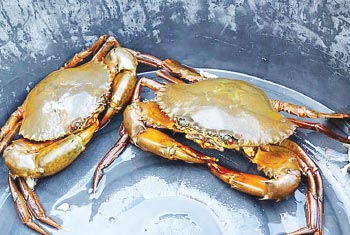 Bangladesh is haemorrhaging millions of dollars in potential export earnings every year as its fledgling crab industry struggles with outdated hatchery technology, crippling seed mortality and inadequate logistics, allowing regional rivals Thailand and Vietnam to dominate the lucrative global market.
Industry leaders have warned that unless Bangladesh rapidly adopts advanced hatchery technology and modern production systems similar to those used in Thailand and Vietnam, the country will continue to miss a golden opportunity to transform crab into one of its most valuable non-traditional export commodities.
The biggest obstacle is the country's extraordinarily low hatchery survival rate. Nearly 97 per cent of hatchery-produced mud crab larvae die before reaching maturity, forcing farmers to depend heavily on wild seed and severely limiting commercial production despite surging international demand.
"Every percentage point increase in hatchery survival translates into millions of dollars in additional export earnings," an exporter told the Daily Observer, describing the technology gap as the industry's greatest challenge.
The warning comes at a time when Bangladesh's crab exports are expanding steadily but remain a fraction of those of its regional competitors.
According to industry data, Bangladesh earned US$14.2 million by exporting 1,166.88 tonnes of live and soft-shell mud crabs in FY2024-25. Export momentum has accelerated further, with shipments during the first ten months of FY2025-26 already surpassing last year's total.
Yet the country's performance pales beside that of Vietnam, which earned a record US$384.9 million from crab and shellfish exports in 2025-almost 27 times Bangladesh's earnings. Thailand, another regional leader, generates an estimated US$250-300 million annually through exports of frozen, canned and value-added crab products.
Industry analysts say the disparity has little to do with natural resources.
For decades, Bangladeshi farmers have relied on juvenile crabs collected from the Sundarbans and coastal rivers before fattening them for export. Although commercial hatcheries have begun producing artificial seed, the country's only government-operated crab hatchery and nursery complex at Kolatoli in Cox's Bazar continues to struggle with obsolete technology, resulting in exceptionally high larval mortality.

"Bangladesh's only government-established crab hatchery is located at Kolatoli in Cox's Bazar. Crab has now become one of the country's most important aquaculture products after shrimp. We recently held a meeting with the Fisheries and Livestock Adviser, where several decisions were taken to improve hatchery operations. We hope to implement effective measures soon to increase crab seed production," he said.
Explaining the low survival rate, Chowdhury said crab larvae are naturally highly cannibalistic.
"They prey on one another during the larval stages. As a result, our hatchery survival rate is only around 2.5 per cent, whereas hatcheries in countries such as Thailand and Vietnam generally achieve 5 to 7 per cent. Bridging this gap would dramatically increase production."
Officials and industry experts believe that even modest improvements in hatchery survival could transform the economics of the sector by ensuring a reliable year-round supply of seed while reducing pressure on wild crab populations.
Cox's Bazar District Fisheries Officer Md. Nazmul Huda said crab farming has become one of the country's most profitable coastal enterprises because it offers faster returns and lower disease risks than shrimp cultivation.
"Export-quality crabs can be produced within just 15 to 20 days, allowing farmers to recover their investment quickly while earning attractive profits. Unlike shrimp farming, crab cultivation faces far fewer viral disease outbreaks," he said.
More than 30,000 hectares of coastal land are now under crab farming, with major production centres in Khulna, Satkhira, Bagerhat, Cox's Bazar and other coastal districts. Demand is particularly strong in China, Hong Kong, Taiwan, Singapore and Thailand, especially during the Chinese New Year festival.
Bangladesh has also entered the premium soft-shell crab market, opening fresh opportunities in Europe and North America.
"Soft-shell crabs are highly prized in the United States and European markets and fetch around US$10-15 per kilogram," Nazmul Huda said.
Manager of the government's crab hatchery Md. Enayetullah Rana said expanding hatchery production would not only strengthen exports but also protect fragile coastal ecosystems by reducing dependence on wild seed collection.
"Bangladesh's coastal region has around five million crab cages, and until recently nearly 80 per cent of seed came directly from nature. Hatchery production will ensure year-round seed availability while conserving biodiversity," he said.
Rana warned that inadequate cold-chain facilities remain another major bottleneck.
"Many live crabs die during transportation because of poor cold storage and weak logistics, causing heavy financial losses. Thailand, China and Vietnam are decades ahead in artificial crab seed production. If Bangladesh adopts similar technologies and modern logistics, national production could easily double."
Official figures reflect the industry's rapid expansion. Data from the Export Promotion Bureau (EPB) show that crab export earnings climbed from Tk 309 crore in FY2020-21 to Tk 867.88 crore in FY2024-25, nearly tripling within five years.
Bangladesh now exports crabs to 17 countries, with China remaining the largest buyer, importing crabs worth Tk 683.48 crore. Soft-shell crabs are primarily shipped to the United States, Australia, Singapore, the United Kingdom and several European Union markets.
According to the Department of Fisheries, commercial crab farming covered 16,672 hectares during the last fiscal year, producing 10,782 tonnes. Crabs are marketed in 18 commercial grades, while soft-shell crabs currently retail domestically at Tk 800 to Tk 1,400 per kilogram, depending on size and quality.
Industry leaders believe Bangladesh now stands at a decisive crossroads.
With sustained investment in advanced hatchery technology, commercial seed production, internationally certified processing plants, modern cold-chain logistics and technology transfer from Thailand and Vietnam, they say the country could rapidly expand exports and establish crab as the next high-value success story after shrimp.
"The market is already there," one exporter said. "What Bangladesh lacks is not demand or natural resources-it is the technology to compete."
The writer is the Chief Reporter of The Daily Observer.

Loading...
Loading...
Also read



Editor : Iqbal Sobhan Chowdhury
Published by the Editor on behalf of the Observer Ltd. from Globe Printers, 24/A, New Eskaton Road, Ramna, Dhaka.
Editorial, News and Commercial Offices : Aziz Bhaban (2nd floor), 93, Motijheel C/A, Dhaka-1000.
Phone: PABX- 41053001-06; Advertisement: 41053012; 01793317829, 01550707291, E-mail: [email protected], [email protected] Online: email: [email protected] 41053014; 01550707297 Advertisement: 01550707296
Published by the Editor on behalf of the Observer Ltd. from Globe Printers, 24/A, New Eskaton Road, Ramna, Dhaka.
Editorial, News and Commercial Offices : Aziz Bhaban (2nd floor), 93, Motijheel C/A, Dhaka-1000.
Phone: PABX- 41053001-06; Advertisement: 41053012; 01793317829, 01550707291, E-mail: [email protected], [email protected] Online: email: [email protected] 41053014; 01550707297 Advertisement: 01550707296


