



| HEADLINE |

|

The Parallel State - PART 2
How Corruption Became the Nation's Costliest Tax
Why Corruption Has Become the Nation's Costliest Tax—and Why
Only a Hybrid Anti-Corruption Model Can Break the Cycle
Published : Saturday, 8 August, 2026 at 12:00 AM
Faruk Ahmed


 Every nation collects taxes to finance development. Bangladesh, however, has long operated under a second, unofficial tax system�"one collected not by the National Board of Revenue but by corrupt officials, brokers and middlemen who have turned public services into private marketplaces.
The latest Transparency International Bangladesh (TIB) National Household Survey 2025 reveals the staggering scale of that hidden economy. More than 81.6 per cent of households encountered corruption while accessing public services last year, 63.6 per cent were compelled to pay bribes and the country's unofficial bribe bill climbed to Tk 12,633.2 crore�"an increase of 15.9 per cent from 2023. Equivalent to 1.58 per cent of the revised national budget and 0.23 per cent of GDP, it is money diverted from households to an entrenched system of illicit payments.
These figures amount to far more than another corruption survey. They expose a governance crisis in which bribery has become institutionalised, public confidence has eroded and corruption increasingly functions as a parallel administrative system.
For the Tarique Rahman-led government, which has pledged to rebuild institutions, strengthen the Anti-Corruption Commission (ACC) and restore integrity in public administration, the report presents an unmistakable warning: Bangladesh cannot achieve sustained economic transformation while corruption remains embedded in the machinery of the state.
 When Bribery Becomes a System
The survey demonstrates that corruption is no longer confined to isolated misconduct or a handful of dishonest officials. It has become embedded in routine service delivery.
Among households that paid bribes, 98.1 per cent said they had no alternative, while more than 91 per cent reported that officials themselves were directly involved in demanding or collecting illicit payments. More than four out of five respondents believed essential services simply could not be obtained without paying extra.
This is no longer corruption at the margins of government. It is an unofficial payment system operating alongside the formal state.
Whether applying for a passport, registering land, obtaining a driving licence, seeking healthcare or dealing with law enforcement, citizens increasingly encounter unofficial charges before receiving services that should be guaranteed by law.
Partial digitalisation has failed to dismantle the problem. Instead, digital platforms often coexist with discretionary authority, opaque procedures and broker networks that continue to profit from administrative complexity.
Technology has modernised transactions without always transforming governance.
The Heavy Price of Corruption
The economic consequences extend far beyond the immediate loss of Tk 12,633.2 crore.
Corruption acts as a hidden tax on households, an informal levy on businesses and a structural brake on national development. It inflates transaction costs, weakens investor confidence, misallocates scarce public resources and suppresses productivity.
Bangladesh's position of 151st among 180 countries in the 2024 Corruption Perceptions Index, with a score of 23 out of 100, reflects not merely a reputational problem but a structural weakness in governance.
Economists estimate that corruption may reduce Bangladesh's annual GDP growth by two to three percentage points, while illicit financial outflows estimated at US$10�"16 billion annually drain capital that could otherwise finance investment, innovation and employment.
For ordinary citizens, the burden is even more immediate.
Poor households seeking passport services spent, on average, 78 per cent of their monthly income, including 37 per cent on bribes alone. In several cases documented by the survey, families paid bribes amounting to several times their annual income.
Corruption therefore widens inequality by transferring resources from the poorest households to those exercising administrative discretion.It reduces disposable income, limits investment in education and healthcare, discourages entrepreneurship and reinforces intergenerational poverty.
The Crisis of Public Trust
Perhaps the survey's most disturbing finding is not the amount of money lost but the collapse of public confidence.
More than half of households did not know how to report corruption. Among those who experienced corruption, only one in ten lodged a complaint, while most complaints produced little or no action.
Silence has become a rational response.
An accountability system that citizens no longer trust ceases to function as an accountability system at all.
The TIB survey identifies impunity as the principal driver of corruption, followed by weak public awareness, inadequate transparency and the continued protection of corrupt officials.These findings expose not simply administrative failure but a deeper erosion of the relationship between citizens and the state.
Why the ACC Alone Cannot Win
The Anti-Corruption Commission remains an indispensable institution, but expecting it alone to eliminate corruption is unrealistic.
Corruption today is decentralised. It extends through local government, land administration, customs, procurement, taxation, licensing and frontline public services.
No single institution, however capable, can dismantle such a deeply embedded ecosystem.Moreover, public confidence in the ACC itself remains fragile.
Institutional independence, adequate resources, professional leadership and consistent enforcement are essential if the Commission is to become the credible guardian envisioned by law.
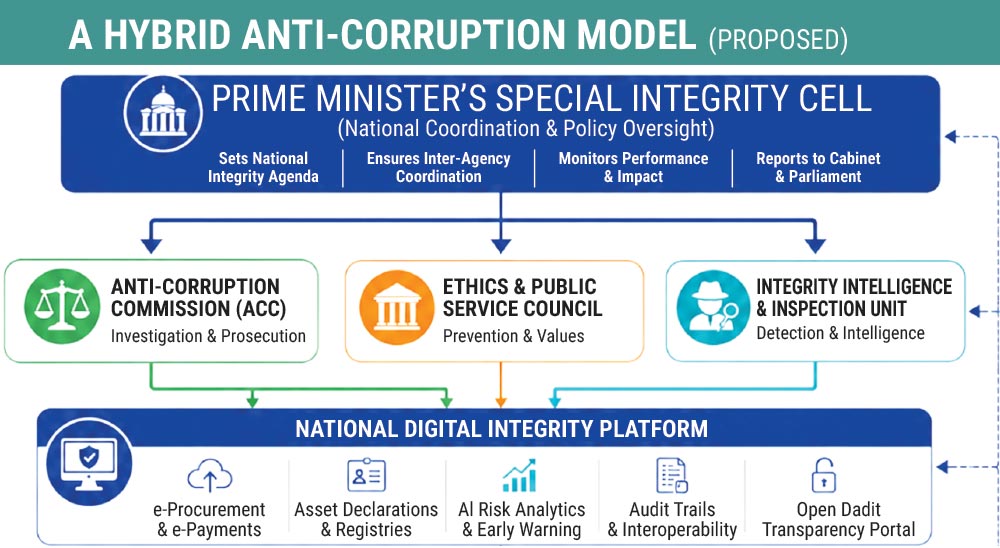
A Hybrid Anti-Corruption Model
Bangladesh now requires a hybrid anti-corruption strategy that combines strong enforcement with structural reform and ethical governance.
International experience offers valuable lessons.
Singapore demonstrates how independent enforcement, swift prosecution and an exceptionally disciplined civil service can minimise opportunities for corruption.Bhutan illustrates the importance of embedding ethics, integrity and public-service values throughout government.Malaysia shows both the potential and the limitations of institutional reform when political commitment fluctuates.
Drawing on these experiences, Bangladesh's strategy should rest on four mutually reinforcing pillars.
First, independent enforcement, with a professionally empowered ACC, specialised anti-corruption courts and timely prosecution insulated from political influence.
Second, institutional reform, including merit-based recruitment, transparent procurement, simplified regulations and mandatory digital records for all public transactions.
Third, technology-enabled accountability, ensuring every payment, approval and procurement decision leaves a fully auditable electronic trail while reducing discretionary decision-making.
Fourth, ethical governance and citizen oversight, supported by whistle-blower protection, stronger grievance mechanisms, independent media, civil society participation and integrity education throughout the public service.
These pillars should function together. Technology without enforcement merely digitises corruption, while enforcement without institutional reform risks selective justice.
The Government's Defining Test
The Tarique Rahman administration has promised to restore integrity, rebuild institutions and modernise governance.
The true measure of those promises will not be speeches or reform blueprints.It will be whether ordinary citizens can obtain a passport, register land, receive hospital treatment or secure a public service without paying an unofficial fee.
That is the benchmark by which institutional reform will ultimately be judged.
Breaking the Parallel State
Bangladesh stands at a decisive moment.
The TIB survey has quantified the cost of corruption, but its real significance lies elsewhere. It demonstrates that corruption has evolved into a parallel system of governance�"one financed by unofficial payments and sustained by weak accountability.
The Tk 12,633.2 crore lost to bribery is not merely money diverted into private pockets. It represents schools that could have been built, hospitals that could have been modernised, infrastructure that could have been completed and businesses that could have expanded.
The challenge before Bangladesh is therefore larger than fighting corruption. It is about restoring the legitimacy of the state itself.
If the country can replace patronage with merit, discretion with transparency and impunity with accountability, corruption will cease to function as an invisible tax on development.Only then can Bangladesh unlock its full economic potential and ensure that public institutions serve citizens rather than those who profit from them.
(CONCLUDED)
The writer is the Consulting Editor of The Daily Observer. He may be reached at [email protected]
Loading...
Loading...
Also read



Editor : Iqbal Sobhan Chowdhury
Published by the Editor on behalf of the Observer Ltd. from Globe Printers, 24/A, New Eskaton Road, Ramna, Dhaka.
Editorial, News and Commercial Offices : Aziz Bhaban (2nd floor), 93, Motijheel C/A, Dhaka-1000.
Phone: PABX- 41053001-06; Advertisement: 41053012; 01793317829, 01550707291, E-mail: [email protected], [email protected] Online: email: [email protected] 41053014; 01550707297 Advertisement: 01550707296
Published by the Editor on behalf of the Observer Ltd. from Globe Printers, 24/A, New Eskaton Road, Ramna, Dhaka.
Editorial, News and Commercial Offices : Aziz Bhaban (2nd floor), 93, Motijheel C/A, Dhaka-1000.
Phone: PABX- 41053001-06; Advertisement: 41053012; 01793317829, 01550707291, E-mail: [email protected], [email protected] Online: email: [email protected] 41053014; 01550707297 Advertisement: 01550707296


