



| HEADLINE |

|

HOW NOT TO BE STUPID
Published : Saturday, 8 August, 2026 at 12:00 AM
Igor Sibaldi


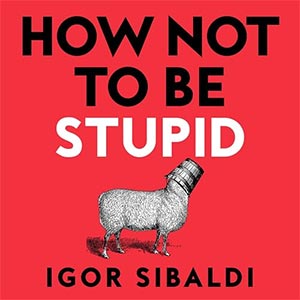 The everyday insult is not about a lack of smarts, argues Igor Sibaldi, it is about how social conventions freeze our ability to think for ourselves…
“Stupid” is one of the most common insults of everyday life, but what does the term really mean? The Oxford dictionary defines it as “showing a lack of thought or good judgement.” Italian philosopher, philologist and bestselling author Igor Sibaldi believes it means much more than that.
In his latest book, How Not to be Stupid: The Transformative Power of Independent Thinking, Sibaldi, who also wrote the acclaimed Disobedience, examines the term through language, thought and social convention. The result makes readers look at not just the word, but the world, in a new light.
Reviewed by Nimish Dubey and Akriti Rana
What is stupidity
Despite its catchy title, How Not to be Stupid is not a self-help book. Reading this slim, 200-page book will not expunge stupidity from our lives or grant us newfound intelligence. It will, however, help us understand what stupidity really is. Sibaldi, an expert in the study of words, points out that we use “stupid” out of habit, without knowing its exact meaning or its connotations.
“‘Stupid’ is a conventional word, just like ‘reality,’ ‘politics’ and so on,” he writes. “Conventional words are like the rules of a game. We accept them at face value and never question them, simply because everyone uses them. Calling someone stupid, or fearing being seen as stupid, doesn’t require you to know exactly what stupidity is.”
The 12 functions of stupidity
How Not to be Stupid is not about the need for intelligence or the importance of avoiding stupidity. It argues for thinking independently, free of social influence. In one of the book’s key passages, Sibaldi writes:
“Stupidity comes from the Latin stupeo, meaning ‘I remain still.’ A stupid person, or stupidus, may seem ignorant, foolish, imbecilic, silly, crack-brained, cretinous, idiotic or weak-minded, but isn’t necessarily any of these things. A stupid person simply has to stand still sometimes, because they don’t know how to react to situations that seem straightforward to others.”
Sibaldi identifies 12 areas, which he calls “functions,” where we tend to be stupid. These functions shape how we see the world and lead us to act, think, desire, remember and forget. They include communication, self-defense, authority, wealth and our sense of obstacles. Sibaldi explains each briefly, often with examples, and in a chapter titled “Twelve Versions of I,” he shows how each one affects us.
A section on psychology follows, along with an epilogue featuring a test built around the 12 functions. For each question, the book offers a good answer and a banal answer, illustrating different ways to approach the same issue, then gives examples of people who reflect the 12 functions in different ways.
‘Stupid people can also be very intelligent’
Though divided into short chapters, How Not to be Stupid is not a quick or effortless read. Readers will pause often, sometimes to think, sometimes to look up a term. Sibaldi seems to forget that many readers lack his vocabulary and depth of knowledge, and some sentences and ideas grow complicated.
Still, everyone should read this book, especially now, when social media influences, and at times controls, so much of our lives. It makes readers think and often holds up a mirror to their own thinking, a reflection that isn’t always comforting but is always necessary. Avoiding stupidity matters, but so does recognizing when we fall into it.
Courtesy: The Indian Express
Loading...
Loading...






Editor : Iqbal Sobhan Chowdhury
Published by the Editor on behalf of the Observer Ltd. from Globe Printers, 24/A, New Eskaton Road, Ramna, Dhaka.
Editorial, News and Commercial Offices : Aziz Bhaban (2nd floor), 93, Motijheel C/A, Dhaka-1000.
Phone: PABX- 41053001-06; Advertisement: 41053012; 01793317829, 01550707291, E-mail: [email protected], [email protected] Online: email: [email protected] 41053014; 01550707297 Advertisement: 01550707296
Published by the Editor on behalf of the Observer Ltd. from Globe Printers, 24/A, New Eskaton Road, Ramna, Dhaka.
Editorial, News and Commercial Offices : Aziz Bhaban (2nd floor), 93, Motijheel C/A, Dhaka-1000.
Phone: PABX- 41053001-06; Advertisement: 41053012; 01793317829, 01550707291, E-mail: [email protected], [email protected] Online: email: [email protected] 41053014; 01550707297 Advertisement: 01550707296


