



| HEADLINE |

|
Darwin’s carnivorous plant claim proven after 150 years
Published : Saturday, 8 August, 2026 at 12:00 AM
Observer Desk


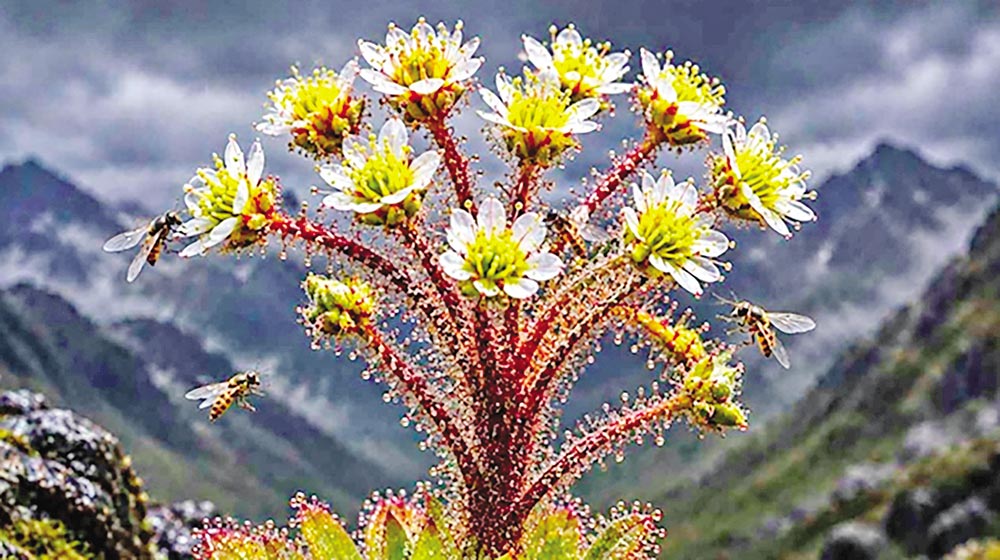 Scientists have confirmed a 150-year-old theory proposed by British naturalist Charles Darwin, showing that plants belonging to the Saxifraga group are capable of trapping and digesting insects.
Darwin suggested in 1875 that Saxifraga rotundifolia and S. umbrosa were insect-eating plants because their hairlike structures, known as glandular trichomes, produce a sticky substance similar to that found in some carnivorous plants. However, he was unable to prove conclusively that the plants could attract, trap and digest insects.
A study published on Tuesday in the journal Nature Communications tested Darwin's hypothesis using Saxifraga candelabrum, a flowering mountain plant found at high altitudes on the southern Qinghai-Tibet Plateau and in China's Yunnan and Sichuan provinces.
Through chemical analysis, researchers found that the plant attracts tiny gnats with scent-producing compounds before trapping and digesting them using an enzyme called phosphatase.
Scientists also used isotope labelling, a technique that tracks elements with different atomic weights, to show that nitrogen-15 from insect prey was absorbed by the plants after digestion, providing direct evidence that nutrients are transferred from insects to the plant.
Genetic analysis revealed that S. candelabrum shares genes with other sticky carnivorous plants responsible for attracting prey, digesting insects and absorbing nutrients.
When researchers expanded their study to other plant groups with different trapping methods, they identified dozens of genes associated with insect digestion. Senior study author Hang Sun, professor and director of the Kunming Institute of Botany at the Chinese Academy of Sciences in Beijing, said the findings could help botanists identify other insect-eating plants that have gone unnoticed.
Scientists estimate there are at least 350,000 species of flowering plants worldwide, with more than 750 known to be carnivorous.
Botanist Susan Myers, horticulture and conservation director at the Pittsburgh Botanic Garden, who was not involved in the study, said different forms of carnivory have evolved independently in 14 plant families. She said the findings provide important new insights into the evolution of this remarkable survival strategy.
Loading...
Loading...
Also read



Editor : Iqbal Sobhan Chowdhury
Published by the Editor on behalf of the Observer Ltd. from Globe Printers, 24/A, New Eskaton Road, Ramna, Dhaka.
Editorial, News and Commercial Offices : Aziz Bhaban (2nd floor), 93, Motijheel C/A, Dhaka-1000.
Phone: PABX- 41053001-06; Advertisement: 41053012; 01793317829, 01550707291, E-mail: [email protected], [email protected] Online: email: [email protected] 41053014; 01550707297 Advertisement: 01550707296
Published by the Editor on behalf of the Observer Ltd. from Globe Printers, 24/A, New Eskaton Road, Ramna, Dhaka.
Editorial, News and Commercial Offices : Aziz Bhaban (2nd floor), 93, Motijheel C/A, Dhaka-1000.
Phone: PABX- 41053001-06; Advertisement: 41053012; 01793317829, 01550707291, E-mail: [email protected], [email protected] Online: email: [email protected] 41053014; 01550707297 Advertisement: 01550707296


