



| HEADLINE |

|
Security alerts keep foreign tourists away from BD
Prolonged security perceptions undermine Bangladesh’s image as an attractive global tourist destination
Published : Tuesday, 18 August, 2026 at 12:00 AM
Mohosinul Karim


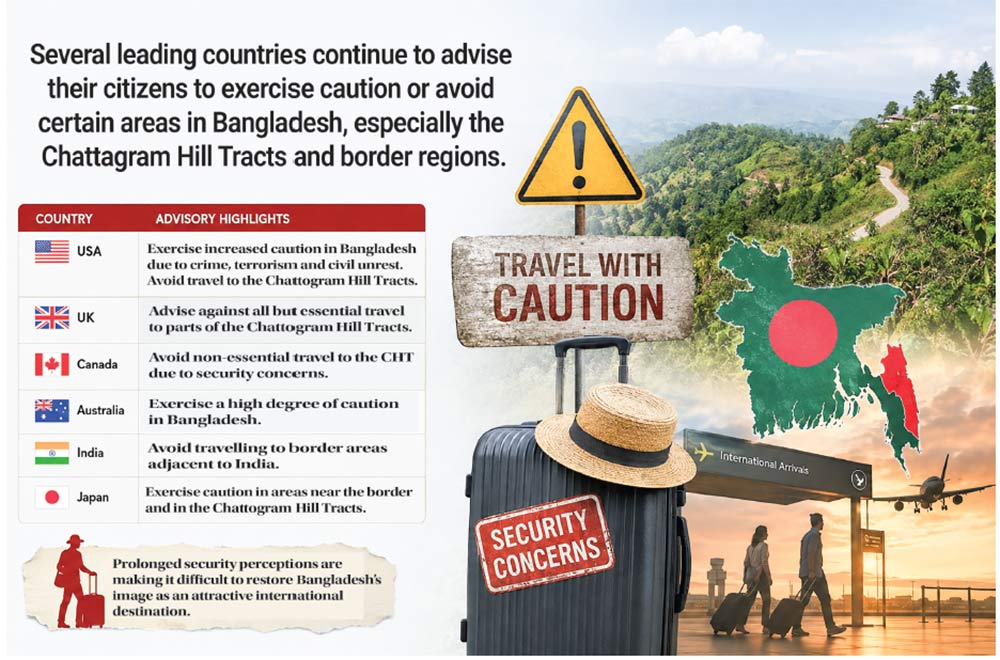 Bangladesh’s tourism industry is facing another major challenge as a number of leading countries continue to maintain security-related travel advisories for their citizens travelling to Bangladesh, particularly for the Chattogram Hill Tracts (CHT) and some border areas.
Although the nature and severity of the advisories vary from country to country, official guidance from several major tourism-source markets continues to urge travellers to exercise heightened caution or avoid particular parts of Bangladesh.
The situation is adding to the difficulties faced by an already fragile tourism industry, which has become heavily dependent on domestic travellers as foreign tourist arrivals remain relatively low. Tourism businesses, tour operators and travel agencies say prolonged security perceptions are making it difficult to restore Bangladesh’s image as an attractive international destination.
Regarding the issue, tourism sector expert and Pacific Asia Travel Association (PATA) Bangladesh Chapter Secretary General Taufiq Rahman told this correspondent that due to negligence from the government authorities, the duration of travel alert is lingering.
“Bangladesh only asks its embassies to different countries to communicate with the governments of the countries issue travel alerts. But, it’s not the system. The government as well as the Bangladesh Tourism Board (BTB) should hold repeated meetings with the envoys of those countries and brief them about the country’s overall situation including the political developments. If the envoys are satisfied, they will tell their governments to withdraw the alerts. But, there is no such initiative unfortunately,’ he added.
When contacted, Bangladesh Tourism Board’s (BTB) Deputy Director Mohibul Islam told this correspondent that after August 5, 2024 changeover, the government authorities concerned have various initiatives to lessen or withdrawal of the travel advisories for the foreign tourists.

There has been an important positive development, however. The United States recently eased its overall travel advisory for Bangladesh from Level 3-“Reconsider Travel” to Level 2-“Exercise Increased Caution.” The change was announced on July 30, 2026, and was welcomed by the Bangladesh government as a sign of improving security and stability.
However, the US continues to classify the Chattogram Hill Tracts-Rangamati, Khagrachari and Bandarban-as Level 4, “Do Not Travel.” The US cites risks including unrest, crime, terrorism and kidnapping.
Japan has similarly maintained a comparatively moderate advisory for most of Bangladesh. Its Foreign Ministry classifies the CHT-comprising Rangamati, Khagrachari and Bandarban-at Level 2, advising against non-essential travel, while the rest of Bangladesh is at Level 1, “Exercise caution.” The current classification has been in place since December 26, 2025.
New Zealand’s SafeTravel guidance remains considerably stricter. Bangladesh is currently classified at Level 3-“Avoid non-essential travel.”
New Zealand also specifically warns of kidnapping, armed robbery and politically motivated and ethnic violence in the CHT.
Canada currently advises its citizens to “Exercise a high degree of caution” throughout Bangladesh because of possible demonstrations, clashes and nationwide strikes. It separately advises “Avoid all travel” to the Chattogram Hill Tracts, citing politically motivated violence, kidnapping and sporadic ethnic clashes. The Canadian advisory was last updated on June 23, 2026.

Australia has also lowered its overall warning compared with its previous position. Its Smartraveller advice currently says travellers should “Exercise a high degree of caution” in Bangladesh overall, while advising them to reconsider their need to travel to the CHT because of kidnapping, politically motivated violence and clashes. The Australian advice remained current on July 28, 2026.
The UK does not currently advise against travel to Bangladesh as a whole. Its Foreign, Commonwealth and Development Office advises against all but essential travel to the Chattogram Hill Tracts, comprising Rangamati, Khagrachari and Bandarban.
France maintains a particularly restrictive advisory. Its current guidance places Bangladesh broadly in an orange zone, meaning travel is discouraged except for compelling reasons because of the terrorism risk.
The French advisory also places the Myanmar-border areas and Saint Martin’s Island in the red zone, where travel is formally discouraged. The CHT is described as particularly problematic because of recurring conflicts between communities. The relevant security map was last updated on March 6, 2026 and remains valid.
Germany’s Foreign Office continues to publish travel and security advice for Bangladesh, with its latest page dated July 31, 2026. The guidance covers the country’s security situation and warns travellers that conditions can change quickly.
Denmark’s Foreign Ministry advises travellers to exercise extra caution throughout Bangladesh and discourages all non-essential travel to the CHT because of risks including violent clashes and kidnapping. Its guidance was valid through July 26, 2026.
Against this backdrop, describing the situation simply as “20 countries have issued travel alerts against Bangladesh” would be misleading.
The prolonged weakness in international tourism has also affected travel agencies.
Industry insiders say a large number of agencies have either closed down, reduced their operations or shifted to a much smaller scale. Businesses that previously depended on international inbound tourists have struggled to maintain staffing, marketing and operational costs in the absence of sufficient foreign demand.
For smaller agencies, the problem is particularly severe because they lack the financial capacity to withstand a prolonged downturn.
Reducing travel advisories, particularly those covering major tourism destinations, could help restore confidence among foreign travellers and international tour operators. At the same time, stronger destination security, transparent communication, better tourist policing, improved emergency services and more aggressive international marketing will be essential.
The challenge for Bangladesh is therefore not simply to persuade foreign tourists that the country is attractive. It is to convince them-and the governments that issue travel advice-that travelling to Bangladesh is safe, predictable and worth the journey.
For an industry increasingly dependent on domestic tourists, restoring international confidence could be critical to bringing back foreign visitors, reviving struggling travel agencies and rebuilding Bangladesh’s position in the regional tourism market.
Loading...
Loading...
Also read



Editor : Iqbal Sobhan Chowdhury
Published by the Editor on behalf of the Observer Ltd. from Globe Printers, 24/A, New Eskaton Road, Ramna, Dhaka.
Editorial, News and Commercial Offices : Aziz Bhaban (2nd floor), 93, Motijheel C/A, Dhaka-1000.
Phone: PABX- 41053001-06; Advertisement: 41053012; 01793317829, 01550707291, E-mail: [email protected], [email protected] Online: email: [email protected] 41053014; 01550707297 Advertisement: 01550707296
Published by the Editor on behalf of the Observer Ltd. from Globe Printers, 24/A, New Eskaton Road, Ramna, Dhaka.
Editorial, News and Commercial Offices : Aziz Bhaban (2nd floor), 93, Motijheel C/A, Dhaka-1000.
Phone: PABX- 41053001-06; Advertisement: 41053012; 01793317829, 01550707291, E-mail: [email protected], [email protected] Online: email: [email protected] 41053014; 01550707297 Advertisement: 01550707296


