



| HEADLINE |

|
SIX-MONTH OF BNP GOVT
Plans aplenty, results awaiting
Published : Tuesday, 18 August, 2026 at 12:00 AM
Jahid Biplob


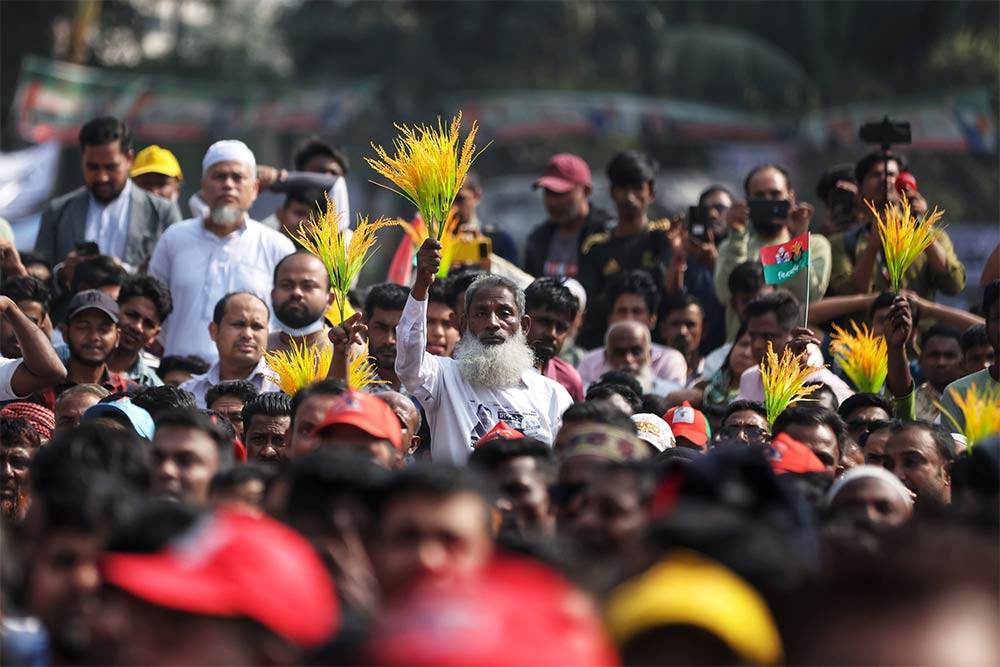 The BNP-led government has completed its first 180 days with a mixed record of reforms, policy decisions and development plans, but the gap between announcements and visible results remains one of its biggest challenges.
Led by Prime Minister Tarique Rahman, the government completed six months in office on August 16, after taking charge on February 17 with promises to fulfil election pledges, reform the administration, revive the economy, improve law and order and restore peace in public life.
During the period, it took several policy decisions, enacted laws and prepared plans covering economic, administrative, legal and development issues. However, public concerns over high prices, gas and electricity shortages, weaknesses in the banking sector, employment and law and order have persisted.
As a result, the first 180 days have largely been a period of initiatives and planning, with several of the expected benefits yet to reach ordinary people.
The government has taken initiatives on legal and policy reforms, including measures to prevent gambling and address enforced disappearances.
It has also formed committees and prepared plans on safe food, the environment and climate change, carbon credits and energy production from waste. Cabinet Division documents show continued administrative decisions and the formation of new committees.
On development, the government has remained active in plans involving the Teesta Master Plan, water buses on Dhaka's waterways, solar power in government buildings and waste management.
It has also identified technology, semiconductors, artificial intelligence and biotechnology as future-oriented sectors requiring greater attention.
The government has sought to strengthen economic and diplomatic relations with Saudi Arabia, the United States and South Korea. Discussions are also continuing over the complexities in Bangladesh-India relations, although the government says conditions are not yet favourable for a prime ministerial visit to India.
It has also placed emphasis on private investment, industrialisation, export diversification and expansion of the technology sector.
The International Monetary Fund has similarly identified revenue collection, banking reforms, investment and employment as important areas for Bangladesh.
Despite the initiatives, high prices remain one of the government's biggest challenges. Although inflation has declined to some extent, many people still find daily necessities unaffordable.
The energy crisis has been another major setback. Gas shortages have disrupted power generation and triggered frequent load shedding, putting pressure on both public life and industrial production.
The government imposed stricter restrictions on electricity use in August to deal with the situation.
BNP Standing Committee member Dr Farhad Halim told the Daily Observer that commodity prices were now at a tolerable level.
He said the gas shortage was linked to power generation and that an LNG cargo ship had become unusable. The government was making alternative arrangements and he hoped the problem would be resolved soon.
He also said the previous interim government had not taken adequate measures to ensure an uninterrupted gas supply, while the present government had taken alternative steps.
Law and order and the rise of mob violence have also remained major concerns. Lynching and taking the law into one's own hands have continued despite the government's stated position that such a culture will not be tolerated.
The situation has raised questions about the state's ability to ensure the rule of law.
On the issue, Farhad Halim attributed part of the problem to the previous Awami League government's appointment of its party supporters to the police administration. He said the government would gradually address the situation, while claiming that law and order was now much better than before.
At a meeting at the Prime Minister's Office on Monday to mark the completion of 180 days, Prime Minister's Adviser and Office Spokesperson Mahdi Amin said it was difficult for any government to solve all problems within six months.
He said the government had the utmost sincerity, commitment and responsibility and was working relentlessly to implement its election manifesto.
According to Amin, the manifesto was prepared based on the BNP's political philosophy and implementation began immediately after the election.
BNP Standing Committee member Ruhul Kabir Rizvi told the Daily Observer that the government had succeeded in many areas and was moving towards success in several others.
However, he said six months was not enough time to evaluate a government's activities. He said the government's performance would be reviewed every six months and expressed hope that the basic problems facing people would be resolved soon.
Overall, the first 180 days of the Tarique Rahman government can be described as a foundation-building period, marked by numerous initiatives but limited visible results in several areas.
The next six months will be more important in determining its performance. Faster implementation, tangible results and visible improvements in people's daily lives will be the key measures of whether the government's plans are translating into meaningful change.
Loading...
Loading...
Also read



Editor : Iqbal Sobhan Chowdhury
Published by the Editor on behalf of the Observer Ltd. from Globe Printers, 24/A, New Eskaton Road, Ramna, Dhaka.
Editorial, News and Commercial Offices : Aziz Bhaban (2nd floor), 93, Motijheel C/A, Dhaka-1000.
Phone: PABX- 41053001-06; Advertisement: 41053012; 01793317829, 01550707291, E-mail: [email protected], [email protected] Online: email: [email protected] 41053014; 01550707297 Advertisement: 01550707296
Published by the Editor on behalf of the Observer Ltd. from Globe Printers, 24/A, New Eskaton Road, Ramna, Dhaka.
Editorial, News and Commercial Offices : Aziz Bhaban (2nd floor), 93, Motijheel C/A, Dhaka-1000.
Phone: PABX- 41053001-06; Advertisement: 41053012; 01793317829, 01550707291, E-mail: [email protected], [email protected] Online: email: [email protected] 41053014; 01550707297 Advertisement: 01550707296


