



| HEADLINE |

|
Measles Death
82pc of children were not fully breastfed: Study
Published : Thursday, 20 August, 2026 at 12:00 AM
Staff Correspondent


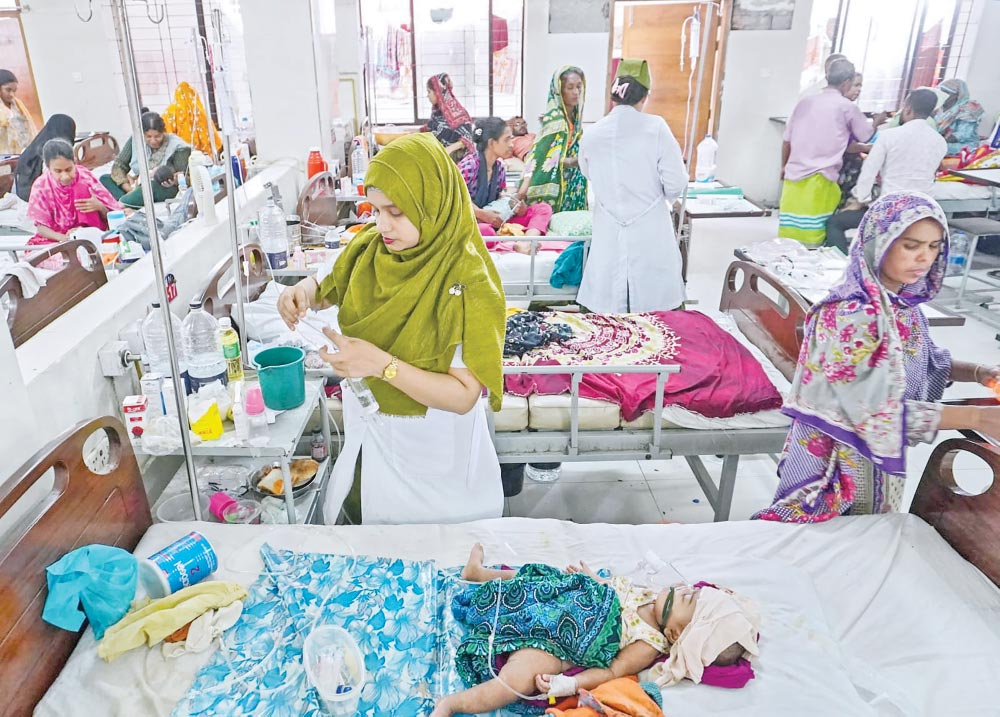 Eighty-two per cent of children who died while undergoing treatment for measles had not received exclusive breastfeeding during the first six months of life, while a large proportion of measles-infected children were also suffering from malnutrition.
This has been revealed in a joint study conducted by Bangladesh Shishu Hospital & Institute (BSHI) and International Centre for Diarrhoeal Disease Research, Bangladesh (icddr,b). The study found that 65 per cent of the affected children suffered from some degree of malnutrition. Of them, 12 per cent were severely malnourished and 53 per cent moderately malnourished.
The findings were presented at a dissemination meeting held at the auditorium of Bangladesh Shishu Hospital & Institute in Sher-e-Bangla Nagar in the capital on Wednesday.
State Minister for Health and Family Welfare Dr MA Muhit attended the event as the chief guest, while Prof Dr AKM Azizul Haque, chairman of the governing board of Bangladesh Shishu Hospital & Institute, chaired the meeting.
The study was conducted on 341 children who had been admitted to hospitals with measles or suspected measles since May this year. Researchers said the study is still ongoing.
According to the main research paper, 43 per cent of the measles-infected children were aged between three and nine months, and 38 per cent of the affected children had not received exclusive breastfeeding during the first six months of life.
The proportion was much higher among children who died while undergoing treatment. As many as 82 per cent of the deceased children had not received exclusive breastfeeding during the first six months of life.
The study also analysed the nutritional status of the affected children and found that 65 per cent were malnourished. Of them, 12 per cent were severely malnourished and 53 per cent moderately malnourished.
Researchers divided the 341 children into four groups based on age and vaccination status. Among 146 children under nine months of age, who were yet to reach the age for routine vaccination, measles was detected in 142, or 97.3 per cent.
Among 126 children who were old enough to receive vaccines but had not received any, 122, or 97 per cent, tested positive for measles.
Of the 48 children who had received one dose of vaccine, 44, or 92 per cent, were diagnosed with measles.
Measles was confirmed in 16 of the 21 children who had received the recommended two doses of vaccine, a rate of 76 per cent.
Researchers clarified that the finding does not mean that 76 per cent of children who receive two doses of measles vaccine become infected.
The study was not conducted among the general population but among a specific group of children admitted to hospitals with suspected measles. Therefore, the finding that 16 of the 21 suspected children who had received two doses tested positive for measles requires further investigation, they said.
The study noted that inadequate immunity after vaccination, declining antibody protection over time, malnutrition and other individual health factors could contribute to infection. However, determining the extent to which each of these factors contributed to infection was beyond the scope of the current study.
The researchers also analysed the types of measles virus detected in the affected children. They said all the identified viruses belonged to the B3 subclade and showed similarities to B3 viruses detected in other countries.
In addition, four changes or mutations were identified in the epitope regions of the virus’s H protein that can be recognised by antibodies.
The study was conducted under the initiative of the Department of Epidemiology and Research at Bangladesh Shishu Hospital & Institute. Prof Dr Mirza Mohammad Ziaul Islam, director of the institute, and Dr Mustafizur Rahman, senior director of icddr,b, presented the main research paper at the meeting.
Speaking at the event, State Minister Dr Muhit said the current measles epidemic was the result of an immunity gap created by delayed action and policy negligence during the 2024 vaccination campaign.
“Installing a thousand ventilators or ICU beds will not stop this wave of deaths. Prevention and vaccination are the only solutions,” he said.
There is no scope for unrealistic assurances, he said, adding that even if the pace of vaccination is increased to 100 per cent, it would take another two to three months to bring the outbreak fully under control.
“However, efforts are underway to reduce child deaths during this period through the highest level of treatment and field-level surveillance,” he added.
Loading...
Loading...
Also read



Editor : Iqbal Sobhan Chowdhury
Published by the Editor on behalf of the Observer Ltd. from Globe Printers, 24/A, New Eskaton Road, Ramna, Dhaka.
Editorial, News and Commercial Offices : Aziz Bhaban (2nd floor), 93, Motijheel C/A, Dhaka-1000.
Phone: PABX- 41053001-06; Advertisement: 41053012; 01793317829, 01550707291, E-mail: [email protected], [email protected] Online: email: [email protected] 41053014; 01550707297 Advertisement: 01550707296
Published by the Editor on behalf of the Observer Ltd. from Globe Printers, 24/A, New Eskaton Road, Ramna, Dhaka.
Editorial, News and Commercial Offices : Aziz Bhaban (2nd floor), 93, Motijheel C/A, Dhaka-1000.
Phone: PABX- 41053001-06; Advertisement: 41053012; 01793317829, 01550707291, E-mail: [email protected], [email protected] Online: email: [email protected] 41053014; 01550707297 Advertisement: 01550707296


