



| HEADLINE |

|

Century-old Benarasi Palli at Ishwardi nears collapse
Published : Sunday, 23 August, 2026 at 12:00 AM
Naresh Madhu


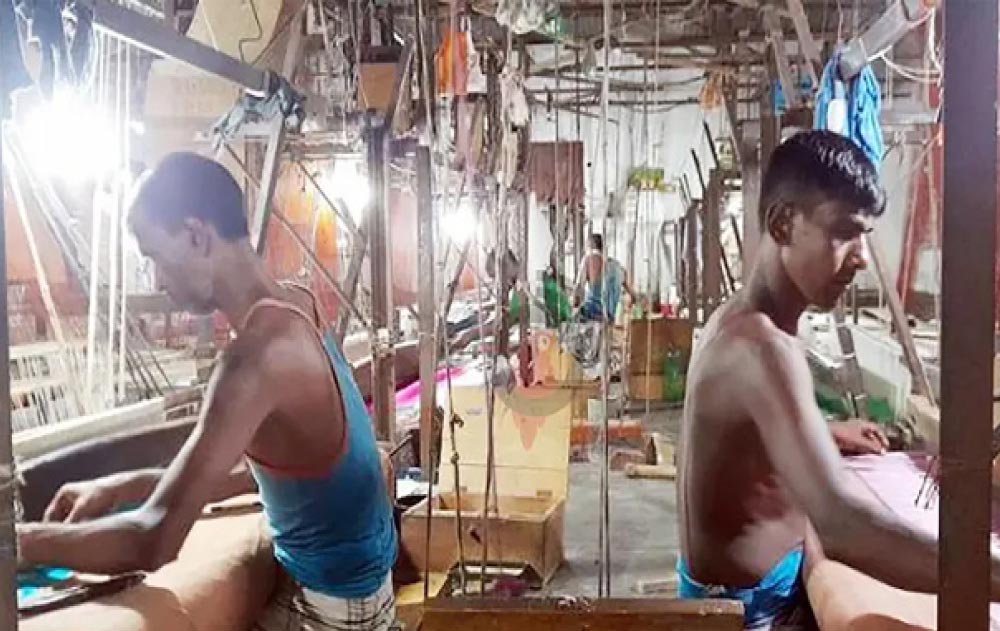 PABNA, Aug 22: The Benarasi weaving industry in Ishwardi Upazila of Pabna traces its roots back to the British era, when artisans from Uttar Pradesh of India settled in Fateh Mohammadpur and began weaving elite sarees such as Benarasi-Katan.
 Despite numerous challenges, over 200 weavers continue to uphold this ancestral craft.
To revitalise the industry, the government established a Benarasi Palli (village) in Fateh Mohammadpur. Construction began in 2000, with plots allotted to weavers from 2004. Yet, 19 years later, most weavers have not built factories. Only seven of the 90 plots have factories, and just five are operational, with two closed for most of the year.
In 2004, the Bangladesh Weaving Board built the country's second-largest Banarasi village on 5.5 acres at a cost of Tk 2.15 crore. Plots were allotted to 90 weavers with a 20-year instalment plan. Although factory construction was required within three months, only seven factories have been built. Several plots have partial brick walls but remain incomplete, and much of the village is now overgrown with bushes.
The sole officer in charge oversees the entire Benarasi Palli while also managing loan distribution for weavers in Atgharia Upazila. Loom owners say they lack capital to build factories, having historically operated in abandoned railway areas. The business is now in decline due to rising yarn prices and labour shortages.
During the Pakistani period, there were about 450 Benarasi factories employing 7,000 people. By 2018, that number had dropped to 250�"300, and now only 50 factories remain operational. The market is flooded with low-quality Indian sarees, while the costs of yarn and materials have risen sharply, forcing many to close.
Two factories of Zaman Textile from Sirajganj operate in Benarasi Palli. Manager Shariful Alam said sarees worth Tk 10,000�"30,000 are produced there, with workers earning Tk 3,000�"8,000 for hand-weaving Benarasi-Katan. Local buyers are scarce. A promised government yarn processing factory never materialised, so yarn must be processed in Mirpur, Dhaka, adding about Tk 1,000 per saree.
Md Nasim Uddin Tutul, owner of Sanjida Saree Factory, said he has never seen such hardship in 30 years. Yarn prices have doubled since 2020, from Tk 2,000 to Tk 4,000 per bundle, but saree prices have not increased. A simple Jamdani now costs Tk 2,700 to make, up from Tk 1,900, yet sells for Tk 2,900. He added that weavers see no extra benefit in building factories on allotted plots, so interest remains low.
Wakil Alam, President of the Ishwardi Primary Benarasi Weavers Association, said most weavers lack capital to build factories. If the government had built the factories, weavers could have moved in. He noted that all local sarees are hand-woven and of superior quality, unlike Indian machine-made versions. Buyers choose cheaper Indian Jamdani, but connoisseurs prefer the real hand-woven product.
He added that low wages deter the younger generation, and no new craftsmen are emerging. His own ten looms are idle due to labour shortage. To save the industry, he urged the government to reduce yarn prices, ban imports of Indian Jamdani and Katan sarees, and provide sufficient interest-free loans. Otherwise, he warned, the Benarasi loom industry will gradually vanish.
Officer-in-Charge Khandaker Obaidur Rahman Jilani confirmed that although weavers bought plots cheaply, most did not build factories. Currently, five factories operate in Benarasi Palli, and full facilities have not been ensured. He noted that 206 weavers are registered, and in 2022 the government allocated Tk 40.40 lakh at 5 per cent service charge. The office lacks peons, night guards, and even a sweeper, leaving him to manage everything alone, including loan duties for Atgharia Upazila.
Loading...
Loading...
Also read



Editor : Iqbal Sobhan Chowdhury
Published by the Editor on behalf of the Observer Ltd. from Globe Printers, 24/A, New Eskaton Road, Ramna, Dhaka.
Editorial, News and Commercial Offices : Aziz Bhaban (2nd floor), 93, Motijheel C/A, Dhaka-1000.
Phone: PABX- 41053001-06; Advertisement: 41053012; 01793317829, 01550707291, E-mail: [email protected], [email protected] Online: email: [email protected] 41053014; 01550707297 Advertisement: 01550707296
Published by the Editor on behalf of the Observer Ltd. from Globe Printers, 24/A, New Eskaton Road, Ramna, Dhaka.
Editorial, News and Commercial Offices : Aziz Bhaban (2nd floor), 93, Motijheel C/A, Dhaka-1000.
Phone: PABX- 41053001-06; Advertisement: 41053012; 01793317829, 01550707291, E-mail: [email protected], [email protected] Online: email: [email protected] 41053014; 01550707297 Advertisement: 01550707296


