



| HEADLINE |

|

From deer to minerals, Nijhum Dwip opens a new frontier
Published : Sunday, 23 August, 2026 at 12:00 AM
Our Correspondent


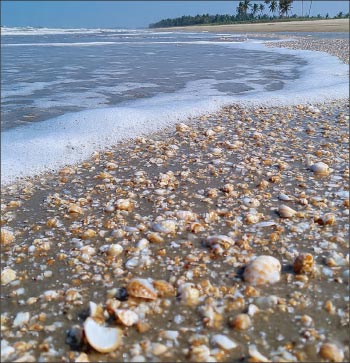 NOAKHALI, Aug 22: Heavy mineral deposits with potential economic and industrial value have been identified in the coastal sands of Nijhum Dwip in Hatiya Upazila, raising hopes of a new avenue for mineral-based industries in the country.
Researchers have found minerals including ilmenite, rutile, zircon, magnetite and garnet in sand samples from the island. A 2022 study on Hatiya Island's mineral sands identified significant concentrations of these valuable heavy minerals and said the deposits could have economic potential if responsibly developed.
The study found ilmenite, rutile, zircon, magnetite and garnet in the beach sands of Nijhum Dwip and other parts of Hatiya. In the Nijhum Dwip sample, the combined concentration of the five minerals was about 11.02%, including 2.52% ilmenite, 2.04% rutile, 2.23% zircon, 2.58% garnet and 1.65% magnetite.
These minerals have applications across several industries. Ilmenite and rutile are important sources of titanium and are used in products including pigments and industrial materials, while zircon is widely used in ceramics, glass and refractory products. Garnet and magnetite also have applications in industrial and manufacturing processes.
The discovery has generated interest among residents of Nijhum Dwip and Hatiya, who hope mineral-based industries could create jobs and boost the local economy alongside tourism.
However, experts say the discovery alone does not mean commercial extraction can begin immediately. Detailed geological surveys, resource assessments and environmental impact studies would be necessary to determine the size, quality and economic viability of the deposits.
Bangladesh has known heavy-mineral deposits along its coastal belt for decades. The Bangladesh Atomic Energy Commission has identified Nijhum Dwip as one of the country's coastal heavy-mineral deposit areas.
Researchers have also stressed the need for responsible extraction. Any future mining operation would need to consider Nijhum Dwip's fragile coastal ecosystem, including its beaches, mangrove vegetation and wildlife.
For a country that imports many mineral-based industrial raw materials, developing domestic resources could potentially reduce import dependence and create new opportunities for local processing and value addition.
Nijhum Dwip, known mainly for its scenic beauty, mangrove vegetation and deer population, could therefore gain another identity�"as a potential source of valuable mineral sands.
But experts caution that the priority should be scientific assessment and environmental protection before commercial exploitation.
Loading...
Loading...
Also read



Editor : Iqbal Sobhan Chowdhury
Published by the Editor on behalf of the Observer Ltd. from Globe Printers, 24/A, New Eskaton Road, Ramna, Dhaka.
Editorial, News and Commercial Offices : Aziz Bhaban (2nd floor), 93, Motijheel C/A, Dhaka-1000.
Phone: PABX- 41053001-06; Advertisement: 41053012; 01793317829, 01550707291, E-mail: [email protected], [email protected] Online: email: [email protected] 41053014; 01550707297 Advertisement: 01550707296
Published by the Editor on behalf of the Observer Ltd. from Globe Printers, 24/A, New Eskaton Road, Ramna, Dhaka.
Editorial, News and Commercial Offices : Aziz Bhaban (2nd floor), 93, Motijheel C/A, Dhaka-1000.
Phone: PABX- 41053001-06; Advertisement: 41053012; 01793317829, 01550707291, E-mail: [email protected], [email protected] Online: email: [email protected] 41053014; 01550707297 Advertisement: 01550707296


