



| HEADLINE |

|
Can People Hope Mirza Fakhrul Will Be President of All?
Published : Sunday, 23 August, 2026 at 12:00 AM
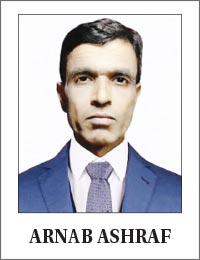
ARNAB ASHRAF


 Mirza Fakhrul Islam Alamgir has won the Presidency! His real test begins now: Can a veteran partisan become a President for an entire nation? In the practice of Bangladesh politics, winning a presidential election is an impressive moment of triumph! And for Mirza Fakhrul, that should be something more demanding: A moment of transition.
On August 20, Mirza Fakhrul Islam Alamgir won the Bangladesh’s Presidency with 255 votes against 88 for Col. (retd) Oli Ahmed, becoming the country’s 23rd President in an independence of 55 years since 1971 and its first President elected through a contested vote after 1991. The arithmetic was decisive. The history will be less forgiving.
Mirza Fakhrul has entered Bangabhaban as a veteran leader of Bangladesh Nationalist Party (BNP), a politician who spent amorphous years in troubled politics. He is no longer a party leader. He is the constitutional head of state.
That distinction may determine how his Presidency is remembered. In fact, Bangladesh does not need another political victory presented as a national achievement. The country needs an institution capable of reminding the citizens that the Republic belongs to them all.
That is the opportunity before the new President. His greatest challenge will not be foreign policy, although the foreign policy will test him. It will not be Rohingya crisis, although the Myanmar’s instability will demand seriousness. It will not even be the politically explosive question of Sheikh Hasina’s extradition. His greatest challenge will be to convince people of Bangladesh that he is the President not merely of those who voted for his political camp, but also of the entire Republic.
Mirza Fakhrul does not need to become universally loved. He needs to become universally recognisable as the President of the People’s Republic of Bangladesh, including even to those who distrust him, oppose him or remember his political past differently.
The Presidency in Bangladesh is constitutionally different from the prime ministership. The government exercises the executive power. The President represents the state. That makes the office less about directing the daily policy and more about the embodying constitutional restraint.
The office carries influence without unlimited power. That may be its greatest strength. A President who understands the limits of his authority can become a guardian of institutions. A President does not have to make everyone happy. He has to make it difficult for anyone to argue that the Presidency has become an instrument of the ruling party. His relationship with BNP belongs to his political history. His relationship with Bangladesh belongs to the Constitution. The political culture of this country was forged through the Liberation War, political assassination, military rule, democratic struggle, mass mobilisation and repeated confrontations.
These experiences left behind a powerful and dangerous political instinct: The belief that politics is a contest between those who belong and those who do not. The Presidency can challenge that instinct. Mirza Fakhrul can use the office as a national classroom�"not a classroom of propaganda, but a classroom of citizenship.
Patriotism should not be measured by party loyalty. For a farmer, the patriotism may mean protecting the land that feeds his family. For a garment worker, it may mean earning a dignified living. For a migrant worker, it may mean sending money home so that his children can study. For a student, it may mean imagining a country better than the one inherited from previous generations. And for every citizen, the patriotism should include the right to live without fear, speak without intimidation.
That promise must extend beyond political opponents. Religious minorities, ethnic communities and citizens who have historically felt excluded from the political mainstream should see in Bangabhaban an institution that protects their equal citizenship.
The international environment will make that responsibility harder. Bangladesh sits at the intersection of several strategic pressures. India remains its most consequential neighbour. China is an increasingly important economic and strategic partner. The United States has a major interest in the Indo-Pacific. And Japan is expanding its engagement in the region.
The Bay of Bengal is becoming more important for trade, connectivity, energy and maritime security. Dhaka needs a foreign policy that is neither submissive nor needlessly confrontational. Friendship without dependence. Cooperation without domination. Security without one-sided expectation. Respect without submission. Strategic autonomy should not mean equidistance from every power. It should mean the freedom to pursue its own national interests with every power.
The question of Sheikh Hasina’s extradition will be especially difficult. The country has legitimate reasons to pursue justice and accountability. India has its own legal and diplomatic considerations. The answer cannot be either surrender or recklessness. The justice must follow its course. The diplomacy must follow its course. The statesmanship lies in preventing the two from destroying each other.
The same principle applies to the relationship with India more broadly. The two countries share common borders, rivers, trade, energy links, security interests and human connections. If Tarique Rahman engages with New Delhi, that interaction could help open a new chapter. But a photograph or joint statement will not erase years of political distrust. A BNP-led Bangladesh will have to demonstrate that it is not anti-India. India, for its part, will have to recognise that the friendship with Bangladesh cannot mean expecting Bangladesh to compromise its national interests.
The President cannot negotiate these relationships. That belongs to the elected government. But he can help create the political atmosphere in which national interests are pursued with confidence rather than insecurity. The credibility of his Presidency will also depend on whether courts, electoral institutions and the civil service are allowed to function without partisan pressures. A President cannot repair every institutions. But he can make clear, through his conduct, that constitutional institutions must be larger than the interests of any political party. Myanmar presents an immediate challenge. War, instability in Rakhine and the unresolved Rohingya crisis threaten Bangladesh’s security and humanitarian capacity. The Middle East poses another risk. Conflict there can affect energy prices, shipping, employment and remittances. For Bangladesh, the safety of workers abroad and the stability of the money they send home are national concerns.
Yet these international pressures should not obscure the central test of the new Presidency. The history will ask simple questions. Did he defend constitutional institutions? Did he treat opponents fairly? Did he exercise restraint when political passions intensified? Did he preserve the dignity of Bangabhaban? Did he become a national figure without pretending that his political past never existed? Did citizens who opposed him nevertheless believe that the Presidency remained open to them? The Presidency is not a trophy awarded to one political camp. It is a national trust temporarily entrusted to one individual on behalf of an entire Republic. Mirza Fakhrul has inherited the Bangladesh’s history. But he has also inherited an opportunity. He can leave Bangabhaban remembered not merely as the place where a veteran BNP leader completed his political journey, but as the place where he began a different one�"from partisan politician to guardian of a national institution.
The choice will not be made by one speech or one ceremony. It will be made quietly, day after day. Through fairness. Through constitutional discipline. Through the courage to disappoint his own political supporters even when the Constitution requires it. That is how Presidents become larger than their parties. And that is how nations begin to trust them. Mirza Fakhrul does not need to become universally loved. He needs to become universally recognisable as the President of the People’s Republic of Bangladesh, including even to those who distrust him, oppose him or remember his political past differently.
Now his greatest victory will not be another parliamentary number. It will be the moment when even his strongest critics can say that Bangabhaban belongs to Bangladesh�"not to BNP. That is the standard by which the history will judge him. And that leaves Bangladesh with a simple aspiration: We hope he will be President of us all. Because we also believe ‘this world is not a dream’.
The writer is a journalist in The Daily Observer
Loading...
Loading...
Also read



Editor : Iqbal Sobhan Chowdhury
Published by the Editor on behalf of the Observer Ltd. from Globe Printers, 24/A, New Eskaton Road, Ramna, Dhaka.
Editorial, News and Commercial Offices : Aziz Bhaban (2nd floor), 93, Motijheel C/A, Dhaka-1000.
Phone: PABX- 41053001-06; Advertisement: 41053012; 01793317829, 01550707291, E-mail: [email protected], [email protected] Online: email: [email protected] 41053014; 01550707297 Advertisement: 01550707296
Published by the Editor on behalf of the Observer Ltd. from Globe Printers, 24/A, New Eskaton Road, Ramna, Dhaka.
Editorial, News and Commercial Offices : Aziz Bhaban (2nd floor), 93, Motijheel C/A, Dhaka-1000.
Phone: PABX- 41053001-06; Advertisement: 41053012; 01793317829, 01550707291, E-mail: [email protected], [email protected] Online: email: [email protected] 41053014; 01550707297 Advertisement: 01550707296


