



| HEADLINE |

|

The Next Chapter in Bangladesh–Japan Ties
Published : Friday, 30 October, 2026 at 12:00 AM
Tanjim Ara Eijhum


 Partnerships are not always measured by size or political clout. Sometimes their worth lies in decades of quiet reliability. By that standard, few relationships matter more to Bangladesh than the one it has built with Japan.
Tokyo recognised Bangladesh in 1972, barely two months after independence, and has stood by it ever since. In a world where alliances shift with every change of government, that continuity is rare. It is also valuable at a moment when global politics is unpredictable and developing countries face hard economic choices.
Japan’s footprint is most visible in concrete and steel. The Dhaka Metro Rail, the Matarbari deep-sea port and major transport corridors all bear its support. But these projects are more than structures. They are bets on productivity, connectivity and future growth.
Yet infrastructure alone does not deliver development. Roads, ports and industrial zones pay off only when efficient institutions, skilled workers and competitive firms use them. That is the test of the next phase of cooperation.
The Economic Partnership Agreement signed in February 2026 offers the chance to meet it. Beyond better market access, the deal opens the door to deeper investment, industrial collaboration and a place in international supply chains, something Bangladesh badly needs as it works to diversify exports and prepare for life after least-developed-country status.
But an agreement on paper transforms nothing by itself. Japanese firms are known for quality, technical sophistication and long-term planning, and they expect the same in return. If Bangladesh wants their capital, it must offer regulatory efficiency, consistent policy and real accountability, and finally clear the obstacles that have long deterred foreign investors.
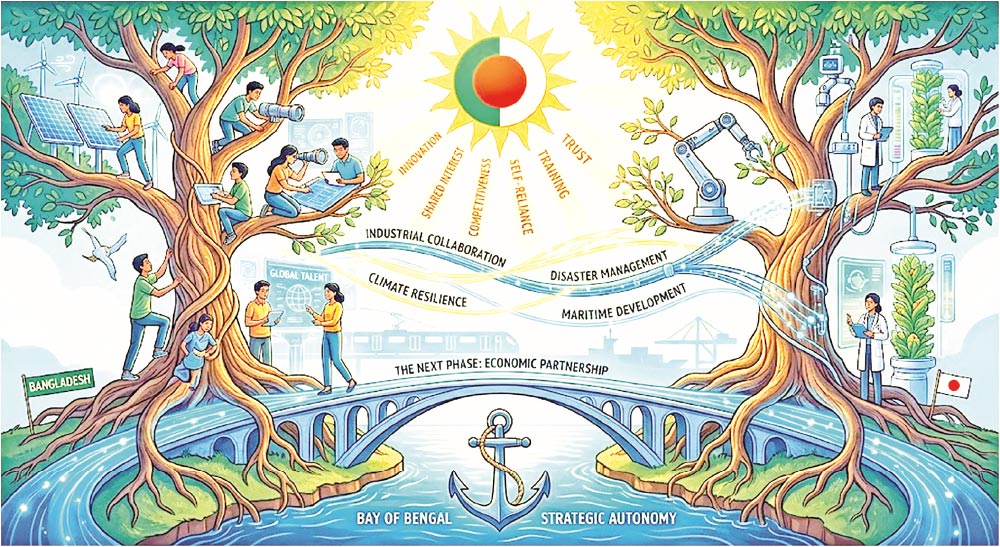 The human dimension may be the most promising of all. Japan is ageing and its workforce is shrinking. Bangladesh has a young population hungry for productive work. The match is obvious, but Dhaka should aim higher than remittances. It should treat Japan as a partner in building globally competitive talent.
That means technical education, Japanese-language training, professional certification and industry-linked apprenticeships that prepare workers for healthcare, engineering, IT and beyond. Universities, technical institutes and skills bodies must work directly with Japanese employers and schools, creating clear pathways from classroom to career. The gains would not stop at the border: returning workers bring knowledge and better professional practice home to Bangladeshi industry.
Strategy matters too. The Bay of Bengal is now a theatre of growing geopolitical interest, and Bangladesh’s location is both an asset and a responsibility. As major powers compete, Dhaka must keep the freedom to engage with all of them without being dragged into their rivalries. Japan, with its focus on connectivity, maritime development and economic security, is a natural partner in that effort.
This should not be mistaken for a game of balancing one power against another. Bangladesh’s foreign policy must be guided by its own interests, strategic autonomy and a commitment to peace. A deeper tie with Japan should complement its other relationships, not complicate them.
Climate offers another frontier. Few countries are as exposed to rising seas, floods and cyclones as Bangladesh, and few are as advanced as Japan in disaster management, resilient infrastructure and clean energy. Joint work in these areas could do more for Bangladesh’s long-term security than many conventional aid programmes.
Ultimately, this relationship should not be judged by the volume of assistance or the number of agreements signed. The real measure is whether it produces industries that last, institutions that work, jobs that pay and opportunities that endure.
Bangladesh has already gained enormously from Japanese goodwill. The task now is to turn a historically successful relationship into a forward-looking one built on innovation and shared interest. Japan can bring technology, expertise and investment. Bangladesh can bring talent, a growing market and a strategic location.
The next chapter must go beyond traditional diplomacy. Its purpose should be a more competitive, resilient and self-reliant Bangladesh.
The writer is a Programme Coordinator and an Adjunct Faculty at Atish Dipankar University of Science and Technology

Loading...
Loading...
Also read



Editor : Iqbal Sobhan Chowdhury
Published by the Editor on behalf of the Observer Ltd. from Globe Printers, 24/A, New Eskaton Road, Ramna, Dhaka.
Editorial, News and Commercial Offices : Aziz Bhaban (2nd floor), 93, Motijheel C/A, Dhaka-1000.
Phone: PABX- 41053001-06; Advertisement: 41053012; 01793317829, 01550707291, 01550707296
E-mail: [email protected], [email protected]. [email protected], [email protected], [email protected], [email protected], Online-email: [email protected]


