



| HEADLINE |

|
DCU: On the back foot from the get-go
Published : Wednesday, 26 August, 2026 at 12:00 AM
Tanvir Raihan


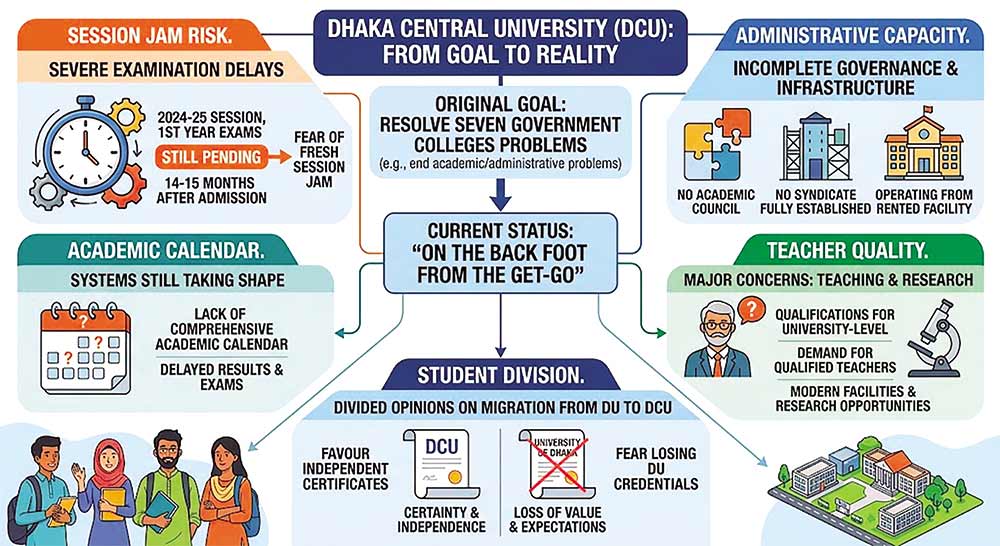 Dhaka Central University (DCU), established to resolve the longstanding academic and administrative problems of the seven government colleges affiliated with the University of Dhaka, is itself facing a growing set of challenges, raising concerns that the institution could become a new source of academic uncertainty instead of the solution students had hoped for.
Questions have emerged over teacher quality, academic standards, student migration, examination schedules, administrative preparedness and infrastructure. The concerns have become particularly significant as the university moves to establish its own academic and administrative systems.
Teacher quality is among the most sensitive issues. Questions are being raised over whether teachers with limited research experience or without higher research degrees such as MPhil or PhD are adequately prepared for university-level teaching. According to Vice-Chancellor Md Nurul Islam, maintaining university-level academic standards requires teachers with strong academic qualifications and research-oriented backgrounds.
Education analysts say transforming colleges into a university involves far more than changing their administrative identity. University teachers are expected not only to conduct classes but also to undertake research, supervise higher studies and contribute to knowledge creation.
Teacher quality, delay in examinations and lack of administrative capacity raise fears of a fresh session jam at Dhaka Central University
The experience of Jagannath University has emerged as a relevant precedent. When Jagannath College was transformed into a university, complications arose over the status of many BCS cadre teachers. Following subsequent legal proceedings, many returned to the college system, while teachers with higher academic qualifications and research backgrounds were retained as university teachers. Analysts believe DCU could eventually face a similar transition, although its legal and institutional framework will ultimately determine how existing teachers are accommodated.
The debate over teachers comes amid growing student concerns.Recently, DCU students held a press conference in front of the Shaheed Minar on the Dhaka College campus and announced a 13-point demand, calling for qualified teachers, research opportunities, modern facilities and an effective academic system.
The seven colleges, Dhaka College, Eden Mohila College, Government Shaheed Suhrawardy College, Kabi Nazrul Government College, Begum Badrunnesa Government Women’s College, Government Bangla College and Government Titumir College-were brought under the University of Dhaka from the National University on February 16, 2017. The move, however, failed to eliminate delays in examinations and results, administrative complications and session jams. Students subsequently launched a movement demanding an independent university.
Following the movement, the government issued the final ordinance establishing DCU on February 8 this year, while Parliament passed the bill on April 10. Yet several problems that students expected the new university to resolve remain unresolved.
A comprehensive academic calendar has yet to be implemented. The Academic Council and Syndicate have not been formed, while the locations of the permanent campus, administrative building and Teachers-Students Centre remain undecided. The university is currently conducting its administrative activities from a rented building in Baridhara DOHS.
Some students want to complete their education under the University of Dhaka, fearing that transferring thousands of records to a newly established university could create complications in examinations and result publication. Others strongly support migration, arguing that DCU would provide an independent institutional identity, certificates without the word “affiliated” and greater certainty over examinations and results.
An online referendum reportedly found 86.4 per cent of students in favour of migration. Eden Mohila College student Alifa Ara Mim said migration could ensure certificates without the affiliation tag, timely examinations and results, while also creating greater opportunities for higher education abroad.
However, fellow Eden student Nure Tamanna Tasfia said students who had invested years of time, money and effort expecting University of Dhaka certificates should not be transferred against their wishes. Dhaka College student Abdur Rahman, convener of the Seven Colleges University Transformation Movement Committee, said opponents of migration were primarily concerned about certificate value, session jams and examination uncertainty.
Ironically, the university created to eliminate session jams is now facing fears of a fresh academic backlog. Around 14 to 15 months after students of the 2024-25 academic session were admitted under DCU, their first-year examinations have yet to be held, with no clear schedule announced. At the same time, the latest HSC and equivalent examinations have ended, while DCU has not fully completed its admission process for the current academic session.
Professor Mahfil Ara Begum, convener of the Seven Colleges Autonomy Protection Committee and former head of the History Department at Eden Mohila College, said the migration issue should first be examined from a legal perspective. She questioned whether major academic and administrative decisions should be based on public opinion polls before the university’s statutory bodies are established. She urged DCU to form its Academic Council and Syndicate before taking major decisions in consultation with stakeholders.
Dhaka College Principal Professor AKM Elias said the university’s capacity to conduct examinations would be crucial. Although first-year examinations were scheduled to begin in August, he said they might not be possible before October, potentially pushing subsequent examinations further behind schedule.
Vice-Chancellor Md Nurul Islam, however, rejected concerns over DCU’s capacity. He said the university was seeking students’ views on whether they wanted to remain under DCU and would give priority to their opinions. He also said the university had sufficient teachers to conduct classes and examinations and that the administration was working to address remaining problems.
Students have demanded qualified university-level teachers, professional development for existing teachers, digital learning resources, modern laboratories, transport and accommodation, research funding, a realistic academic calendar, timely examinations and results, contemporary subjects from the 2026-27 academic session and construction of a Teachers-Students Centre.
The developments have placed DCU at a critical juncture. Unless teacher quality, administrative capacity, examination schedules, migration and infrastructure are addressed promptly, the university risks reproducing the very academic uncertainty and session jams it was created to eliminate.
Loading...
Loading...
Also read



Editor : Iqbal Sobhan Chowdhury
Published by the Editor on behalf of the Observer Ltd. from Globe Printers, 24/A, New Eskaton Road, Ramna, Dhaka.
Editorial, News and Commercial Offices : Aziz Bhaban (2nd floor), 93, Motijheel C/A, Dhaka-1000.
Phone: PABX- 41053001-06; Advertisement: 41053012; 01793317829, 01550707291, E-mail: [email protected], [email protected] Online: email: [email protected] 41053014; 01550707297 Advertisement: 01550707296
Published by the Editor on behalf of the Observer Ltd. from Globe Printers, 24/A, New Eskaton Road, Ramna, Dhaka.
Editorial, News and Commercial Offices : Aziz Bhaban (2nd floor), 93, Motijheel C/A, Dhaka-1000.
Phone: PABX- 41053001-06; Advertisement: 41053012; 01793317829, 01550707291, E-mail: [email protected], [email protected] Online: email: [email protected] 41053014; 01550707297 Advertisement: 01550707296


