



| HEADLINE |

|

El Niño 2026: When Climate Change Stops being a Warning and Starts being the Weather
Published : Monday, 31 August, 2026 at 12:00 AM
Arghya Protik Chowdhury


 The warning signs have been visible for months in the temperature anomaly charts streaming out of Boulder, Colorado, and Reading, England. Now the scientific consensus has hardened into something approaching certainty: El Niño is returning in 2026, and it is arriving with formidable force. For Bangladesh, a delta nation of 170 million people perched at the intersection of the Bay of Bengal and three great river systems, this is not merely a meteorological footnote. It is a civilisational stress test that can no longer be separated from the most consequential fact of our era: that anthropogenic climate change has permanently altered the baseline conditions within which every future climate shock will unfold.
The Physics of a Double Emergency: El Niño is defined by an anomalous warming of at least 0.5°C in sea surface temperatures across the Niño 3.4 region of the east-central equatorial Pacific, sustained across five consecutive overlapping three-month periods. When that threshold is crossed, a cascade of atmospheric teleconnections follows: weakened Walker Circulation, a disrupted Indian Ocean Monsoon, suppressed convection over the Bay of Bengal, and a displaced Inter-Tropical Convergence Zone. For Bangladesh, the operational outcome is a deficient or delayed monsoon, aggravated pre-monsoon heat, and an erratic alternation of torrential rainfall and protracted dry spells.
The NOAA Climate Prediction Centre’s ENSO Probability Forecast, issued in May 2026, presents a stark picture. There is a 92% probability of El Niño conditions through June-July-August, rising to 95% through July-August-September, and levelling at 97 to 98% through October-November-December 2026. The IRI and Columbia University ensemble model places the Niño 3.4 sea surface temperature anomaly between +1.5°C and +2.0°C by mid-2026, potentially reaching +2.6°C in the latter half of the year. At those anomaly magnitudes, this event would rank among the strongest in the modern instrumental record, comparable to the catastrophic 1997-98 Super El Niño and the powerful 2015-16 event. The probability of a very strong or super classification currently stands at approximately 20%.
What the probabilistic ENSO forecasts do not capture, however, is the climate change multiplier now embedded in every such event. The global mean surface temperature in 2024 crossed 1.5°C above the pre-industrial baseline for the first time in the instrumental record. The Bay of Bengal itself has warmed by approximately 0.6°C over the past four decades. These are not background statistics. They represent a structural transformation in the atmospheric and oceanic conditions within which every future El Niño will operate. Climate scientists call this mechanism “loading the dice”: El Niño does not independently manufacture extreme weather, but it dramatically amplifies the probability of events whose base frequency has already been rising for decades under sustained greenhouse gas accumulation. Bangladesh in 2026 is not facing a natural climate perturbation on an otherwise stable planet.
A Baseline That No Longer Exists: Understanding the true severity of what 2026 represents requires accounting for cumulative damage, not just the current ENSO signal in isolation. During the 2023-24 El Niño, temperatures exceeded 40°C to 43°C across 51 of Bangladesh’s 64 districts, according to the Bangladesh Meteorological Department. That event is widely attributed to Bangladesh recording its hottest year on record and to a monsoon rainfall deficit of 67% below average, surpassing even the 60% deficit documented during the severe 1997 El Niño. Groundwater tables in the northwest and north-central districts have been declining across successive dry seasons, each drawdown leaving a shallower aquifer for the next year’s irrigation demand.
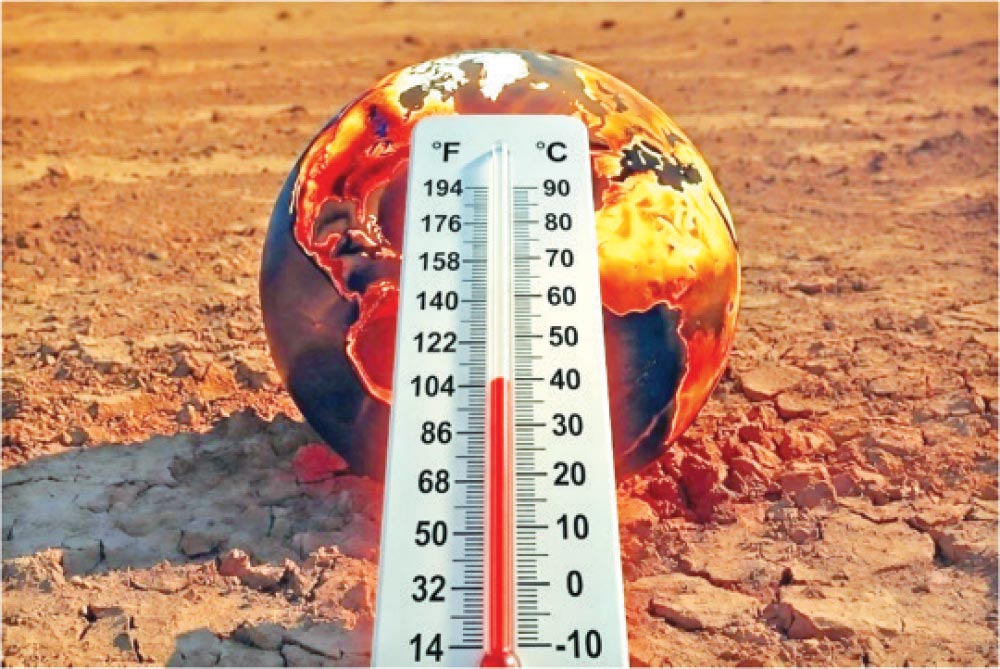 The critical analytical point is this: each prior El Niño event, each anomalous heat season, and each groundwater drawdown has narrowed the buffer available for the next perturbation. The 2026 El Niño is not arriving at a historical baseline. It is arriving at a system already operating close to the margins of resilience, those margins having been systematically eroded by cumulative warming. That is the climate change dimension that demands the most urgent analytical attention, not that warming causes El Niño, but that warming has structurally reduced the distance between a manageable ENSO stress and a cascading humanitarian emergency across agriculture, public health, and water security simultaneously.
Agriculture at the Convergence of Two Crises: Food security in Bangladesh is, in practical terms, rice security. Rice accounts for approximately 80% of all cereal consumption for 169 million people, grown across three distinct seasons: Aus, Aman, and Boro. A deficient monsoon across June-July-August 2026 threatens not only the Aman harvest directly, but also the aquifer recharge and river discharge levels that sustain Boro irrigation across the subsequent dry season. The 2020 drought in Rajshahi reduced Boro yields by approximately 30% through a combination of delayed planting and constrained irrigation availability. The 2017 haor flash floods eliminated 1.2 lakh hectares of standing Boro rice immediately before harvest. A super El Niño of the projected 2026 magnitude may activate several of these risk pathways concurrently, compressing planting windows, degrading irrigation infrastructure reliability, and reducing pre-harvest soil moisture below viable thresholds across multiple agro-ecological zones.
What makes this moment analytically distinct from prior ENSO years is the intersection with rising background temperatures. Heat stress on rice at the critical flowering stage suppresses grain filling and reduces yields even when water availability is not the limiting factor. With mean temperatures already elevated above historical norms, the thermal damage threshold arrives earlier in the growing season and persists longer into it. Drought-tolerant variety promotion and adjusted planting calendars are necessary policy responses, but they must be understood for what they are: adaptations to a climate system that is shifting structurally and permanently beneath Bangladesh’s agricultural foundation, not temporary adjustments to an anomalous year.
The Disease Burden of a Warming ENSO: The public health consequences of a strong ENSO year in Bangladesh are systematically underweighted in policy discourse relative to agricultural losses, despite a substantial peer-reviewed literature documenting the connections with precision. Research published in Scientific Reports established a statistically significant relationship between ENSO forcing and dengue incidence in Bangladesh, operating through a biological lag of one to six months that reflects mosquito development cycles and viral incubation periods. The 2023 dengue outbreak resulted in 203,406 reported cases and 989 deaths between January and September alone. The preceding 2022 outbreak recorded 62,382 cases and 281 deaths. If the 2026 El Niño reaches strong-to-super classification, the epidemiological projections are for case loads that will exceed these figures.
The cholera dimension compounds this risk. Published analysis has documented a positive correlation between tropical Pacific sea surface temperature anomalies and subsequent seasonal cholera incidence in Bangladesh, particularly through the August to November monsoon window. A late, compressed, or irregular monsoon disrupts water source reliability and elevates contamination risk for communities dependent on surface water. Climate change intensifies this pathway directly.The Accountability That Climate Change Demands: There is a political dimension to the 2026 emergency that analytical writing on El Niño consistently understates, and it must be stated plainly. Bangladesh’s per capita CO2 emissions rank among the lowest in the world. The country contributes less than 0.5% of cumulative global greenhouse gas emissions. Yet it sits among the top ten countries most exposed to climate-related risk on virtually every index that has been constructed to measure such vulnerability. The intensification of El Niño events under anthropogenic warming is not a natural fluctuation that Bangladesh must absorb as a neutral fact of geography. It is, in the most technically precise sense, a consequence of emissions for which the world’s largest historical emitters bear overwhelming responsibility, and for which Bangladesh has received a small fraction of the climate finance it was promised under successive international frameworks.
The Preparedness Window: Climate forecasts are probabilistic, not deterministic, and this distinction matters. When the probability of a strong El Niño sits between 92% and 98% across the peak monsoon months, risk management demands a response proportional to that probability. The Bangladesh Water Development Board should conduct an immediate district-level survey of groundwater levels, river discharge, and reservoir storage, identifying which upazilas are already at critical thresholds before the dry season deepens further. The Department of Agricultural Extension must accelerate promotion of drought-tolerant and heat-resistant rice varieties, with advance guidance on adjusted planting calendars and supplemental irrigation scheduling. The Ministry of Health must activate El Niño-responsive dengue and cholera surveillance protocols now, pre-positioning oral rehydration salts, vector control resources, and hospital surge capacity for a potential concurrent disease peak in late 2026. Bangladesh has genuine institutional assets in the Bangladesh Meteorological Department, the BWDB, and established technical partnerships with IRI, NOAA, and the Red Cross Red Crescent Movement. Those assets must now be pushed to their operational limits.
The deeper imperative, however, extends beyond any single season’s preparedness. A Bangladesh that transformed itself from a food-deficit state to a rice-exporting success story across three decades did so within a climate envelope that no longer exists. Every future ENSO event will be amplified by the warming already locked into the Earth system.
The writer is an Environmental Science undergraduate student at Bangladesh University of Professionals (BUP)

Loading...
Loading...
Also read



Editor : Iqbal Sobhan Chowdhury
Published by the Editor on behalf of the Observer Ltd. from Globe Printers, 24/A, New Eskaton Road, Ramna, Dhaka.
Editorial, News and Commercial Offices : Aziz Bhaban (2nd floor), 93, Motijheel C/A, Dhaka-1000.
Phone: PABX- 41053001-06; Advertisement: 41053012; 01793317829, 01550707291, E-mail: [email protected], [email protected] Online: email: [email protected] 41053014; 01550707297 Advertisement: 01550707296
Published by the Editor on behalf of the Observer Ltd. from Globe Printers, 24/A, New Eskaton Road, Ramna, Dhaka.
Editorial, News and Commercial Offices : Aziz Bhaban (2nd floor), 93, Motijheel C/A, Dhaka-1000.
Phone: PABX- 41053001-06; Advertisement: 41053012; 01793317829, 01550707291, E-mail: [email protected], [email protected] Online: email: [email protected] 41053014; 01550707297 Advertisement: 01550707296


