



| HEADLINE |

|

Children on the Frontlines of Climate Crisis
Published : Monday, 31 August, 2026 at 12:00 AM
Musharraf Tansen


 UNICEF has released its Children’s Climate Risk Report 2026in June. The publication should serve as a wake-up call for governments, development agencies, and citizens across the world. While climate change is often discussed in terms of rising temperatures, melting glaciers, carbon emissions, and economic losses, the report reminds us of a more urgent and human reality: climate change is increasingly becoming a child rights crisis. The report paints a sobering picture of a world in which children�"who have contributed least to global warming�"are bearing some of its most severe consequences.
The report provides the most detailed global assessment to date of how climate hazards intersect with children’s vulnerabilities. Using new data and a refined analytical framework, UNICEF demonstrates that climate risks are not experienced equally. Children are uniquely vulnerable because of their developing bodies, dependence on essential services, and limited ability to protect themselves from environmental shocks. Climate hazards that may inconvenience adults can have lifelong consequences for children’s health, nutrition, education, protection, and development.
Perhaps the most alarming finding is the scale of exposure. Nearly every child on Earth is now exposed to at least one significant climate hazard. More than 1.8 billion children are affected by drought conditions, while around 1.5 billion are exposed to increasingly frequent and intense heatwaves. Approximately 1.2 billion children live in areas experiencing extreme heat, and hundreds of millions face risks from flooding, tropical storms, fires, and other climate-related hazards. Even more concerning is that around 1.1 billion children are exposed to at least three overlapping climate hazards simultaneously, creating compounded risks to their health, education, and survival.
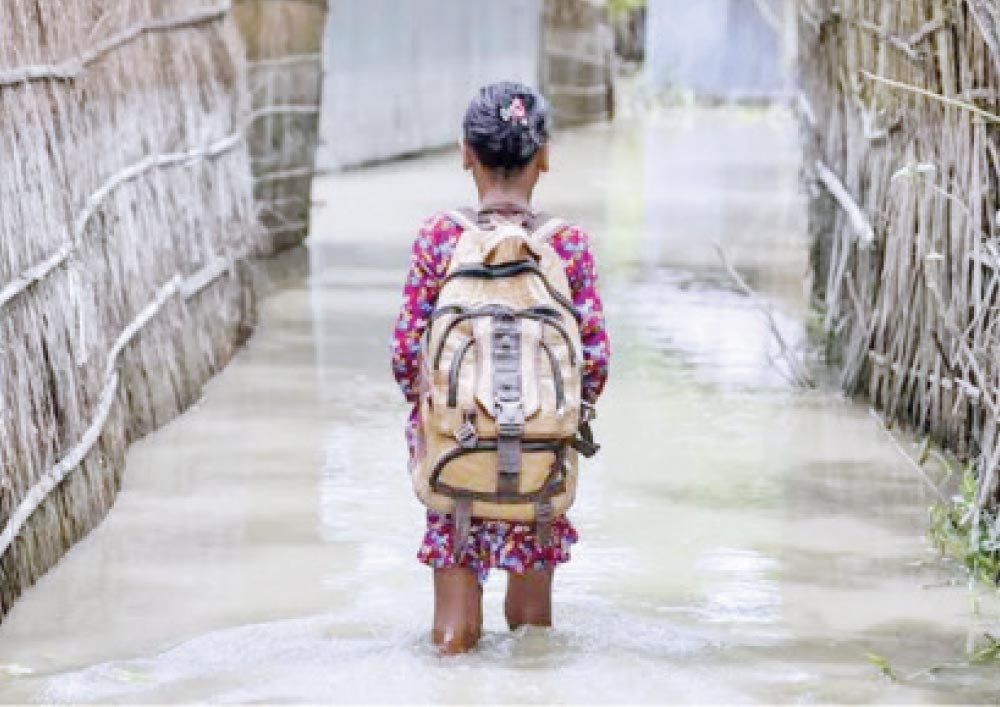 The report moves beyond simply identifying hazards. It highlights how climate risks become particularly dangerous when combined with inadequate access to essential services such as healthcare, clean water, sanitation, nutrition, education, and social protection. A drought in a well-resourced community may be manageable. The same drought in a community with weak health systems, limited water infrastructure, and widespread poverty can become catastrophic. Climate hazards and social vulnerability interact to create conditions that trap children in cycles of deprivation and insecurity.
 For countries like Bangladesh, the report carries special significance. Bangladesh is frequently cited as one of the countries most vulnerable to climate change despite contributing only a tiny fraction of global greenhouse gas emissions. Millions of Bangladeshi children already face recurring floods, cyclones, river erosion, salinity intrusion, heat stress, and displacement. Climate-related disruptions regularly affect schools, health services, water supplies, and livelihoods. The report’s findings reinforce what many communities in Bangladesh already experience: climate change is not a distant future threat but a present reality shaping children’s everyday lives.
The implications for education are particularly troubling. Extreme weather events increasingly interrupt schooling around the world. Flooded classrooms, damaged infrastructure, prolonged heatwaves, and displacement prevent children from learning consistently. UNICEF estimates that climate-related disasters are already disrupting education for tens of millions of children each year. In many low-income countries, children who leave school following disasters often never return, especially girls who face heightened risks of child marriage, domestic labour, or exploitation during periods of crisis.
The health consequences are equally severe. Children are more susceptible than adults to heat stress, dehydration, malnutrition, infectious diseases, and air pollution. Climate change is expanding the geographical reach of diseases such as malaria and dengue fever while worsening food insecurity and nutritional deficiencies. The report estimates that around one billion children live in areas exposed to malaria risks, while air pollution affects nearly all children worldwide. Such conditions threaten not only survival but also cognitive development, educational achievement, and long-term productivity.
Another important contribution of the report is its emphasis on climate justice. The countries and communities facing the greatest climate risks are often those that have contributed least to global emissions. Children living in fragile states, low-income countries, and marginalised communities face the highest levels of vulnerability. This stark imbalance raises fundamental ethical questions. Why should children in drought-prone regions of Africa, flood-prone areas of South Asia, or cyclone-affected island states pay the highest price for emissions generated elsewhere? Climate change is not only an environmental issue; it is increasingly an issue of fairness, equity, and intergenerational responsibility.
The report also highlights a persistent gap in climate financing. Despite growing international commitments, only a small proportion of climate finance directly addresses children’s needs. Climate adaptation projects frequently focus on infrastructure, energy systems, or economic resilience without adequately considering children’s specific vulnerabilities. Yet investments in child-sensitive adaptation measures�"such as climate-resilient schools, child-focused health systems, safe water infrastructure, nutrition programmes, and social protection mechanisms�"can significantly reduce climate risks while producing long-term developmental benefits.
Encouragingly, UNICEF does not present children merely as victims of climate change. Across the world, young people are increasingly emerging as advocates, innovators, and leaders in climate action. From grassroots environmental campaigns to international climate negotiations, children and youth are demanding a greater voice in decisions that will shape their futures. The report argues that meaningful participation by children should be considered an essential component of climate policy rather than an optional addition. Policies designed without listening to those most affected are unlikely to achieve lasting success.
For Bangladesh, the report offers both a warning and an opportunity. The country has already demonstrated global leadership in disaster preparedness, community resilience, and climate adaptation. However, future strategies must place children at the centre. Climate-resilient schools, child-sensitive disaster management systems, expanded social protection programmes, improved healthcare services, and climate education should become central pillars of adaptation planning. Investments in children’s resilience today will determine the country’s ability to navigate an increasingly uncertain climate future.
Ultimately, the Children’s Climate Risk Report 2026 challenges us to rethink how we understand climate change. The climate crisis is not simply about rising temperatures or extreme weather statistics. It is about whether children can attend school safely, access clean drinking water, receive healthcare, grow up free from hunger, and realise their full potential. It is about whether the next generation inherits a world of opportunity or a future defined by escalating environmental risks.
The report’s central message is clear: protecting children from climate change is not a peripheral concern�"it is one of the defining development and human rights challenges of our time. If governments are serious about building resilient societies and achieving sustainable development, children must move from the margins of climate policy to its very centre. The future of climate action will ultimately be judged not by the number of pledges made or conferences held, but by whether today’s children are able to inherit a safe, healthy, and liveable world.
The writer is a development analyst and former Country Representative of the Malala Fund
Loading...
Loading...
Also read



Editor : Iqbal Sobhan Chowdhury
Published by the Editor on behalf of the Observer Ltd. from Globe Printers, 24/A, New Eskaton Road, Ramna, Dhaka.
Editorial, News and Commercial Offices : Aziz Bhaban (2nd floor), 93, Motijheel C/A, Dhaka-1000.
Phone: PABX- 41053001-06; Advertisement: 41053012; 01793317829, 01550707291, E-mail: [email protected], [email protected] Online: email: [email protected] 41053014; 01550707297 Advertisement: 01550707296
Published by the Editor on behalf of the Observer Ltd. from Globe Printers, 24/A, New Eskaton Road, Ramna, Dhaka.
Editorial, News and Commercial Offices : Aziz Bhaban (2nd floor), 93, Motijheel C/A, Dhaka-1000.
Phone: PABX- 41053001-06; Advertisement: 41053012; 01793317829, 01550707291, E-mail: [email protected], [email protected] Online: email: [email protected] 41053014; 01550707297 Advertisement: 01550707296


