



| HEADLINE |

|

How safe is ChatGPT in the hands of children?
Published : Monday, 7 September, 2026 at 12:00 AM
Mizanur Rahman


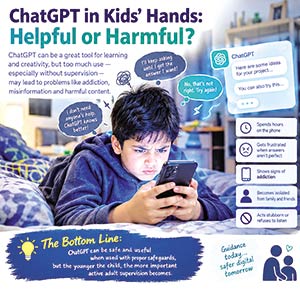 For many families, it has become increasingly common for children to use ChatGPT for educational purposes. From writing essays and understanding difficult subjects to solving mathematical problems, learning English and gathering information, artificial intelligence (AI) has emerged as a useful learning assistant.
But how many parents actually know what their children are asking AI, what kind of answers they are receiving, and how dependent they are becoming on the technology?
Experts say ChatGPT and other AI chatbots can be powerful educational tools for children and teenagers, but they cannot be considered completely safe. The risks include misinformation, inappropriate content, excessive dependence, disclosure of personal information, cyber misuse and overreliance on AI during serious emotional or psychological crises.
OpenAI’s current policy states that ChatGPT is not intended for children under 13. Users aged 13 to 18 require parental permission. The company also acknowledges that, despite efforts to provide age-appropriate responses, ChatGPT may sometimes generate content that is not suitable for all age groups.
What are children doing with AI?: A significant portion of children’s AI use is related to education. Problems arise, however, when AI stops being a learning assistant and starts doing the work for them.
Students can easily use AI to prepare assignments, essays, reports, presentations and answers. While this may save time, excessive dependence can discourage children from reading, researching and thinking independently.
Another major concern is misinformation. ChatGPT can present information in a confident and convincing manner even when the information is inaccurate. If children accept AI-generated answers without checking them against textbooks, teachers or reliable sources, they may develop incorrect knowledge.
Excessive dependence on AI is another concern. If children begin turning to AI for solutions to every problem instead of trying to solve problems themselves, their critical thinking, problem-solving skills and creativity could gradually be affected.
Inappropriate content remains a concern: Children are naturally curious. Depending on their age, they may ask questions about sex, violence, drugs, relationships, their bodies, mental health or self-harm.
AI safety systems attempt to prevent harmful responses, but no technology is completely foolproof.
OpenAI has introduced additional safeguards for teenagers covering areas such as self-harm, violence, eating disorders, dangerous activities and sexual or graphic content. The company has also introduced a separate ChatGPT for Teens experience, under which users identified as being under 18 can receive additional safety protections.
Concerns over self-harm: One of the most serious concerns surrounding AI chatbots involves lengthy and emotionally intense conversations about self-harm and suicide.
In the United States, the suicide of a teenager led to allegations by his family concerning ChatGPT’s role and the effectiveness of its safety systems. The case resulted in legal action and intensified international debate over the responsibility of AI companies when vulnerable young people interact with chatbots.
OpenAI has subsequently acknowledged that its safety measures can fail in certain circumstances, particularly during long conversations, and has said it is working to strengthen safeguards.
Its current system can identify serious self-harm concerns and, in limited circumstances, provide safety notifications to parents after appropriate review.
However, an important point for parents is that Parental Controls do not allow them to read all of their child’s conversations. When a parent links their account to a teenager’s account, they cannot access the child’s complete chat history or monitor conversations in real time. Notifications may be provided only when serious safety concerns are detected.
Risk of personal information exposure: Children may unknowingly share personal information with AI, including their name, address, school, phone number, family details, personal problems or photographs.
There is also a risk that a child could inadvertently disclose a password, OTP, PIN, banking information or other sensitive data.
Therefore, children should be taught from the beginning that they should never share passwords, OTPs, PINs, bank-card information or highly sensitive personal details with an AI chatbot.
AI can also be misused to create phishing messages, fake emails and social-engineering content or to imitate another person’s identity. Generative AI can further be used to create manipulated images, fake photographs and content intended to harass or humiliate others.
The risk of excessive use: The concern is not limited to dangerous questions. Spending excessive amounts of time interacting with AI can also become problematic.
If children begin using AI for education, entertainment, advice, relationships and personal problems on a constant basis, their dependence on real-world human interaction may gradually decline.
OpenAI’s teen-focused experience includes measures designed to encourage balanced use, including break reminders and features intended to make it clear that the user is interacting with an AI system.
What can parents do?: OpenAI’s Parental Controls allow parents to link their account with a teenager’s account and manage certain settings. These include reducing sensitive content, disabling image generation, controlling voice mode, managing saved memory and setting Quiet Hours. Study Mode can also be managed through parental controls.
Parents may also receive a safety notification in limited circumstances if a serious self-harm concern is detected.
However, these controls should not be mistaken for a complete monitoring system. Technology alone cannot guarantee a child’s safety.
Age-based approach is essential: Under 13: Direct use of ChatGPT should generally be avoided. If AI is used for educational purposes, an adult should directly supervise the interaction.
13-15: Parental consent, regular discussion and supervision are important.
16-17: Children should be taught AI literacy, privacy protection, misinformation awareness and responsible use. Parental controls and reasonable time limits may also be considered.
18 and above: Users can use AI independently but should remain aware of privacy risks, misinformation and the limitations of AI-generated answers.
Awareness matters more than surveillance: Experts say technological restrictions alone cannot solve the problem. Instead of secretly monitoring children, parents should explain how AI works, what its limitations are and which types of questions or interactions may be risky.
Children should also understand that AI is not a substitute for parents, teachers, doctors, friends or mental-health professionals.
In cases involving self-harm, abuse, sexual harassment, drugs, violence or serious psychological distress, children should be encouraged to seek help from parents, teachers or qualified professionals rather than relying on prolonged conversations with an AI chatbot.
AI may be becoming increasingly powerful, but responsibility for a child’s safety ultimately rests not with a chatbot, but with parents, guardians, educators and society.

Loading...
Loading...
Also read



Editor : Iqbal Sobhan Chowdhury
Published by the Editor on behalf of the Observer Ltd. from Globe Printers, 24/A, New Eskaton Road, Ramna, Dhaka.
Editorial, News and Commercial Offices : Aziz Bhaban (2nd floor), 93, Motijheel C/A, Dhaka-1000.
Phone: PABX- 41053001-06; Advertisement: 41053012; 01793317829, 01550707291, E-mail: [email protected], [email protected] Online: email: [email protected] 41053014; 01550707297 Advertisement: 01550707296
Published by the Editor on behalf of the Observer Ltd. from Globe Printers, 24/A, New Eskaton Road, Ramna, Dhaka.
Editorial, News and Commercial Offices : Aziz Bhaban (2nd floor), 93, Motijheel C/A, Dhaka-1000.
Phone: PABX- 41053001-06; Advertisement: 41053012; 01793317829, 01550707291, E-mail: [email protected], [email protected] Online: email: [email protected] 41053014; 01550707297 Advertisement: 01550707296


